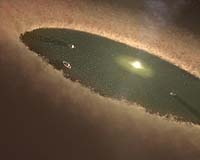
An artist's conception of planets clearing a gap in a stellar disk. NASA/JPL-Caltech/T. Pyle (SSC).
An artist's conception of planets clearing a gap in a stellar disk. NASA/JPL-Caltech/T. Pyle (SSC). |
But new evidence from NASA's Spitzer Space Telescope suggests that some gas giants may sprout in less than one million years, more like planetary wildflowers than trees.
The evidence comes in the form of gaps and holes. Planets are born out of flat disks of dust and gas that spin around young stars. As a burgeoning planet circles around its star, it is thought to cut through the disk, leaving an empty gap or doughnut-like hole.
Spitzer is acquiring data on more and more of these disk clearings around stars that are surprisingly young. Though some of the clearings were seen before, Spitzer's highly sensitive infrared eyes are providing new, detailed information that indicates gas giant planets may be the cause. Because the stars are only about one million years old, relatively young in cosmic terms, the putative planets would have sprung up quickly.
"The results pose a challenge to existing theories of giant planet formation, especially those in which planets build up gradually over millions of years," said Dr. Nuria Calvet of the University of Michigan, Ann Arbor. "Studies like this one will ultimately help us better understand how our outer planets, as well as others in the universe, form."
A new paper from Calvet and her team, appearing in the Sept. 10 issue of the Astrophysical Journal Letters, presents further evidence for fast-track planets. They report the most detailed models yet of two known clearings around young stars � a gap in the disk of GM Aurigae, and a hole in the disk of DM Tauri. Last year, the team found similar results on a third clearing, a hole in the disk of an equally young star called CoKuTau4. That study was led by team member Dr. Dan Watson of the University of Rochester, N.Y.
In all three cases, the Spitzer data reveal that the clearings have sculpted outer walls, a strong indicator that bodies are sweeping through the dust, leaving empty trails. The bodies would most likely be gas giants because rocky planets would be too small to produce the clearings. These observations were made with Spitzer's infrared spectrograph.
"Before we had only a fuzzy knowledge of the holes and the gap," said Calvet. "Spitzer's infrared spectrograph doesn't give us a picture, but provides detailed information about the structure of the clearings. The structure suggests that planets may be present."
GM Aurigae, DM Tauri and CoKuTau4 are all sibling stars living in the same youthful stellar neighborhood in the Taurus constellation, 420 light-years from Earth. GM Aurigae is about the same size as our Sun, while the two siblings are smaller. If DM Tauri's hole existed in our own solar system, it would encompass Mercury, Venus, Earth and Mars; CoKuTau4's hole would expand out to the orbit of Saturn, and GM Aurigae's gap would span the space between the orbits of Jupiter and Uranus.
"GM Aurigae is essentially a much younger version our Sun," said Watson. "Looking at it is like looking at baby pictures of our Sun and outer solar system."
Future Spitzer observations of similarly young stars and their disks will help astronomers determine if planets are indeed making their way through the dust. Ultimately, this information will help astronomers better understand the roots of our own planetary garden.
Related Links
 Sun Has Binary Partner, May Affect The Earth
 Los Angeles CA (SPX) Sep 14, 2005
| The content herein, unless otherwise known to be public domain, are Copyright 1995-2006 - SpaceDaily.AFP and UPI Wire Stories are copyright Agence France-Presse and United Press International. ESA PortalReports are copyright European Space Agency. All NASA sourced material is public domain. Additionalcopyrights may apply in whole or part to other bona fide parties. Advertising does not imply endorsement,agreement or approval of any opinions, statements or information provided by SpaceDaily on any Web page published or hosted by SpaceDaily. Privacy Statement |