|
 |
 |
 |
 |
 |
 |
 |
 |
 |

| . |  |
. |
Dawn One Step Away From Asteroid Belt Trip
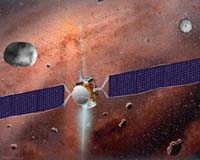
Pasadena CA (JPL) Sep 12, 2007 The Dawn spacecraft completed the 25-kilometer (15-mile) journey from Astrotech Space Operations in Titusville, Fla., to Pad-17B of the Cape Canaveral Air Force Station at 5:10 a.m. EDT today. The launch period for Dawn, NASA's eight-year, more than 5-billion-kilometer (3.2-billion-mile) odyssey into the heart of the asteroid belt, opens Sept. 26. "From here, the only way to go is up," said Dawn project manager Keyur Patel of NASA's Jet Propulsion Laboratory in Pasadena, Calif. "We are looking forward to putting some space between Dawn and Mother Earth and making some space history." Dawn's goal is to characterize the conditions and processes of the solar system's earliest epoch 4.5 billion years ago by investigating in detail the massive asteroid Vesta and the dwarf planet Ceres. They reside between Mars and Jupiter in the asteroid belt. Scientists theorize these were budding planets never given the opportunity to grow. However, Ceres and Vesta each followed a very different evolutionary path during the solar system's first few million years. By investigating two diverse asteroids during the spacecraft's eight-year flight, the Dawn mission aims to unlock some of the mysteries of planetary formation. Dawn will be the first spacecraft to orbit an object in the asteroid belt and the first to orbit two bodies after leaving Earth. Recent images taken by NASA's Hubble Space Telescope raise further intriguing questions about the evolution of these asteroids. Now that the Dawn payload is atop the Delta II 7925-H, a heavier-lift model of the standard Delta II that uses larger solid rocket boosters, a final major test will be conducted. This integrated test of the Delta II and Dawn working together will simulate all events as they will occur on launch day, but without propellants aboard the vehicle. The Sept. 26 launch window is 4:25 to 4:54 a.m. PDT (7:25 to 7:54 a.m. EDT). Should the launch be postponed 24 hours for any reason, the launch window will extend from 4:20 to 4:49 a.m. PDT (7:20 to 7:49 a.m. EDT). For a 48-hour postponement, the launch window will be from 4:14 to 4:43 a.m. PDT (7:14 to 7:43 a.m EDT). Dawn's launch period closes Oct. 15. The Dawn mission to Vesta and Ceres is managed by JPL for the NASA Science Mission Directorate in Washington. The University of California Los Angeles is responsible for overall Dawn mission science. Other scientific partners include Los Alamos National Laboratory, New Mexico; German Aerospace Center, Berlin; Max Planck Institute for Solar System Research, Katlenburg, Germany; and Italian National Institute of Astrophysics, Palermo. Orbital Sciences Corporation of Dulles, Va., designed and built the Dawn spacecraft. The NASA Launch Services Program at Kennedy Space Center and the United Launch Alliance are responsible for the launch of the Delta II. Community Email This Article Comment On This Article Related Links Dawn Asteroid and Comet Mission News, Science and Technology
 Subaru Astronomers Measure Meteoroid Tunnels In Earth's Atmosphere
 Tokyo, Japan (SPX) Sep 12, 2007
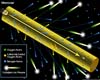
When meteoroids flash through the Earth's atmosphere, they bore tunnels through the air, leaving behind narrow meteor tracks that are heated by the collision of the fast-moving incoming object with atoms of highly diluted atmospheric gases. Most meteoroids are bits of space debris the size of a grain of sand. The width of the tracks they make has long been known to be narrower than a meter, but until recently, more precise measurements have been impossible to make. |
|
|

| The content herein, unless otherwise known to be public domain, are Copyright 1995-2006 - SpaceDaily.AFP and UPI Wire Stories are copyright Agence France-Presse and United Press International. ESA PortalReports are copyright European Space Agency. All NASA sourced material is public domain. Additionalcopyrights may apply in whole or part to other bona fide parties. Advertising does not imply endorsement,agreement or approval of any opinions, statements or information provided by SpaceDaily on any Web page published or hosted by SpaceDaily. Privacy Statement |