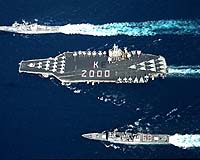
disclaimer: image is for illustration purposes only
disclaimer: image is for illustration purposes only |
Over the past 60 years the United States has often enjoyed the same result from sending not a lowly gunboat, but a gigantic nuclear-powered aircraft carrier as a show of strength.
It is not often recognized how often the sending of an aircraft carrier in a timely manner has defused international crises or led to them being resolved along lines satisfactory to the United States and its allies.
In 1990 the first Bush administration overlooked clear warning signs from Iraqi dictator Saddam Hussein that he was planning to conquer Kuwait, which successive Iraqi governments had coveted for generations as their so-called long-lost 19th province.
In fact, Kuwait was an effectively independent emirate for more than 150 year before Iraq was created. A sitting Kuwaiti premier even issued congratulations to the 13 American colonies when they issued their Declaration of Independence on July 4, 1776.
When Saddam conquered Kuwait in July 1990, it took the assembling of a gigantic 700,000-strong, U.S.-led and dominated land army to push him out of it again in the 1991 Gulf War. However, 29 years earlier, the British Royal Navy successfully deterred an earlier Iraqi dictator, Abd al-Karim Qassem, from attacking Kuwait by simply sending a light fleet aircraft carrier, HMS Bulwark, carrying a small British Commando force, to protect the emirate.
In 1995 and 1996 the Clinton administration sent U.S. Navy aircraft carrier battle groups into the Strait of Taiwan between Taiwan and the Chinese Mainland as a warning to the People's Republic of China that it was prepared to defend Taiwan.
However, U.S. aircraft carrier battle groups are not just about deterrence or bluff. Their deterrent effect is great because they have repeatedly displayed their real military power as well.
Carrier-based U.S. air power played a major force in assuring U.S. strategic air supremacy throughout the 1950-53 Korean War and the period of major U.S. direct participation in the Vietnam War from 1965 to 1972. Whenever U.S. aircraft carrier battle groups are directed to recurring trouble spots around the world, whether they occur around the Middle East, off North Korea or in the Taiwan Strait, governments, diplomats and military leaders sit up and take notice. They know that, to paraphrase U.S. President Theodore Roosevelt, one of the great visionaries and architects of U.S. global sea power, a very large and formidable stick is being waved at them.
In terms of confirming American military credibility and influence around the world, and as a boost for U.S. diplomatic efforts, aircraft carrier battle groups, for all their great cost, have prevented wars and helped contain wars that were being fought. They have also played a huge role in guaranteeing the U.S. government's freedom of action, especially in considering the use of military force and air power around the world.
For unlike land-based air force assets, carrier-based air power is not dependent on the continuing good will of the governments of host countries, and therefore it is not at the whim of short-term fluctuations of fortune in the political process that can lead local governments to refuse to allow the U.S. Air Force to use air bases in their countries for politically controversial or sensitive operations.
This most famously happened when several major NATO allies refused to allow U.S. C-5A Galaxy heavy transports to land for refueling on their territories when the aircraft were rushing urgently needed weapons and ammunition to Israel during the 1973 Yom Kippur War, or war of Ramadan.
However, for all their great and continuing value in projecting U.S. power around the world, in deterring some wars and helping win others, aircraft carriers are far from invulnerable. Major fields of naval war technology have been devoted over the past 40 years to developing asymmetrical ways to destroy them.
Next: The vulnerabilities of modern aircraft carriers
Community
 Defense Focus: Carrier strategy -- Part 1
 Washington (UPI) Mar 25, 2008
| The content herein, unless otherwise known to be public domain, are Copyright 1995-2007 - SpaceDaily.AFP and UPI Wire Stories are copyright Agence France-Presse and United Press International. ESA Portal Reports are copyright European Space Agency. All NASA sourced material is public domain. Additional copyrights may apply in whole or part to other bona fide parties. Advertising does not imply endorsement,agreement or approval of any opinions, statements or information provided by SpaceDaily on any Web page published or hosted by SpaceDaily. Privacy Statement |