
. Military Space News .
STELLAR CHEMISTRY
Doomed star in Milky Way threatens rare gamma-ray burst
by Staff Writers
Sydney, Australia (SPX) Nov 20, 2018

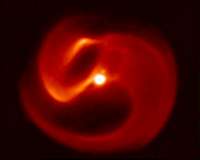
This is an image of Apep captured at 8 microns in the thermal infrared with the VISIR camera on the European Southern Observatory's VLT telescope, Mt Paranal, Chile. The system can be seen to be a binary, with a much fainter companion to the North of the heart of the system. This companion is not believed to play a role in the sculping of the extended dust plume, about 12 arcseconds across. The origin of this structure comes from the central region, believed itself to contain a binary (the whole thing being a triple star).

University of Sydney astronomers, working with international colleagues, have found a star system like none seen before in our galaxy.

The scientists believe one of the stars - about 8000 light years from Earth - is the first known candidate in the Milky Way to produce a dangerous gamma-ray burst, among the most energetic events in the universe, when it explodes and dies.

The system, comprising a pair of scorchingly luminous stars, was nicknamed Apep by the team after the serpentine Egyptian god of chaos. One star is on the brink of a massive supernova explosion.

The findings, published in Nature Astronomy, are controversial as no gamma-ray burst has ever been detected within our own galaxy, the Milky Way.

Yet in the southern constellation of Norma, nestled just beneath Scorpio's tail, astronomers have discovered this uniquely beautiful star system.

At its heart, wrapped in an elegantly sculpted plume of dust and gas, lies a powerful binary pair.

The two hot, luminous stars - known to astronomers as Wolf-Rayets - orbit each other every hundred years or so, according to the research conducted at the Sydney Institute for Astronomy.

This orbital dance is embossed on a fast wind streaming off the stars. Using spectroscopy, the astronomers have measured the velocity of the stellar winds as fast as 12 million kilometres an hour, about 1 percent the speed of light.

Dr Joe Callingham, lead author of the study, said: "We discovered this star as an outlier in a survey with a radio telescope operated by the University of Sydney.

"We knew immediately we had found something quite exceptional: the luminosity across the spectrum from the radio to the infrared was off the charts," said Dr Callingham, who is now at the Netherlands Institute for Radio Astronomy.

"When we saw the stunning dust plume coiled around the these incandescent stars, we decided to name it 'Apep' - the monstrous serpent deity and mortal enemy of Sun god Ra from Egyptian mythology."

That sculpted plume is what makes the system so important, said Professor Peter Tuthill, research group leader at the University of Sydney.

"When we saw the spiral dust tail we immediately knew we were dealing with a rare and special kind of nebula called a pinwheel," Professor Tuthill said.

"The curved tail is formed by the orbiting binary stars at the centre, which inject dust into the expanding wind creating a pattern like a rotating lawn sprinkler. Because the wind expands so much, it inflates the tiny coils of dust revealing the physics of the stars at the heart of the system."

However, the data on the plume presented a conundrum: the stellar winds were expanding 10 times faster than the dust.

"It was just astonishing," Professor Tuthill said. "It was like finding a feather caught in a hurricane just drifting along at walking pace."

Dr Benjamin Pope, a co-author from New York University, said: "The key to understanding the bizarre behaviour of the wind lies in the rotation of the central stars.

"What we have found in the Apep system is a supernova precursor that seems to be very rapidly rotating, so fast it might be near break-up."

Wolf-Rayet stars, like those driving Apep's plume, are known to be very massive stars at the ends of their lives; they could explode as supernovae at any time.

"The rapid rotation puts Apep into a whole new class. Normal supernovae are already extreme events but adding rotation to the mix can really throw gasoline on the fire."

The researchers think this might be the recipe for a perfect stellar storm to produce a gamma-ray burst, which are the most extreme events in the Universe after the Big Bang itself. Fortunately, Apep appears not to be aimed at Earth, because a strike by a gamma-ray burst from this proximity could strip ozone from the atmosphere, drastically increasing our exposure to UV light from the Sun.

"Ultimately, we can't be certain what the future has in store for Apep," Professor Tuthill said.

"The system might slow down enough so it explodes as a normal supernova rather than a gamma-ray burst. However, in the meantime, it is providing astronomers a ringside seat into beautiful and dangerous physics that we have not seen before in our galaxy."

Research Report: "Anisotropic winds in a Wolf-Rayet binary identify a potential gamma-ray burst progenitor"


Related Links
University of Sydney
Stellar Chemistry, The Universe And All Within It


Thanks for being here;
We need your help. The Space Media Network continues to grow but revenues have never been harder to maintain.

With the rise of Ad Blockers, and Facebook - our traditional revenue sources via quality network advertising continues to decline. And unlike so many other news sites, we don't have a paywall - with those annoying usernames and passwords.

Our news coverage takes time and effort to publish 365 days a year.

If you find our news sites informative and useful then please consider becoming a regular supporter or for now make a one off contribution.
SpaceMediaNetwork Contributor
$5 Billed Once


credit card or paypal
SpaceMediaNetwork Monthly Supporter
$5 Billed Monthly


paypal only


STELLAR CHEMISTRY
UD astronomers detect once-in-a-lifetime gamma rays
Newark DE (SPX) Nov 16, 2018
Scientists have discovered something amazing. In a cluster of some of the most massive and luminous stars in our galaxy, about 5,000 light years from Earth, astronomers detected particles being accelerated by a rapidly rotating neutron star as it passed by the massive star it orbits only once every 50 years. The discovery is extremely rare, according to University of Delaware astrophysicist Jamie Holder and doctoral student Tyler Williamson, who were part of the international team that documented ... read more

Comment using your Disqus, Facebook, Google or Twitter login.


Share this article via these popular social media networks
del.icio.usdel.icio.us DiggDigg RedditReddit GoogleGoogle

STELLAR CHEMISTRY
Raytheon to supply Romania with Patriot missile defense systems

Raytheon's SM-3 IIA successful in ballistic missle defense test

Aerojet Rocketdyne propulsion critical to successful intercept test for SM-3 Block IIA Missile

Aegis Combat System Demonstrates Success During At-Sea Test Against Medium Range Ballistic Missile

STELLAR CHEMISTRY
Air Force contracts Lockheed for production of Long Range Anti-Ship Missiles

MBDA shows off naval version of MMP guided tank missile

NATO chief voices concern about Chinese missiles

Gripen E fighter successfully test fires Meteor missile

STELLAR CHEMISTRY
Northrop Grumman tapped for South Korean drone support

Alpha Unmanned Systems selects Robotic Skies for global support

China steps up drone race with stealth aircraft

CERTAIN program uses NextNav's 3D geolocation technology (mbs) for urban drone operations

STELLAR CHEMISTRY
Rockwell Collins airborne radio certified by NSA

NSA certifies Harris AN/PRC-163 radio for top secret intelligence

Raytheon tapped by DARPA for high frequency digital communications research

Laser technology could be used to attract attention from aliens

STELLAR CHEMISTRY
Air Force F-35As test GBU-49 Paveway II bombs in exercise

BAE to provide technical services for Army's 116th MIB

Program targets innovative propulsion solutions for ground-based weapons delivery system

Seven Turkish soldiers die in munitions blast

STELLAR CHEMISTRY
Pentagon spends $560M to fix failures found by 'largest audit in history'

Macron snubs US arms in defence spat with Trump

Norway freezes defence export licences to Saudi

Swiss backtrack on selling weapons to conflict states

STELLAR CHEMISTRY
US could lose in war with China or Russia, panel warns

Australia, Japan to deepen defence ties after historic Darwin visit

Pence says US to partner in Papua New Guinea military base

Intense week of talks ahead of Brexit showdown summit

STELLAR CHEMISTRY
Stealth-cap technology for light-emitting nanoparticles

Nano-scale process may speed arrival of cheaper hi-tech products

Watching nanoparticles

Penn engineers develop ultrathin, ultralight nanocardboard


The content herein, unless otherwise known to be public domain, are Copyright 1995-2024 - Space Media Network. All websites are published in Australia and are solely subject to Australian law and governed by Fair Use principals for news reporting and research purposes. AFP, UPI and IANS news wire stories are copyright Agence France-Presse, United Press International and Indo-Asia News Service. ESA news reports are copyright European Space Agency. All NASA sourced material is public domain. Additional copyrights may apply in whole or part to other bona fide parties. All articles labeled "by Staff Writers" include reports supplied to Space Media Network by industry news wires, PR agencies, corporate press officers and the like. Such articles are individually curated and edited by Space Media Network staff on the basis of the report's information value to our industry and professional readership. Advertising does not imply endorsement, agreement or approval of any opinions, statements or information provided by Space Media Network on any Web page published or hosted by Space Media Network. General Data Protection Regulation (GDPR) Statement Our advertisers use various cookies and the like to deliver the best ad banner available at one time. All network advertising suppliers have GDPR policies (Legitimate Interest) that conform with EU regulations for data collection. By using our websites you consent to cookie based advertising. If you do not agree with this then you must stop using the websites from May 25, 2018. Privacy Statement. Additional information can be found here at About Us.