|
|
 |
 by Staff Writers West Lafayette IN (SPX) Oct 10, 2014
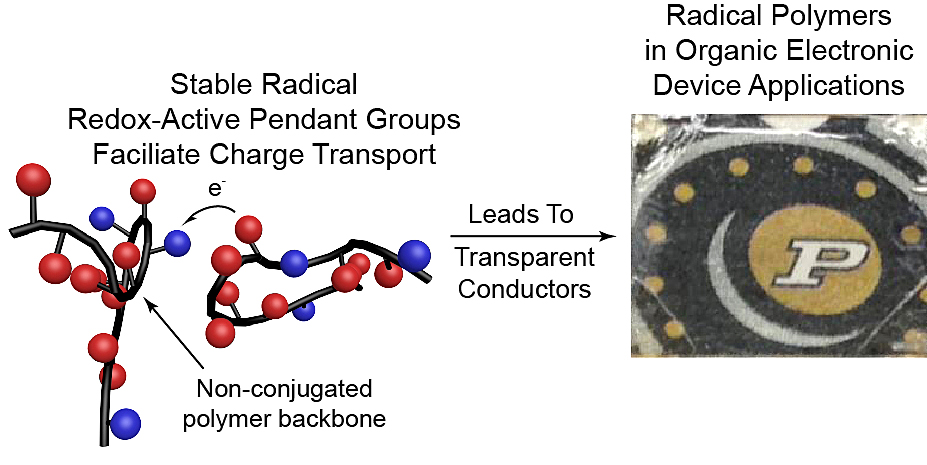
An emerging class of electrically conductive plastics called "radical polymers" may bring low-cost, transparent solar cells, flexible and lightweight batteries, and ultrathin antistatic coatings for consumer electronics and aircraft. Researchers have established the solid-state electrical properties of one such polymer, called PTMA, which is about 10 times more electrically conductive than common semiconducting polymers. "It's a polymer glass that conducts charge, which seems like a contradiction because glasses are usually insulators," said Bryan Boudouris, an assistant professor of chemical engineering at Purdue University. The polymer is easy to manufacture, resembling Plexiglas, an inexpensive transparent plastic found in numerous products. However, unlike Plexiglas it conducts electricity. "We make billions of tons of plastic every year," Boudouris said. "So imagine if you could produce that same kind of material at that same scale but now it has electronic properties." The PTMA is in a class of electrically active polymers that could bring inexpensive transparent solar cells; antistatic and antiglare coatings for cellphone displays; antistatic coverings for aircraft to protect against lightning strikes; flexible flash drives; and thermoelectric devices, which generate electricity from heat. The polymers have seen commercial use in new types of batteries. However, finding widespread practical applications for the polymers will require increasing the conductivity another 100 to 1,000 times, Boudouris said. Recent research findings were detailed in a paper published online in May in the journal Macromolecules. A review article on the subject appeared in September in the same journal and is featured on the cover. The American Chemical Society also has recorded a series of podcast with Boudouris, accessible at http://pubs.acs.org/page/mamobx/audio/index.html. The review article is authored by Purdue graduate students Edward P. Tomlinson and Martha E. Hay, and Boudouris. The research article published in May was authored by graduate student Lizbeth Rostro, undergraduate student Si Hui Wong, and Boudouris. Polymers are strings of molecules with a central backbone and may contain side chains called "pendant groups" that dangle from the central structure. In radical polymers, it's these pendant groups that allow charge to be transported, conducting current. To create the radical polymer, the researchers used a procedure called deprotection, which involves replacing a specific hydrogen atom in the pendant group with an oxygen atom, converting it into a so-called radical group. "We just finally studied deprotection in a way others had not to learn how it affects the electronic properties of the radical polymers," Boudouris said. Electrons surround an atom's nucleus in "shells," and these electrons are usually paired. The oxygen atom in PTMA, however, has one unpaired electron in its outer shell, making it amendable to transporting charge. "You have to control the deprotection process very well because it makes the conductivity vary by orders of magnitude," he said. The researchers have determined that the deprotection step can lead to four distinct chemical functionalities of the radical polymer, two of which are promising for increasing the conductivity of the polymer. "So manipulating the reaction conditions for this deprotection step, and monitoring closely the resultant chemical functionalities, is critical in tuning the electrical properties of radical polymers," Boudouris said. The research is ongoing and has been funded by the National Science Foundation (NSF), the Air Force Office of Scientific Research (AFOSR) and the Defense Advanced Research Projects Agency (DARPA).
Related Links Purdue University All About Solar Energy at SolarDaily.com
|
|
|
| The content herein, unless otherwise known to be public domain, are Copyright 1995-2014 - Space Media Network. All websites are published in Australia and are solely subject to Australian law and governed by Fair Use principals for news reporting and research purposes. AFP, UPI and IANS news wire stories are copyright Agence France-Presse, United Press International and Indo-Asia News Service. ESA news reports are copyright European Space Agency. All NASA sourced material is public domain. Additional copyrights may apply in whole or part to other bona fide parties. Advertising does not imply endorsement, agreement or approval of any opinions, statements or information provided by Space Media Network on any Web page published or hosted by Space Media Network. Privacy Statement All images and articles appearing on Space Media Network have been edited or digitally altered in some way. Any requests to remove copyright material will be acted upon in a timely and appropriate manner. Any attempt to extort money from Space Media Network will be ignored and reported to Australian Law Enforcement Agencies as a potential case of financial fraud involving the use of a telephonic carriage device or postal service. |

 del.icio.us
 Digg
Digg Reddit
 Google