
Subscribe free to our newsletters via your
. Military Space News .


BIO FUEL
Elucidation of chemical ingredients in rice straw
by Staff Writers
Kobe, Japan (SPX) Jun 22, 2015


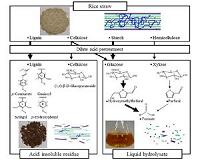
This image shows the flow of rice straw components following pretreatment. Image courtesy Kobe University. For a larger version of this image please go here.

For the first time, researchers at Kobe University and RIKEN successfully elucidated the biochemical and biofuel-producing materials contained in rice straw. Future applications include using these materials in species of rice with high starch content, as well as reducing costs and increasing the efficiency of biochemical and biofuel production. The results of the study will be published in the American science journal PLOS ONE.

In order to produce chemicals and fuels such as bioethanol from biomass in rice and wheat, unnecessary components must be eliminated during preprocessing using diluted sulfuric acid, and the resulting sugars must be fermented by microorganisms. The research team focused on rice straws, the most abundant disposable biomass source in Japan.

Thirteen species of rice straw maintained at the Graduate School of Agricultural Science at Kobe University were preprocessed using technologies developed over the course of bio refinery research spearheaded by the Graduate School of Engineering, which yielded 47 types of structural materials.

Changes to these materials were analyzed at RIKEN using NMR techniques. In addition, the concentrations of sugars and acids obtained after preprocessing were analyzed and tested for correlations with the abundances of the 47 types of structural materials. The results demonstrated that after preprocessing, cellulose and glucose were contained in the solids and fluids, respectively, and that glucose levels were influenced by starch levels.

In this study, the chemical ingredients of rice straws were clarified for the first time via integrated analytical techniques that utilized the collection of rice species at the Graduate School of Agricultural Science at Kobe University, the bio refinery research of the Graduate School of Engineering, and NMR techniques at RIKEN. These results open the possibility for efficient production of biochemical and biofuels in the future.

This joint study was conducted by KONDO Akihiko, Professor at the Graduate School of Engineering and member of the Network Project of Carbon Dioxide Resource Studies in Plants at Kobe University; OGINO Chiaki, Associate Professor at the Graduate School of Engineering; TERAMURA Hiroshi, Academic Researcher; SASAKI Kengo, Project Assistant Professor and member of Innovative BioProduction Kobe; YAMASAKI Masanori, Associate Professor at the Graduate School of Agricultural Science; SHIRAI Tomokazu, associate team leader and a member of the Cell Factory Research Team at the RIKEN Center for Sustainable Resource Science; and KIKUCHI Jun, team leader and a member of the Environmental Metabolic Analysis Research Team. The main conclusion of the study results were obtained by analyzing rice straws using the combined strengths and integrated technologies of each research organization, ultimately yielding an elucidation of the rice straws' chemical ingredients.


Thanks for being here;
We need your help. The Space Media Network continues to grow but revenues have never been harder to maintain.

With the rise of Ad Blockers, and Facebook - our traditional revenue sources via quality network advertising continues to decline. And unlike so many other news sites, we don't have a paywall - with those annoying usernames and passwords.

Our news coverage takes time and effort to publish 365 days a year.

If you find our news sites informative and useful then please consider becoming a regular supporter or for now make a one off contribution.
SpaceMediaNetwork Contributor
$5 Billed Once


credit card or paypal
SpaceMediaNetwork Monthly Supporter
$5 Billed Monthly


paypal only


.


Related Links
Kobe University
Bio Fuel Technology and Application News


Comment on this article via your Facebook, Yahoo, AOL, Hotmail login.

Share this article via these popular social media networks
del.icio.usdel.icio.us DiggDigg RedditReddit GoogleGoogle


BIO FUEL
A new method of converting algal oil to transportation fuels
Sendai, Japan (SPX) Jun 18, 2015
A new method of converting squalene, which is produced by microalgae, to gasoline or jet fuel, has been developed by the research group of Professor Keiichi Tomishige and Dr. Yoshinao Nakagawa from Tohoku University's Department of Applied Chemistry, and Dr. Hideo Watanabe from the University of Tsukuba. This study is part of a research project titled 'Next-generation energies for Tohoku r ... read more


BIO FUEL
US Authorizes 'Forward-Based' Missile Defense System for Allies

USAF Early Warning Satellites Get No-Cost Update from Lockheed Martin

Boecore to support Army missile defense

Germany opts for MEADS missile defence system

BIO FUEL
Raytheon, Kongsberg extend missile partnership agreement

Javelin demos range, versatility

Egypt orders AASM missiles from Sagem

Aviation security endangered by spread of missiles: study

BIO FUEL
Amazon sees line-of-sight hurdle to US drone parcel delivery

Italy orders Predator UAS simulators

Maneuvering mini drone quickly destroyed in laser test

Australian troops receive small UAS from AeroVironment

BIO FUEL
US nuclear bombers lack satellite terminals for emergencies

New USAF satellites to use updated spacecraft

Harris providing Australia with support for radio system

US Navy accepts third LMC-Built MUOS comsat

BIO FUEL
Northrop Grumman touts its next-generation targeting pod

Thales producing equipment for Canadian vehicles

ONR-sponsored technology to lighten marines' loads

VSE wins places on Army TACOM contracts

BIO FUEL
Senate okays defense bill over White House objections

Spain to decide on lifting A400M flight suspension next week

US Defense Secretary Carter signs defence projects with India

Army contracting official charged in parts investigation

BIO FUEL
China deports British investigator, wife in GSK case

NATO says implementing 'biggest' defence boost since Cold War

Some building in disputed waters to finish soon: China

An eventful year for Great Britiain

BIO FUEL
Nanoparticles can be intrinsically left- and right-handed

Unlocking nanofibers' potential

Scientists observe photographic exposure live at the nanoscale

Measuring the mass of molecules on the nano-scale


The content herein, unless otherwise known to be public domain, are Copyright 1995-2014 - Space Media Network. All websites are published in Australia and are solely subject to Australian law and governed by Fair Use principals for news reporting and research purposes. AFP, UPI and IANS news wire stories are copyright Agence France-Presse, United Press International and Indo-Asia News Service. ESA news reports are copyright European Space Agency. All NASA sourced material is public domain. Additional copyrights may apply in whole or part to other bona fide parties. Advertising does not imply endorsement, agreement or approval of any opinions, statements or information provided by Space Media Network on any Web page published or hosted by Space Media Network. Privacy Statement All images and articles appearing on Space Media Network have been edited or digitally altered in some way. Any requests to remove copyright material will be acted upon in a timely and appropriate manner. Any attempt to extort money from Space Media Network will be ignored and reported to Australian Law Enforcement Agencies as a potential case of financial fraud involving the use of a telephonic carriage device or postal service.