
. Military Space News .
Embryonic Star Captured With Jets Flaring

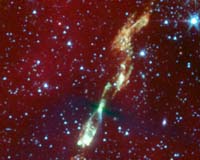
A rare, infrared view of a developing star and its flaring jets taken by NASA's Spitzer Space Telescope. Image credit: NASA/JPL-Caltech/UIUC
by Staff Writers
Pasadena CA (JPL) Nov 30, 2007
A developing star wrapped in a black cocoon of dust is seen sprouting giant jets in a new image from NASA's Spitzer Space Telescope. The stellar portrait, captured in infrared light, offers the first glimpse at a very early stage in the life of an embryonic sun-like star -- a time when the star's natal envelope is beginning to flatten and collapse, and streams of gas are escaping. The observations will ultimately help astronomers better understand how stars and their planets form.

"This is the first time we've clearly seen a flattened envelope around a forming star," said Leslie Looney of the University of Illinois at Urbana-Champaign, lead author of a study about the star, called L1157, appearing Dec. 1 in Astrophysical Journal Letters. "Some theories had predicted that envelopes flatten as they collapse onto their stars and surrounding planet-forming disks, but we hadn't seen any strong evidence of this until now."

Stars are born out of thick clouds, or envelopes, of gas and dust that condense and collapse inward. As a star grows and feeds off the envelope, it spins faster and faster like a twirling ice skater. A disk of planet-forming material begins to take shape in orbit around the star, and jets of gas shoot up from above and below the disk to relieve the star's accumulating pressure. Eventually, the original envelope falls onto the spinning disk, and the jets slow to a stop.

The regions where all the action takes place are dark and dusty, letting little visible light escape. For example, the embryonic star L1157 appears black in visible-light views. Spitzer's infrared view of the star, on the other hand, penetrates the dusty haze, giving us a rare look at what our own solar system might have looked like when it was very young.

The bipolar jets shooting away from L1157 are enormous; light itself would take about nine months to travel the length of one jet. The color white shows the hottest parts of the jets, with temperatures around 100 degrees Celsius (212 degrees Fahrenheit). Most of the material in the jets, seen in orange, is roughly zero degrees on the Celsius and Fahrenheit scales.

The flattened envelope around the fledgling star is perpendicular to the jets and appears deep black. This is because it is so thick with dust that even infrared light cannot escape. The envelope is big enough to engulf the equivalent of tens of thousands of mature solar systems similar to our own, while the planet-forming disk tucked inside cannot be seen in this photo - it is smaller than a pixel.

L1157 is located about 800 light-years away in the constellation Cepheus. It is roughly 10,000 years old, and, according to astronomers' estimates, will ignite to become a full-fledged star about the mass of our sun in a million years or so.

"Taking baby pictures of stars is not easy to do," said Looney. "Now that we have a good picture, we can begin to ask questions about whether this star system and its potential planets will grow up to become like ours."

Other authors of this study include John J. Tobin of the University of Michigan, Ann Arbor, and Woojin Kwon of the University of Illinois.

Community
Email This Article
Comment On This Article

Related Links
Stellar Chemistry, The Universe And All Within It


Memory Foam Mattress Review
Newsletters :: SpaceDaily :: SpaceWar :: TerraDaily :: Energy Daily
XML Feeds :: Space News :: Earth News :: War News :: Solar Energy News


Chandra Discovers A Cosmic Cannonball
Boston MA (SPX) Nov 29, 2007
Astronomers using NASA's Chandra X-ray Observatory have discovered one of the fastest stars ever seen. It's a "cosmic cannonball" that is challenging theories to explain its blistering speed. The name of the star is RX J0822-4300. It's a neutron star created by the Puppis A supernova explosion about 3700 years ago. Three Chandra observations clearly show the neutron star moving away from the center of the blast. Speed: 3 million mph! At this rate, RX J0822-4300 is destined to escape the Milky Way just millions of years from now.


  • China says ties with US damaged, amid naval row
  • US, China, feud over Taiwan, Tibet, port dispute
  • Keating Aims To Improve Communication With China After Port Call Rejections
  • Russia studying US missile defence proposals: agencies

  • NKorea to come clean on secret nuclear programme: US envoy
  • US energy pact does not prevent new Indian nuclear tests: PM
  • Mechanical Engineer Aims To Improve Detection Of Nuclear Smuggling Activity
  • Ahmadinejad hits back after 'nuclear spy' cleared

  • Lockheed Martin-built Trident II D5 Missile Achieves Record 120 Successful Test Launches In A Row
  • Iran builds new longer-range missile
  • India tests SAM missile near Pakistan border: officials
  • Asymmetrical Iskander Missile Systems

  • STSS's Second Satellite Completes Thermal Vacuum Testing At Northrop Grumman
  • Ex-Czech PM calls US anti-missile plan 'provocation': report
  • US, Russians hold missile defense talks: Pentagon
  • Russia dismisses US offers on missile defence: reports

  • Announcement Of Opportunity For Sounding Rocket And Balloon Flights
  • China to order up to 150 Airbus jets during Sarkozy visit: report
  • Time Magazine Recognizes The X-48B
  • Virgin to offer carbon offsets alongside drinks and perfume

  • UK Awards Lockheed Martin 4.8 Million Dollars For Desert Hawk III Unmanned Aircraft Systems
  • Boeing Awarded International Aviation Trophy For X-45A
  • Galileo Avionica: The UAV FALCO System Completes Operational Validation Testing
  • NASA Evaluates Compact Synthetic Aperture Radar

  • Feature: U.S. works hearts, minds
  • Analysis: Kirkuk project battle heats up
  • Japan opposition votes to end Iraq mission
  • Ex-US commander in Iraq backs troop pullout bill

  • EDO Receives 54.4 Million Dollar Contract For F-22 Weapon-Release System
  • BAE Systems Completes In-Country Commissioning Of Airborne Reconnaissance System
  • F135 Team Delivers F135 STOVL Propulsion System To LockMart
  • Unit Receives Task Force Marne�s First MRAPs

  • The content herein, unless otherwise known to be public domain, are Copyright 1995-2006 - SpaceDaily.AFP and UPI Wire Stories are copyright Agence France-Presse and United Press International. ESA PortalReports are copyright European Space Agency. All NASA sourced material is public domain. Additionalcopyrights may apply in whole or part to other bona fide parties. Advertising does not imply endorsement,agreement or approval of any opinions, statements or information provided by SpaceDaily on any Web page published or hosted by SpaceDaily. Privacy Statement