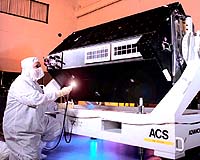
File photo of Hubble's Advanced Camera for Surveys (ACS).
File photo of Hubble's Advanced Camera for Surveys (ACS). |
The instrument had been operating on its redundant electronics since June 30, 2006, when NASA engineers transitioned from the primary, Side A, electronics package due to a malfunction. Engineers currently are assessing the option to return ACS science operations to the primary electronics so that observations could resume in a reduced mode.
Hubble was recovered from safemode around 2 a.m. EST on Jan. 28, and science observations will resume this week using the remaining Hubble instruments: Wide Field Planetary Camera 2, Near Infrared Camera Multi-Object Spectrograph, and the Fine Guidance Sensors.
In November 2006, the Space Telescope Science Institute in Baltimore selected a set of backup non-ACS science programs for use in case of a future ACS anomaly. These programs now will be inserted into the science schedule to maintain a highly productive observing program.
An Anomaly Review Board was appointed on Jan. 29, to investigate the ACS anomaly. The board will perform a thorough investigation and assessment to decide the best course of action. The board is scheduled to present their findings and recommendations by March 2.
"It is too early to know what influences the ACS anomaly may have on Hubble Space Telescope Servicing Mission-4 planning" said Preston Burch, associate director/program manager for the Hubble Space Telescope.
"It is important that the review board conduct a thorough investigation that will allow us to determine if there are any changes needed in the new instruments that will be installed on the upcoming servicing mission so that we can be sure of maximizing the telescope's scientific output. We are continuing to make excellent progress in our preparations for the servicing mission, which is presently targeted to fly in September 2008."
The Advanced Camera for Surveys is a third-generation instrument consisting of three electronic cameras, filters and dispersers that detect light from the ultraviolet to the near infrared. The instrument was installed during a March 2002, servicing mission.
It was developed jointly by NASA's Goddard Space Flight Center, Greenbelt, Md., Johns Hopkins University, Baltimore; Ball Aerospace, Boulder, Colo.; and the Space Telescope Science Institute.
earlier related report
Hubble's main camera stops working
On Saturday 27 January, Hubble's main camera, the Advanced Camera for Surveys (ACS), stopped working. Until a solution, at least in part, can be found, Hubble will be returned to work with the remaining instruments.
On Saturday 27 January 2007 at 13:34 CET the NASA/ESA Hubble Space Telescope entered into a protective "safemode" condition, most likely triggered by a short circuit in Hubble's main instrument the Advanced Camera for Surveys (ACS). ACS had been running since June 2006 on its secondary backup electrical system.
NASA has full responsibility for the mission operations of Hubble. Accordingly, NASA has set up an Anomaly Review Board. This will investigate whether ACS can be returned to using the primary electrical system enabling one of its parts, the Solar Blind Channel, to return to operation. However, at this time, it is expected that the main part of ACS will most likely not be restored.
Another Hubble Servicing Mission (SM4) has been scheduled for "not earlier than May 2008" by NASA. Options for repairing the ACS camera during this mission are being investigated.
In the meantime, Hubble will be returned to work again with the other available instruments onboard: the Near Infrared Camera and Multi-object Spectrometer (NICMOS), the Wide Field and Planetary Camera 2 (WFPC2) and the Fine Guidance Sensors (FGS'es).
A call to the astronomers using Hubble is being issued, urging them to re-plan their upcoming observing programmes to take the new situation into account. The deadline for these changed proposals for the present observing cycle, Cycle 16 is 9 February 2007. Out of a total of 750 proposals for the cycle, 500 requested use of the ACS camera (2/3).
"ACS took over from WFPC2 as Hubble's "workhorse" at the last Servicing Mission in 2002. Although we are taking a step back, it is far from "game over" for Hubble", says ESA Hubble scientist Bob Fosbury.
Related Links
 James Webb Space Telescope Has A Healthy Spine
 Greenbelt MD (SPX) Jan 31, 2007
| The content herein, unless otherwise known to be public domain, are Copyright 1995-2006 - SpaceDaily.AFP and UPI Wire Stories are copyright Agence France-Presse and United Press International. ESA PortalReports are copyright European Space Agency. All NASA sourced material is public domain. Additionalcopyrights may apply in whole or part to other bona fide parties. Advertising does not imply endorsement,agreement or approval of any opinions, statements or information provided by SpaceDaily on any Web page published or hosted by SpaceDaily. Privacy Statement |