. Military Space News .
Exoplanet Hunt Update

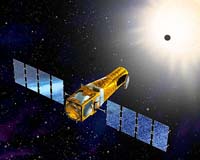
This artist's view shows the COROT satellite, consisting of a 30-centimetre space telescope launched on 27 December 2006. COROT will use its telescope to monitor closely the changes in a star's brightness that comes from a planet crossing in front of it. While it is looking at a star, COROT will also be able to detect 'starquakes', acoustical waves generated deep inside a star that send ripples across a star's surface, altering its brightness. The exact nature of the ripples allows astronomers to calculate the star's precise mass, age and chemical composition. Credits: CNES/D. Ducros
by Staff Writers
Boston MA (SPX) May 22, 2008
Two new exoplanets and an unknown celestial object are the latest findings of the COROT mission. These discoveries mean that the mission has now found a total of four new exoplanets. These results were presented this week at the IAU symposium 253 in Massachusetts, USA.

COROT has now been operating for 510 days, and the mission started observations of its sixth star field at the beginning of May this year. During this observation phase, which will last 5 months, the spacecraft will simultaneously observe 12 000 stars.

The two new planets are gas giants of the hot Jupiter type, which orbit very close to their parent star and tend to have extensive atmospheres because heat from the nearby star gives them energy to expand.

In addition, an oddity dubbed 'COROT-exo-3b' has raised particular interest among astronomers. It appears to be something between a brown dwarf, a sub-stellar object without nuclear fusion at its core but with some stellar characteristics, and a planet. Its radius is too small for it to be a super-planet.

If it is a star, it would be among the smallest ever detected. Follow-up observations from the ground have pinned it at 20 Jupiter massses. This makes it twice as dense as the metal Platinum.

Scientists suspect that with the detection of COROT-exo-3b, they might just have discovered between stars and planets.

COROT has also detected extremely faint signals that, if confirmed, could indicate the existence of another exoplanet, as small as 1.7 times Earth's radius.

This is an encouraging sign in the delicate and difficult search for small, rocky exoplanets that COROT has been designed for.
Community
Email This Article
Comment On This Article

Share This Article With Planet Earth
del.icio.usdel.icio.us DiggDigg RedditReddit
YahooMyWebYahooMyWeb GoogleGoogle FacebookFacebook


Related Links
COROT at ESA
Lands Beyond Beyond - extra solar planets - news and science
Life Beyond Earth


Memory Foam Mattress Review
Newsletters :: SpaceDaily :: SpaceWar :: TerraDaily :: Energy Daily
XML Feeds :: Space News :: Earth News :: War News :: Solar Energy News


Planets By The Dozen
Huntsville AL (SPX) May 12, 2008
You know the planets of our solar system, each a unique world with its own distinctive appearance, size, and chemistry. Mars, with its bitter-cold, rusty red sands; Venus, a fiery world shrouded in thick clouds of sulfuric acid; sideways Uranus and its strange vertical rings. The variety is breathtaking.


  • US ambassador urges Japan to boost defence spending
  • Outside View: Russia at war -- Part 2
  • Walker's World: Building with BRICs
  • US warns China of 'technological isolation'

  • Israel PM calls for naval blockade of Iran: report
  • NKorea to blow up nuke plant tower in symbolic gesture: official
  • Detained Pakistan nuclear scientist allowed to visit friends
  • Lockheed Martin-Built Trident Achieves Record 122 Successful Test Launches In A Row

  • Boeing Completes Six Years Of On-Time Minuteman III Missile Guidance Set Deliveries
  • Boeing Receives Contract To Further Develop Dual-Role Missile
  • Successful NetFires Precision Attack Missile Flight Test
  • Pakistan test-fires nuclear-capable cruise missile: military

  • Russian ABM Plans Part Two
  • India Sees Agni-3 As Deterrent To China
  • BMD Focus: Medvedev's missile pledge
  • Outside View: Russia's ABM plans -- Part 1

  • China's new jumbo-jet firm no threat to Airbus, Boeing: state media
  • China unveils new jumbo jet company: report
  • NASA And JAXA To Conduct Joint Research On Sonic Boom Modeling
  • Analysis: Can airplanes go green?

  • Boeing Flies A160T Hummingbird Unmanned Rotorcraft For 18 Hours
  • Northrop Grumman Showcases UAV Capabilities At Berlin ILA Air Show 2008
  • GD Delivers First USV To US Navy For LCS
  • AAI's Shadow UAS Reach 300,000 Flight Hours

  • Deployment plans keep US forces in Iraq level into 2009: Pentagon
  • Key architect of Iraq war defends case for US-led invasion
  • Feature: U.S. cites attacks despite truce
  • Features: More graves found

  • Iron Man Underscores Critical Need For Armor Part One
  • US opposes cluster bomb ban, backs 'technological fixes'
  • Team LM Fires Fire Shadow Loitering Munition
  • Thompson Files: Defense consensus

  • The content herein, unless otherwise known to be public domain, are Copyright 1995-2007 - SpaceDaily.AFP and UPI Wire Stories are copyright Agence France-Presse and United Press International. ESA Portal Reports are copyright European Space Agency. All NASA sourced material is public domain. Additional copyrights may apply in whole or part to other bona fide parties. Advertising does not imply endorsement,agreement or approval of any opinions, statements or information provided by SpaceDaily on any Web page published or hosted by SpaceDaily. Privacy Statement