
. Military Space News .
BIO FUEL
Fast, low energy, and continuous biofuel extraction from microalgae
by Staff Writers
Kumamoto, Japan (SPX) May 02, 2017


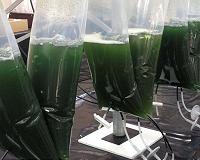
File image

As an alternative to liquid fossil fuels, biodiesel extracted from microalgae is an increasingly important part of the bioenergy field. While it releases a similar amount of CO2 as petroleum when burned, the CO2 released from biodiesel is that which has recently been removed from the atmosphere via photosynthesis meaning that it does not contribute to an increase of the greenhouse gas.

Furthermore, research has shown that microalgae produces a much higher percentage of their biomass to usable oil in a significantly smaller land mass than terrestrial crops. Currently, one of the largest obstacles in replacing diesel with biodiesel is the cost of production. Fossil fuels are still cheaper than biofuels so improvements in production efficiency are highly sought-after.

Recently, efforts have been made by researchers in Japan to reduce the cost of biodiesel production by using pulsed electric fields (PEF) to extract hydrocarbons from microalgae. A milli- or microsecond PEF is typically used to weaken cell walls and increase permeability allowing for extraction of elements inside the cell.

Kumamoto University researchers, on the other hand, used a nanosecond PEF (nsPEF) to focus on the microalgae matrix instead of the cells. A nsPEF generally uses less energy than the us/msPEFs even at high voltages, and is not as destructive or costly as the traditional drying method of oil extraction.

The researchers performed several tests with the nsPEF on the microalgae Botryococcus braunii (Bb) to determine the optimal electric field, energy, and pulse repetition frequency for hydrocarbon extraction. Interestingly, it was found that doubling the energy only resulted in a 10% increase in hydrocarbon extraction.

At 10 Hz, the optimal field and energy conditions were determined to be approximately 50 kV/cm and 55.6 J/ml respectively per volume of algae. Further, the researchers found that pulse frequency had little to no effect on extraction percentage, meaning that a large amount of hydrocarbons may be extracted quickly for large/industrial systems.

"The advantage with this extraction mechanism is that it separates hydrocarbons from a matrix, rather than extracts them from cells. Other microalgae do not secrete a matrix so the cell membranes must be damaged or destroyed to get at the hydrocarbons, which both takes more energy and is less efficient than our method," said lead researcher, Professor Hamid Hosseini of the Institute of Pulsed Power Science at Kumamoto University.

"On top of that, many extraction processes practiced today use a drying method to extract oil which ends in the destruction of the algae. Our method is relatively non-destructive and the microalgae are able to rebuild their colonies after extraction has finished."

One minor drawback is the impurity of the matrix; polysaccharides must be purified from the extracted hydrocarbon solution. Fortunately, these molecules may be used in the creation of bioethanol but their concentration is low.

It is hoped that this technology will improve biofuel production as an appropriate green energy source.

This work may be found in the online BioMed Central journal, Biotechnology for Biofuels. Guionet, A., Hosseini, B., Teissie , J., Akiyama, H., and Hosseini, H. (2017). A new mechanism for efficient hydrocarbon electro-extraction from Botryococcus braunii. Biotechnology for Biofuels, 10(1), 39. DOI: 10.1186/s13068-017-0724-1

BIO FUEL
Finding best combination for biofuel corn, soil protection
Washington DC (SPX) Apr 27, 2017
The phrase "a double-edged sword" describes something that is beneficial in some ways but problematic in others. One example is removing maize stover (the husks, stems and leaves of corn plants) from fields. Maize stover is used to make cellulosic ethanol, a renewable biofuel. And renewable biofuels are beneficial to the environment. However, removing the stover can harm the environment because ... read more

Related Links
Kumamoto University
Bio Fuel Technology and Application News


Thanks for being here;
We need your help. The Space Media Network continues to grow but revenues have never been harder to maintain.

With the rise of Ad Blockers, and Facebook - our traditional revenue sources via quality network advertising continues to decline. And unlike so many other news sites, we don't have a paywall - with those annoying usernames and passwords.

Our news coverage takes time and effort to publish 365 days a year.

If you find our news sites informative and useful then please consider becoming a regular supporter or for now make a one off contribution.
SpaceMediaNetwork Contributor
$5 Billed Once


credit card or paypal
SpaceMediaNetwork Monthly Supporter
$5 Billed Monthly


paypal only


Comment using your Disqus, Facebook, Google or Twitter login.

Share this article via these popular social media networks
del.icio.usdel.icio.us DiggDigg RedditReddit GoogleGoogle

BIO FUEL
Seoul rejects Trump demand it pays for missile system

Syria to buy latest Russian anti-missile system: Assad

Israeli missile shoots down 'target' over Golan: army

US missile system in S.Korea operational soon: US admiral

BIO FUEL
Tokyo subway halt for 10 minutes over NKorea scare

Sweden orders additional anti-ship missiles from Saab

SM-6 missile completes final round of tests

Northrop to integrate missile countermeasure systems for Air Force, Navy

BIO FUEL
Dutch production facility opens for Predator B landing gear

Lockheed flies long-range endurance test flights of Fury unmanned aircraft

Service Academies Swarm Challenge Live-Fly Competition Begins

MQ-8C Fire Scout takes first flight from littoral combat ship

BIO FUEL
MUOS Satellite Now Supporting Troops with Ultra High Frequency Communications

Navy's New Satellite Network to Be Fitted With Advanced Data Transfer Gear

U.S. Marine Corps tests WiFi system at its air stations

World's Most Powerful Emulator of Radio-Signal Traffic Opens for Business

BIO FUEL
U.S. Air Force signs Raytheon to upgrade operations center weapons systems

France orders new armored vehicles from Nexter, Renault, Thales

Canadian army to modernize training simulation system

Field trials underway for Russia's next-generation battle tank

BIO FUEL
Dutch court jails Charles Taylor arms-supplier for 19 years

Canada moves to join treaty curbing foreign arms sales

India inks weapons deal worth nearly $2 bn with Israel

U.S. lawmakers push for Pentagon reforms

BIO FUEL
Philippines' Duterte hesitant on US visit, warm on China

Turkey, EU leaders to meet during NATO summit: minister

Trump vows to win 'battles' ahead, at home and abroad

Utah Air Force base members participate in NATO exercise in Spain

BIO FUEL
Scientists set record resolution for drawing at the one-nanometer length scale

X-ray microscope optics resolve 50-nm features while eliminating chromatic aberrations

Self-assembled nanostructures can be selectively controlled

Nanotubes that build themselves


The content herein, unless otherwise known to be public domain, are Copyright 1995-2024 - Space Media Network. All websites are published in Australia and are solely subject to Australian law and governed by Fair Use principals for news reporting and research purposes. AFP, UPI and IANS news wire stories are copyright Agence France-Presse, United Press International and Indo-Asia News Service. ESA news reports are copyright European Space Agency. All NASA sourced material is public domain. Additional copyrights may apply in whole or part to other bona fide parties. All articles labeled "by Staff Writers" include reports supplied to Space Media Network by industry news wires, PR agencies, corporate press officers and the like. Such articles are individually curated and edited by Space Media Network staff on the basis of the report's information value to our industry and professional readership. Advertising does not imply endorsement, agreement or approval of any opinions, statements or information provided by Space Media Network on any Web page published or hosted by Space Media Network. General Data Protection Regulation (GDPR) Statement Our advertisers use various cookies and the like to deliver the best ad banner available at one time. All network advertising suppliers have GDPR policies (Legitimate Interest) that conform with EU regulations for data collection. By using our websites you consent to cookie based advertising. If you do not agree with this then you must stop using the websites from May 25, 2018. Privacy Statement. Additional information can be found here at About Us.