Does a twin Earth exist somewhere in our galaxy? Astronomers are getting closer and closer to finding an Earth-size planet in an Earth-like orbit. NASA's Kepler spacecraft just launched to find such worlds.
Once the search succeeds, the next questions driving research will be: Is that planet habitable? Does it have an Earth-like atmosphere? Answering those questions will not be easy.
Due to its large mirror and location in outer space, the James Webb Space Telescope (scheduled for launch in 2013) will offer astronomers the first real possibility of finding those answers.
In a new study, Lisa Kaltenegger (Harvard-Smithsonian Center for Astrophysics) and Wesley Traub (Jet Propulsion Laboratory) examined the ability of JWST to characterize the atmospheres of hypothetical Earth-like planets during a transit, when part of the light of the star gets filtered through the planet's atmosphere.
They found that JWST would be able to detect certain gases called biomarkers, such as ozone and methane, only for the closest Earth-size worlds.
"We'll have to be really lucky to decipher an Earth-like planet's atmosphere during a transit event so that we can tell it is Earth-like," said Kaltenegger. "We will need to add up many transits to do so - hundreds of them, even for stars as close as 20 light-years away."
"Even though it's hard, it will be an incredibly exciting endeavor to characterize a distant planet's atmosphere," she added.
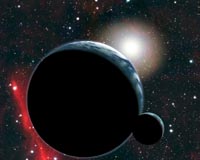
In a transit event, a distant, extrasolar planet crosses in front of its star as seen from Earth. As the planet transits, gases in its atmosphere absorb a tiny fraction of the star's light, leaving fingerprints specific to each gas.
By splitting the star's light into a rainbow of colors or spectrum, astronomers can look for those fingerprints. Kaltenegger and Traub studied whether those fingerprints would be detectable by JWST.
Their study has been accepted for publication in the Astrophysical Journal.
The transit technique is very challenging. If Earth were the size of a basketball, the atmosphere would be as thin as a sheet of paper, so the resulting signal is incredibly tiny. Moreover, this method only works when the planet is in front of its star, and each transit lasts for a few hours at most.
Kaltenegger and Traub first considered an Earth-like world orbiting a Sun-like star. To get a detectable signal from a single transit, the star and planet would have to be extremely close to Earth. The only Sun-like star close enough is Alpha Centauri A. No such world has been found yet, but technology is only now becoming capable of detecting Earth-size worlds.
The study also considered planets orbiting red dwarf stars. Such stars, called type M, are the most abundant in the Milky Way - far more common than yellow, type G stars like the Sun. They are also cooler and dimmer than the Sun, as well as smaller, which makes finding an Earth-like planet transiting an M star easier.
An Earth-like world would have to orbit close to a red dwarf to be warm enough for liquid water. As a result, the planet would orbit more quickly and each transit would last a couple of hours to mere minutes. But it would undergo more transits in a given amount of time.
Astronomers could improve their chances of detecting the atmosphere by adding the signal from several transits, making red dwarf stars appealing targets because of their more frequent transits.
An Earth-like world orbiting a star like the Sun would undergo a 10-hour transit once every year. Accumulating 100 hours of transit observations would take 10 years. In contrast, an Earth orbiting a mid-sized red dwarf star would undergo a one-hour transit once every 10 days. Accumulating 100 hours of transit observations would take less than three years.
"Nearby red dwarf stars offer the best possibility of detecting biomarkers in a transiting Earth's atmosphere," said Kaltenegger.
"Ultimately, direct imaging - studying photons of light from the planet itself - may prove a more powerful method of characterizing the atmosphere of Earth-like worlds than the transit technique," said Traub.
Both NASA's Spitzer and Hubble Space Telescopes have studied the atmospheric compositions of extremely hot, gas-giant extrasolar planets.
The characterization of a "pale blue dot" is the next step from there, whether by adding up hundreds of transits of one planet or by blocking out the starlight and analyzing the planet's light directly.
In a best-case scenario, Alpha Centauri A may turn out to have a transiting Earth-like planet that no one has spotted yet. Then, astronomers would need only a handful of transits to decipher that planet's atmosphere and possibly confirm the existence of the first twin Earth.
 del.icio.us
 Digg
Digg Reddit
 YahooMyWeb
 Google
 Facebook

