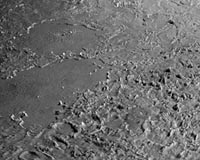
Newly released images commemorate the 20-year anniversary of the Voyager flyby of Neptune's moon Triton on Aug. 24, 2009.
Triton was the last solid object visited by NASA's Voyager 2 spacecraft as it headed toward the edges of our solar system.
Triton, Neptune's largest moon, is one of the "coolest" objects in the solar system, literally, with a surface temperature of minus 235 degrees Celsius (minus 391 degrees Fahrenheit). Voyager 2 discovered that Triton has active geysers.
The images and a movie show the moon's sparsely cratered surface with smooth volcanic plains, mounds and round pits formed by icy lava flows.
The Voyagers are the farthest human-made objects in the solar system. Voyager 1 is 16.6 billion kilometers (10.3 billion miles) or about 111 Astronomical Units from the Sun.
Voyager 2 is 13.5 billion kilometers (8.4 billion miles) or about 90 Astronomical Units from the Sun. Both are expected to reach interstellar space in five to eight years (2014 - 2017).
 del.icio.us
 Digg
Digg Reddit
 YahooMyWeb
 Google
 Facebook