. Military Space News .
Frantic Activity Revealed In Dusty Stellar Factories

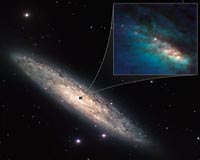
NGC 253 is one of the brightest spiral galaxies in the sky, and also one of the dustiest. The whole galaxy is shown here as observed with the WFI instrument, while the insert shows a close-up of the central parts as observed with the NACO instrument on ESO's Very Large Telescope and the ACS on the NASA/ESA Hubble Space Telescope. This unique set of observations has allowed a team of astronomers from the Instituto de Astrof�sica de Canarias (Spain) to study the galaxy in great detail, uncovering many young, massive and dusty stellar nurseries. They also found that the centre of this galaxy appears to harbour a twin of our own Milky Way's supermassive black hole. ESO image. Click for more images and captions.
by Staff Writers
La Silla, Chile (ESO) Jan 22, 2009
Thanks to the Very Large Telescope's acute and powerful near-infrared eye, astronomers have uncovered a host of new young, massive and dusty stellar nurseries in nearby galaxy NGC 253. The centre of this galaxy appears to harbour a twin of our own Milky Way's supermassive black hole.

Astronomers from the Instituto de Astrof�sica de Canarias (Spain) used NACO, a sharp-eyed adaptive optics instrument on ESO's Very Large Telescope (VLT), to study the fine detail in NGC 253, one of the brightest and dustiest spiral galaxies in the sky. Adaptive Optics (AO) corrects for the blurring effect introduced by the Earth's atmosphere.

This turbulence causes the stars to twinkle in a way that delights poets, but frustrates astronomers, since it smears out the images. With AO in action the telescope can produce images that are as sharp as is theoretically possible, as if the telescope were in space.

NACO revealed features in the galaxy that were only 11 light-years across. "Our observations provide us with so much spatially resolved detail that we can, for the first time, compare them with the finest radio maps for this galaxy - maps that have existed for more than a decade," says Juan Antonio Fernandez-Ontiveros, the lead author of the paper reporting the results [1].

Astronomers identified 37 distinct bright regions, a threefold increase on previous results, packed into a tiny region at the core of the galaxy, comprising just one percent of the galaxy's total size.

The astronomers combined their NACO images with data from another VLT instrument, VISIR, as well as with images from the NASA/ESA Hubble Space Telescope and radio observations made by the Very Large Array and the Very Large Baseline Interferometer.

Combining these observations, taken in different wavelength regimes, provided a clue to the nature of these regions.

"We now think that these are probably very active nurseries that contain many stars bursting from their dusty cocoons," says Jose Antonio Acosta-Pulido, a member of the team. NGC 253 is known as a starburst galaxy, after its very intense star formation activity. Each bright region could contain as many as one hundred thousand young, massive stars.

This comprehensive set of data also leads astronomers to conclude that the centre of NGC 253 hosts a scaled-up version of Sagittarius A*, the bright radio source that lies at the core of the Milky Way and which we know harbours a massive black hole (see ESO 46/08). "We have thus discovered what could be a twin of our Galaxy's Centre," says co-author Almudena Prieto.

Because observations in the radio wavelength domain are not affected by the turbulence of the atmosphere and because radio waves have much longer wavelengths than visible light, it is relatively easy to obtain very high spatial resolution at radio wavelengths by combining observations from well-separated radio telescopes (using interferometry).

This is why, until recently, radio maps of galaxies show much more detail than their equivalents in the near-infrared or the optical.

Fernandez-Ontiveros J.A., Prieto M.A. and Acosta-Pulido J.A., The nucleus of NGC 253 and its massive stellar clusters at parsec scales, MNRAS letters, 2009, 392, L16, DOI: 10.1111/j.1745-3933.2008.00575.x Note; J.A. Fernandez-Ontiveros, M.A. Prieto, and J.A. Acosta-Pulido Instituto de Astrof�sica de Canarias, Spain Phone: +34 922 605 369 E-mail: jafo (at) iac.es, aprieto (at) iac.es, jap (at) iac.es
Share This Article With Planet Earth
del.icio.usdel.icio.us DiggDigg RedditReddit
YahooMyWebYahooMyWeb GoogleGoogle FacebookFacebook


Related Links
ESO at La Silla
Stellar Chemistry, The Universe And All Within It


Memory Foam Mattress Review
Newsletters :: SpaceDaily :: SpaceWar :: TerraDaily :: Energy Daily
XML Feeds :: Space News :: Earth News :: War News :: Solar Energy News


First Light Curve Analysis Of 20 Eclipsing Binaries With Integral OMC
Paris, France (ESA) Jan 20, 2009
Photometric data gathered by Integral's Optical Monitoring Camera (OMC) has been used to study selected eclipsing binary stars for which the light curve had hitherto not been analyzed.


  • China calls on Obama to strengthen military ties
  • NATO chief hopes for French return at summit in April
  • Japan-China joint history study delayed: project head
  • Clinton vows new dawn for diplomacy after nomination vote

  • UN's Ban urges nuclear disarmament deal
  • NKorea says SKorea gripped by "war hysteria"
  • South Korea vows calm response to NKorean threats
  • US takes poke at Iran in signing UAE civil nuclear deal

  • India test-fires supersonic cruise missile
  • Taiwan not impressed by reported Chinese plan to withdraw missiles
  • Javelin Joint Venture Awarded Contract For Command Launch Unit Upgrade
  • NLOS-LS Completes Third Test Flight Of Precision Attack Missile

  • Obama Takes The Football And Mitt Part Four
  • Obama Missile Defense Priorities Part Three
  • Nuclear Doctrine Junket Season Set To reSTART Part Three
  • New US president could order missile shield review: official

  • New Turbines Can Cut Fuel Consumption For Business Jets
  • Air China expects to post 'significant loss' for 2008
  • Nations demand climate plan from air, maritime industries
  • Heathrow expansion to get green light despite protests: reports

  • USAF Remains Committed To Unmanned Aircraft Systems
  • Boeing-Insitu ScanEagle Completes 1500 Shipboard Sorties With US Navy
  • Skylark 1 LE Selected By Israeli Ministry Of Defense
  • Russia mulls unprecedented Israel drones purchase

  • Pentagon readies 16-month Iraq withdrawal option for Obama
  • Iran to seek influence through Iraq elections: Pentagon
  • Analysis: KBR, U.S. critiqued by SIGIR
  • Dogs of War: Immunity and impunity

  • A Whole New Type Of Protective Armour
  • Rockwell Collins To Provide HMD For Land Warrior Program
  • Russian RPG Line Remains Dominant
  • Mid-Range Munition Completes First Cartridge Integration Test

  • The content herein, unless otherwise known to be public domain, are Copyright 1995-2007 - SpaceDaily.AFP and UPI Wire Stories are copyright Agence France-Presse and United Press International. ESA Portal Reports are copyright European Space Agency. All NASA sourced material is public domain. Additional copyrights may apply in whole or part to other bona fide parties. Advertising does not imply endorsement,agreement or approval of any opinions, statements or information provided by SpaceDaily on any Web page published or hosted by SpaceDaily. Privacy Statement