
Subscribe free to our newsletters via your
. Military Space News .


BIO FUEL
Fueling aviation with hardwoods
by Staff Writers
Syracuse NY (SPX) May 09, 2014


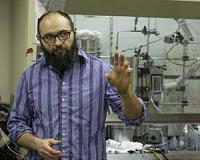
Professor Bond is a team member and lead author of of a summary on the use of technology designed to transform lignocellulosic biomass into a jet fuel surrogate via catalytic chemistry. Image courtesy Syracuse University.

A key challenge in the biofuels landscape is to get more advanced biofuels-fuels other than corn ethanol and vegetable oil-based biodiesel-into the transportation pool. Utilization of advanced biofuels is stipulated by the Energy Independence and Security Act; however, current production levels lag behind proposed targets.

Additionally, certain transportation sectors, such as aviation, are likely to continue to require liquid hydrocarbon fuels in the long term even as light duty transportation shifts to alternative power sources.

A multi-university team lead by George Huber, Professor of Chemical and Biological Engineering at the University of Wisconsin-Madison, has addressed both challenges through the concerted development of technology designed to transform lignocellulosic biomass into a jet fuel surrogate via catalytic chemistry.

This promising approach highlights the versatility of lignocellulose as a feedstock and was recently summarized in the journal Energy and Environmental Science by team member and lead author Jesse Q. Bond, Syracuse University Assistant Professor of Biomedical and Chemical Engineering.

Lignocellulosic biomass is an abundant natural resource that includes inedible portions of food crops as well as grasses, trees, and other "woody" biomass. According to the United States Department of Energy, the United States could sustainably produce as much as 1.6 billion tons of lignocellulose per year as an industrial feedstock.

Lignocellulose can be processed to yield various transportation fuels and commodity chemicals; however, current strategies are not generally cost-competitive with petroleum. Here, Huber's team presents a comprehensive approach toward streamlining biomass processing for the production of aviation fuels.

The proposed technology hinges on efficient production of furfural and levulinic acid from sugars that are commonly present in lignocellulosic biomass. These two compounds are then transformed into a mixture of chemicals that are indistinguishable from the primary components of petroleum-derived aviation fuels.

The technology was demonstrated through a multi-university partnership that brought together expertise in biomass processing, catalyst design, reaction engineering, and process modelling. Economic analysis suggests that, based on the current state of the technology, jet fuel-range hydrocarbons could be produced at a minimum selling price of $4.75 per gallon. The work also identifies primary cost drivers and suggests that increasing efficiency in wastewater treatment and decreasing catalyst costs could reduce that amount to $2.88 per gallon.

"This effort exemplifies the impact of a well-designed collaboration," said Bond. "As individual researchers, we sometimes focus too narrowly on problems that we can resolve using our own existing skills. Biomass refining is complex, and bio-based aviation fuels are difficult targets. Many of the real roadblocks occur at scarcely-studied research intersections. In our view, the only meaningful way to tackle these challenges is through strategic partnerships, and that is precisely what we've done in this program."

.


Related Links
Syracuse University
Bio Fuel Technology and Application News


Comment on this article via your Facebook, Yahoo, AOL, Hotmail login.

Share this article via these popular social media networks
del.icio.usdel.icio.us DiggDigg RedditReddit GoogleGoogle


BIO FUEL
Ozone levels drop 20 percent with switch from ethanol to gasoline
Chicago IL (SPX) Apr 30, 2014
A Northwestern University study by an economist and a chemist reports that when fuel prices drove residents of Sao Paulo, Brazil, to mostly switch from ethanol to gasoline in their flexible-fuel vehicles, local ozone levels dropped 20 percent. At the same time, nitric oxide and carbon monoxide concentrations tended to go up. The four-year study is the first real-world trial looking at the ... read more


BIO FUEL
Army orders Patriot missile segment enhancement

MEADS Technology Will Enable Germany To Build Its Future Air And Missile Defense System

India test-fires anti-ballistic missile

Raytheon touts ballistic missile defense weapon

BIO FUEL
Britain eyes adaption of naval air defense missile for army

Harpoon missile sale in works for Brazil

Enhanced infrared sensor system for Seasparrow missiles

Certification process for Talon Laser-Guided Rocket kit completed

BIO FUEL
S. Korea has 'smoking gun' proof North sent drones

Hummingbird line of VTOL unmanned aerial systems to make debut

Navy readies X-47B unmanned combat air vehicle for new sea tests

US drone ban infringes press freedom: news groups

BIO FUEL
Testing facility paves way for more radio connections to MUOS satellites

LGS Innovations completes upgrade of Army communications center in Kuwait

Britain contracts General Dynamics UK to support Bowman radios

DISA Awards Northrop Grumman contract for Joint Command and Control System

BIO FUEL
Japan makes first arrest over 3-D printer guns: reports

25 hurt as fire, blasts rock Philippine army munitions depot

Navy tasks Oshkosh Defense with continued UGV work

Chinese man jailed for 10 years over military secrets: Xinhua

BIO FUEL
India's Modi pledges defence procurement overhaul

US military reviews hairstyle rules after outcry

EU firms help power China's military rise

Deloitte says defense industry profits dipped in 2013

BIO FUEL
US warship arrives in Georgia amid Ukraine crisis

ASEAN leaders meet under China cloud

Hagel warns Americans of the risks of isolationism

America strikes out (again!)

BIO FUEL
Harnessing Magnetic Vortices for Making Nanoscale Antennas

New method for measuring the temperature of nanoscale objects discovered

Nanomaterial Outsmarts Ions

World's thinnest nanowires created by Vanderbilt grad student


The content herein, unless otherwise known to be public domain, are Copyright 1995-2014 - Space Media Network. All websites are published in Australia and are solely subject to Australian law and governed by Fair Use principals for news reporting and research purposes. AFP, UPI and IANS news wire stories are copyright Agence France-Presse, United Press International and Indo-Asia News Service. ESA news reports are copyright European Space Agency. All NASA sourced material is public domain. Additional copyrights may apply in whole or part to other bona fide parties. Advertising does not imply endorsement, agreement or approval of any opinions, statements or information provided by Space Media Network on any Web page published or hosted by Space Media Network. Privacy Statement All images and articles appearing on Space Media Network have been edited or digitally altered in some way. Any requests to remove copyright material will be acted upon in a timely and appropriate manner. Any attempt to extort money from Space Media Network will be ignored and reported to Australian Law Enforcement Agencies as a potential case of financial fraud involving the use of a telephonic carriage device or postal service.