
. Military Space News .
BIO FUEL
Fungi that evolved to eat wood offer new biomass conversion tool
by Staff Writers
Amherst MA (SPX) Jul 25, 2017


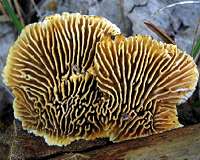
Basidiomycota brown rot fungi use a non-enzymatic, chelator-mediated biocatalysis method to digest woody biomass that is very different than methods used by any other microorganism studied, say Barry Goodell and colleagues at UMass Amherst, working with an international team. Credit Karel Tejkal, used with permission

Twenty years ago, microbiologist Barry Goodell, now a professor at the University of Massachusetts Amherst, and colleagues discovered a unique system that some microorganisms use to digest and recycle wood. Three orders of "brown rot fungi" have now been identified that can break down biomass, but details of the mechanism were not known.

Now, using several complementary research tools, Goodell and colleagues report new details of this unexpected mechanism at work, one that surprisingly does not involve enzymes, the usual accelerators of chemical reactions.

Instead, Basidiomycota brown rot fungi, use a non-enzymatic, chelator-mediated biocatalysis method that is "very different than that used by any other microorganism studied," he says. Chelators are organic compounds that bind metal ions, and in this case, they also generate "hydroxyl radicals" to break down wood and produce simple building-block chemicals.

Described by collaborators at Oak Ridge National Laboratory as "a paradigm shift in understanding fungal biocatalysis for biomass conversion," the findings appear in the current issue of Biotechnology for Biofuels. Goodell says, "Our research on fungal bioconversion systems looks at a novel mechanism that has potential use in bio-refineries to 'deconstruct' woody biomass for conversion into platform chemicals for biopolymers or energy products."

Brown rot fungi appear in both the northern and southern hemispheres and are some of the most common decay fungi in North America. Because they evolved relatively recently, there are fewer brown rot species compared to older white rot species. "However, because of their efficiency in degrading wood, brown rot fungi have come to dominate, particularly in degrading softwoods," Goodell says, and they now dominate by recycling approximately 80 percent of the softwood biomass carbon in the world, found mostly in the great forests of the northern hemisphere.

Goodell points out that most microorganisms use enzymes to break down compounds, but enzymes are huge molecules and physiologically "expensive" to produce because they contain so much nitrogen. "Scientists used to think that these fungi would make holes in the cell wall that would let in the big enzymes," he notes, a sort of pretreatment model. "But as we explain here, that is not how it works."

"The fungi we study use a non-enzymatic, catalytic chelator-mediated Fenton system instead, a very simple process that makes use of hydrogen peroxide, also generated by the fungal system, and iron found in the environment," Goodell says. He adds that he and colleagues believe the brown rot fungi's efficiency comes from their use of the chelator-mediated Fenton system rather than the use of enzymes exclusively, as white rot fungi do.

Goodell notes, "This group of brown rot fungi figured out how to generate hydroxyl radicals at a distance, that is, away from the fungus, to keep them away so the radicals won't damage themselves while breaking down wood." Hydroxyl radicals are very damaging to cells, the most potent oxidizing agents known in biological systems.

For this work, Goodell and colleagues including his collaborator Jody Jellison, now director of the Center for Agriculture, Food and the Environment at UMass Amherst, used a suite of investigative methods including small angle neutron scattering (SANS), sum frequency generation (SFG) spectroscopy, Fourier transform infrared (FTIR) analysis, X-ray diffraction (XRD), atomic force microscopy (AFM) and transmission electron microscopy (TEM) to fully describe the process.

Goodell says, "These fungi do produce a limited number of enzymes, but they come into play after the non-enzymatic action conversion by the fungi using chelators. The chelators are secondary metabolites, whose function is not easily followed using 'omics' techniques such as genomics. Using many advanced techniques though, we saw that some very small, low-molecular-weight compounds were working their way into the cell wall. This new paper describes how."

Goodell and Jellison relate a process that begins with the fungi in the lumen - the hollow space found inside plant cells. Using their hyphae, thread-like growth filaments, the fungi then mount a biochemical attack on the wood cell components.

As Goodell explains, "This group of fungi evolved a way to break down the wood substrate by first diffusing chelators into the cell wall. The fungus makes the chelator and produces hydrogen peroxide from oxygen, and together they start to digest the cell wall into the sugar found in the basic building block of wood, glucose, which the fungus can use as food. This is how these fungi are eating the wood."

BIO FUEL
How enzymes produce hydrogen
Bochum, Germany (SPX) Jul 24, 2017
Researchers at Ruhr-Universitat Bochum and the Freie Universitat Berlin have clarified the crucial catalytic step in the production of hydrogen by enzymes. The enzymes, called [FeFe]-hydrogenases, efficiently turn electrons and protons into hydrogen. They are thus a candidate for the biotechnological production of the potential energy source. 'In order to produce hydrogen on an industrial ... read more

Related Links
University of Massachusetts at Amherst
Bio Fuel Technology and Application News


Thanks for being here;
We need your help. The Space Media Network continues to grow but revenues have never been harder to maintain.

With the rise of Ad Blockers, and Facebook - our traditional revenue sources via quality network advertising continues to decline. And unlike so many other news sites, we don't have a paywall - with those annoying usernames and passwords.

Our news coverage takes time and effort to publish 365 days a year.

If you find our news sites informative and useful then please consider becoming a regular supporter or for now make a one off contribution.
SpaceMediaNetwork Contributor
$5 Billed Once


credit card or paypal
SpaceMediaNetwork Monthly Supporter
$5 Billed Monthly


paypal only


Comment using your Disqus, Facebook, Google or Twitter login.

Share this article via these popular social media networks
del.icio.usdel.icio.us DiggDigg RedditReddit GoogleGoogle

BIO FUEL
Lockheed awarded $130.3 million contract for Patriot missile foreign sales

US deploys Patriots in Lithuania for NATO war games

San Diego 'likely' in range of N.Korea ICBM in 2 years: US monitor

US conducts successful missile intercept test amid NKorea tensions

BIO FUEL
New anti-ship missile tipped for Japanese fighters

Lockheed receives $37.7M contract for JASSM-ER missile development

Stratospheric Combat: Russian MiG-31 Intercepts, Destroys Supersonic Missile

UK Eurofighter Typhoon successfully fires MDBA Brimstone missile

BIO FUEL
Leonardo DRS, Moog receive counter-UAS weapons contract

Singapore offers Manila drones, urban warfare training

Explotrain develops drone-simulated IED training system

New Reaper drone variant performs first combat mission

BIO FUEL
North Dakota UAS Training Center Depends on IGC Satellite Connectivity

First UAVs, Now Ships - Connectivity for the next generation of remote naval operations

Northrop Grumman receives Australian satellite ground station contract

DISA extends Comtech satellite services to Marines

BIO FUEL
LOC Performance receives $49.1 million Bradley upgrade contract

Nigeria starts receiving armored vehicles from Streit

Rheinmetall enhancing Puma IFV for German Army

Orbital ATK shows ammo development for MK44 gun

BIO FUEL
White House to issue executive order on defense industry sourcing

Pentagon trims Pakistan military aid over Haqqani inaction

Raytheon lobbyist to be nominated for Army secretary

House approves $696B budget for Pentagon

BIO FUEL
On third MH17 anniversary, families unveil 'living memorial'

International talks set for Monday on Ukraine conflict

Moldova renews calls for Russian troop withdrawal

NATO, Jordan mark establishment of new cybersecurity team

BIO FUEL
Nanoparticles could spur better LEDs, invisibility cloaks

New material resembling a metal nanosponge could reduce computer energy consumption

How do you build a metal nanoparticle?

Nanostructures taste the rainbow


The content herein, unless otherwise known to be public domain, are Copyright 1995-2024 - Space Media Network. All websites are published in Australia and are solely subject to Australian law and governed by Fair Use principals for news reporting and research purposes. AFP, UPI and IANS news wire stories are copyright Agence France-Presse, United Press International and Indo-Asia News Service. ESA news reports are copyright European Space Agency. All NASA sourced material is public domain. Additional copyrights may apply in whole or part to other bona fide parties. All articles labeled "by Staff Writers" include reports supplied to Space Media Network by industry news wires, PR agencies, corporate press officers and the like. Such articles are individually curated and edited by Space Media Network staff on the basis of the report's information value to our industry and professional readership. Advertising does not imply endorsement, agreement or approval of any opinions, statements or information provided by Space Media Network on any Web page published or hosted by Space Media Network. General Data Protection Regulation (GDPR) Statement Our advertisers use various cookies and the like to deliver the best ad banner available at one time. All network advertising suppliers have GDPR policies (Legitimate Interest) that conform with EU regulations for data collection. By using our websites you consent to cookie based advertising. If you do not agree with this then you must stop using the websites from May 25, 2018. Privacy Statement. Additional information can be found here at About Us.