|
 |
 |
 |
 |
 |
 |
 |
 |
 |

| . |  |
. |
Germanys License To Kill Gone
UPI Germany Correspondent Kehl Am Rhein, Germany (UPI) Feb 16, 2006 The German Supreme Court has overturned a law that would have allowed the government to shoot down passenger planes hijacked by terrorists. The Karlsruhe-based court said the Aviation Security Act was "incompatible with the fundamental right to life," ruling that the law, passed in 2004 by Germany's parliament, was unconstitutional as it would sacrifice the lives of civilians. Hesse's state Premier Roland Koch said after the decision that the German government now was "defenseless" against a terror attack from the air, adding his party may try to amend the constitution. Both Chancellor Angela Merkel's conservatives and their Social Democratic partners have backed the ruling as a final alternative. But others are happy that the legislation has been annulled. "This was a good decision," Christian Pestalozza, a constitutional law expert at Berlin's Free University, told United Press International Thursday via telephone. "The state can't have a license to kill civilians to save the lives of other civilians. These cases cannot be regulated. Each has to be handled individually." The law had been introduced by the previous German government led by former Chancellor Gerhard Schroeder in a response to the terrorist attacks of Sept. 11, 2001, and two other incidents in Germany: Berlin prepared the law after a mentally disturbed pilot threatened to crash his small plane into the European Central Bank and other landmarks in Frankfurt's business district. Only a few months after it came into effect, a man who had killed his wife crashed his plane into the lawn in front of parliament, dangerously close to the chancellor's office. Since then Berlin has enforced a no-fly zone around the government district. The German Supreme Court last July overturned another law, which observers say was far more important in the fight against terrorism than the recently annulled one. Judges at the time exonerated German-Syrian terrorist suspect Mamoun Darkazanli, after Madrid authorities sought to extradite him to Spain under a European Union Arrest warrant. The decision in favor of Darkazanli, who is believed to have been involved in the 2004 Madrid train bombings that killed 191 people, was seen as a slap in the face against European lawmakers. Europe nonetheless is a divided continent when it comes to anti-terror legislation: in most of Scandinavia, anti-terror laws are lax, while in France, they are relatively harsh given the history of guerrilla warfare against the French in Algeria. Germany is somewhere in the middle, but the latest decision may turn the tide against proponents of tougher state control when it comes to fighting terrorism. Peter Clark, Britain's top anti-terror police official Thursday called for a new strategy to prosecute terrorist suspects. He implied the U.K. should allow the use of evidence such as phone tap material against terrorists, a move which the government is currently debating. British Premier Tony Blair has already introduced a new anti-terror bill which remains in parliamentary limbo. If turned into law, the bill would allow authorities to charge people who "praise or celebrate" terrorism, prosecute individuals for preparing a terrorist act, giving or receiving terrorist training, and spreading terrorist publications, according to the BBC. It would also widen powers to ban organisations that glorify terrorism. Spain said it wants to establish a special police force to counter large-scale terrorist attacks, adding it would prepare a proposal for a European anti-terrorism force, the daily El Pais reported last month. Both Britain and Spain fell victim to the two most recent large-scale terrorist attacks in Europe, and their proposals come at a time when the conflict between the West and the Islamic world seems to take on heat with each passing day. Back in Germany, conservative security experts said they would try to amend the constitution to revive the law. But such an amendment would need a two-thirds majority in the Bundestag -- an unlikely scenario. "The Supreme Court has left not doubt that such a regulation is unconstitutional," Pestalozza said. "I don't think we will see it again in the future." However, in a side comment, the presiding judge indicated that in case of a real emergency, it would be up to the individual to make a decision. According to Pestalozza, this is still preferable to giving the state legal ground to shoot down planes. "If a plane with five civilians on board would attempt to crash into a building with thousands, then the defense minister can order the plane shot down and take over the responsibility before court," he said. "That may appear cowardly, but I think it's the best way to go."
Source: United Press International Related Links -  Holland Deploys Nuclear, Biological, Chemical Fox To Watch Out
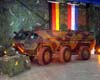 Kiel, Germany (SPX) Feb 09, 2006
Rheinmetall Landsysteme has just delivered six highly advanced FOX NBC reconnaissance vehicles to the Dutch armed forces. In a ceremony at Rheinmetall Landsysteme GmbH's Kassel plant on January 25, 2006, Cees van der Knaap, the Dutch Deputy Minister of Defence, was presented with a symbolic key to the vehicles ahead of their official transfer to the NBC Reconnaissance Company of the Dutch armed forces. |
|
|

| The content herein, unless otherwise known to be public domain, are Copyright 1995-2006 - SpaceDaily.AFP and UPI Wire Stories are copyright Agence France-Presse and United Press International. ESA PortalReports are copyright European Space Agency. All NASA sourced material is public domain. Additionalcopyrights may apply in whole or part to other bona fide parties. Advertising does not imply endorsement,agreement or approval of any opinions, statements or information provided by SpaceDaily on any Web page published or hosted by SpaceDaily. Privacy Statement |