
. Military Space News .
PHYSICS NEWS
Gravitational wave network catches another neutron star collision
by Staff Writers
Washington DC (SPX) Jan 07, 2020

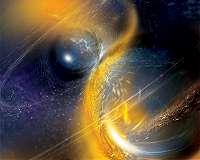
Artist's rendition of a binary neutron star merger.

On April 25, 2019, the LIGO Livingston Observatory picked up what appeared to be gravitational ripples from a collision of two neutron stars. LIGO Livingston is part of a gravitational-wave network that includes LIGO (the Laser Interferometer Gravitational-wave Observatory), funded by the National Science Foundation (NSF), and the European Virgo detector.

Now, a new study confirms that this event was indeed likely the result of a merger of two neutron stars. This would be only the second time this type of event has ever been observed in gravitational waves.

The first such observation, which took place in August of 2017, made history for being the first time that both gravitational waves and light were detected from the same cosmic event. The April 25 merger, by contrast, did not result in any light being detected. However, through an analysis of the gravitational-wave data alone, researchers have learned that the collision produced an object with an unusually high mass.

"From conventional observations with light, we already knew of 17 binary neutron star systems in our own galaxy and we have estimated the masses of these stars," says Ben Farr, a LIGO team member based at the University of Oregon. "What's surprising is that the combined mass of this binary is much higher than what was expected."

"We have detected a second event consistent with a binary neutron star system and this is an important confirmation of the August 2017 event that marked an exciting new beginning for multi-messenger astronomy two years ago," says Jo van den Brand, Virgo Spokesperson and professor at Maastricht University, and Nikhef and VU University Amsterdam in the Netherlands. Multi-messenger astronomy occurs when different types of signals are witnessed simultaneously, such as those based on gravitational waves and light.

The study, submitted to The Astrophysical Journal Letters, is authored by an international team comprised of the LIGO Scientific Collaboration and the Virgo Collaboration, the latter of which is associated with the Virgo gravitational-wave detector in Italy. The results were presented at a press briefing January 6, at the 235th meeting of the American Astronomical Society in Honolulu, Hawaii.

Neutron stars are the remnants of dying stars that undergo catastrophic explosions as they collapse at the end of their lives. When two neutron stars spiral together, they undergo a violent merger that sends gravitational shudders through the fabric of space and time.

LIGO became the first observatory to directly detect gravitational waves in 2015; in that instance, the waves were generated by the fierce collision of two black holes. Since then, LIGO and Virgo have registered dozens of additional candidate black hole mergers.

The August 2017 neutron star merger was witnessed by both LIGO detectors, one in Livingston, Louisiana, and one in Hanford, Washington, together with a host of light-based telescopes around the world (neutron star collisions produce light, while black hole collisions are generally thought not to do so). This merger was not clearly visible in the Virgo data, but that fact provided key information that ultimately pinpointed the event's location in the sky.

The April 2019 event was first identified in data from the LIGO Livingston detector alone. The LIGO Hanford detector was temporarily offline at the time, and, at a distance of more than 500 million light-years, the event was too faint to be visible in Virgo's data.

Using the Livingston data, combined with information derived from Virgo's data, the team narrowed the location of the event to a patch of sky more than 8,200 square degrees in size, or about 20 percent of the sky. For comparison, the August 2017 event was narrowed to a region of just 16 square degrees, or 0.04 percent of the sky.

"This is our first published event for a single-observatory detection," says Caltech's Anamaria Effler, a scientist who works at LIGO Livingston. "But Virgo made a valuable contribution. We used information about its non-detection to tell us roughly where the signal must have originated from."

The LIGO data reveal that the combined mass of the merged bodies is about 3.4 times the mass of our Sun. In our galaxy, known binary neutron star systems have combined masses up to only 2.9 times that of Sun. One possibility for the unusually high mass is that the collision took place not between two neutron stars, but a neutron star and a black hole, since black holes are heavier than neutron stars.

But if this were the case, the black hole would have to be exceptionally small for its class. Instead, the scientists believe it is much more likely that LIGO witnessed a shattering of two neutron stars.

"What we know from the data are the masses, and the individual masses most likely correspond to neutron stars. However, as a binary neutron star system, the total mass is much higher than any of the other known galactic neutron star binaries," says Surabhi Sachdev, a LIGO team member based at Penn State. "And this could have interesting implications for how the pair originally formed."

Neutron star pairs are thought to form in two possible ways. They might form from binary systems of massive stars that each end their lives as neutron stars, or they might arise when two separately formed neutron stars come together within a dense stellar environment.

The LIGO data for the April 25 event do not indicate which of these scenarios is more likely, but they do suggest that more data and new models are needed to explain the merger's unexpectedly high mass.


Related Links
International Ligo-Virgo Collaboration
The Physics of Time and Space


Thanks for being here;
We need your help. The Space Media Network continues to grow but revenues have never been harder to maintain.

With the rise of Ad Blockers, and Facebook - our traditional revenue sources via quality network advertising continues to decline. And unlike so many other news sites, we don't have a paywall - with those annoying usernames and passwords.

Our news coverage takes time and effort to publish 365 days a year.

If you find our news sites informative and useful then please consider becoming a regular supporter or for now make a one off contribution.
SpaceMediaNetwork Contributor
$5 Billed Once


credit card or paypal
SpaceMediaNetwork Monthly Supporter
$5 Billed Monthly


paypal only


PHYSICS NEWS
Hebrew U researcher cracks Newton's elusive '3-body' problem
Jerusalem (SPX) Dec 19, 2019
It's been nearly 350 years since Sir Isaac Newton outlined the laws of motion, claiming "For every action, there is an equal and opposite reaction." These laws laid the foundation to understand our solar system and, more broadly, to understand the relationship between a body of mass and the forces that act upon it. However, Newton's groundbreaking work also created a pickle that has baffled scientists for centuries: The Three-Body Problem. After using the laws of motion to describe how planet Eart ... read more

Comment using your Disqus, Facebook, Google or Twitter login.


Share this article via these popular social media networks
del.icio.usdel.icio.us DiggDigg RedditReddit GoogleGoogle

PHYSICS NEWS
Lockheed nabs $114M deal to deliver Patriot missiles to UAE

Syrian defences fire on 'hostile missiles' from Israel: state media

Moscow lifts veil on missile attack warning system

Germany in talks with Lockheed, MBDA for missile defense program

PHYSICS NEWS
Boeing awarded $265.2M modification to GMD missile upgrade contract

Russia's Avangard hypersonic missile system has entered service

Raytheon nabs $768.3M contract to provide AMRAAMs to foreign partners

Russia says first Avangard hypersonic missiles enter service

PHYSICS NEWS
F-16 shoots down drone at Eglin AFB in cruise missile defense test

Lockheed Martin and Canadian UAVs to improve unmanned beyond visual line of sight operations

Inmarsat Government bulk orders airborne satcom terminals from Orbit CS

US proposes remote ID requirement for drones

PHYSICS NEWS
General Dynamics receives $730M for next-gen satcom system

Airbus' marks 50 years in Skynet secure satellite communications for UK

Lockheed Martin gets $3.3B contract for communications satellite work

GenDyn nets $783M for next-gen Navy MUOS operations

PHYSICS NEWS
Digital engineering transformation coming to the AF Weapons Enterprise

BAE Systems awarded $249.2 million modification for self-propelled Howitzers

Oshkosh Defense receives $801M to deliver JLTVs to Montenegro

AFRL, AFLCMC respond to warfighter request for assistance

PHYSICS NEWS
China slams US defence act over trade restrictions

Switzerland drops case against aerospace firm tied to Saudis

BAE Systems to eliminate 325 jobs at Pearl Harbor ship repair facility

Cobham says US firm set to complete takeover

PHYSICS NEWS
Trump says doesn't need Congress's OK for even 'disproportionate' strike

Trump's no 'stupid' wars doctrine faces biggest test

US places ban on Cuban defense chief

Before Libya, Turkey's main military operations abroad

PHYSICS NEWS
Creating a nanoscale on-off switch for heat

Nanoscience breakthrough: Probing particles smaller than a billionth of a meter

SMART discovers breakthrough way to look at the surface of nanoparticles

Visible light and nanoparticle catalysts produce desirable bioactive molecules


The content herein, unless otherwise known to be public domain, are Copyright 1995-2024 - Space Media Network. All websites are published in Australia and are solely subject to Australian law and governed by Fair Use principals for news reporting and research purposes. AFP, UPI and IANS news wire stories are copyright Agence France-Presse, United Press International and Indo-Asia News Service. ESA news reports are copyright European Space Agency. All NASA sourced material is public domain. Additional copyrights may apply in whole or part to other bona fide parties. All articles labeled "by Staff Writers" include reports supplied to Space Media Network by industry news wires, PR agencies, corporate press officers and the like. Such articles are individually curated and edited by Space Media Network staff on the basis of the report's information value to our industry and professional readership. Advertising does not imply endorsement, agreement or approval of any opinions, statements or information provided by Space Media Network on any Web page published or hosted by Space Media Network. General Data Protection Regulation (GDPR) Statement Our advertisers use various cookies and the like to deliver the best ad banner available at one time. All network advertising suppliers have GDPR policies (Legitimate Interest) that conform with EU regulations for data collection. By using our websites you consent to cookie based advertising. If you do not agree with this then you must stop using the websites from May 25, 2018. Privacy Statement. Additional information can be found here at About Us.