
Subscribe free to our newsletters via your
. Military Space News .


BIO FUEL
Ground broken on $6 million Hungarian farm biogas plant
by Staff Writers
Bekes, Hungary (UPI) Dec 9, 2013


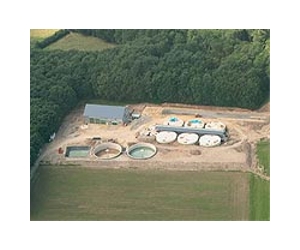
disclaimer: image is for illustration purposes only

Construction of a new biogas plant is under way in Hungary, where officials predict it will cover the energy needs of thousands of homes.

Executives of Hidashati Farm Ltd. and the plant's builder, Biogaz Unio, said Saturday the $6 million, 1.2-megawatt anaerobic digestion plant they've started putting up near Bekes in eastern Hungary will transform animal waste and other farm materials into enough power for 2,500 homes and heat for 1,500 homes annually.

Such plants produce power by breaking down wet, biodegradable, organic wastes such as manure, whole crop silages, wet food and feed wastes.

Hidashati Farm Chief Executive Laszlo Vegh said the raw material will be provided from the manure of 2,400 head of cattle on the 800-acre farm. The plant will produce both electricity and heat, as well as 2,000-2,500 tons of fertilizer and soil conditioners as by-products.

"In the longer term, costs will be reduced and thus increase our competitiveness," Vegh said. "The ability to compete against Western European companies is a very important part of the process for us."

Biogaz Unio Chief Executive Peter Pongracz said the development of the biogas plant was made possible with a $2.9 million investment from the Hungarian government's transport operational program via the European Union and additional funding from local investors.

Bekes Mayor Gabor Izso declared the introduction of advanced technologies into Hungary's farm country is necessary to ensure the country's energy independence.

"It's very important to us that the biogas plant is being built -- it is city's major contribution to strengthening energy security," he said.

Hungarian Member of Parliament Jozsef Kovacs noted raw materials for biogas production are abundant locally, which makes it a good bet for future projects. He also praised the environmental and economic development potential of biogas, the regional daily Bekes County News reported.

Hungarian agriculture is dominated by high livestock density, which is accompanied by production of a surplus of animal manure. That poses over-fertilization and environmental risks, and so excess of nutrients need to be carefully managed and recycled when possible.

Through the use of anaerobic digestion, odors and pathogens from manure can be cut and a renewable fuel -- biogas -- can be produced.

The EU has set a goal of producing 20 percent of its power needs through renewable sources by 2020, with at least 25 percent of that total from biogas.

Budapest's political target is to reach 34 megawatts of power to be generated from biogas by 2020, about 5 percent of the total renewable energy sources in the country.

The EU has determined Hungary has a very good chance to reach that target, with the potential to generate almost 9 billion cubic meters of biogas from agricultural resources such as animal by-products, sewage sludge and municipal organic waste.

?However, the commercial profitability of biogas is still insufficient for it to compete with cheaper fossil fuels such as natural gas and coal on its own. Backers hope further technological advances combined with guaranteed feed-in tariffs and other support programs will help trigger new investments in Hungary.

.


Related Links
Bio Fuel Technology and Application News


Comment on this article via your Facebook, Yahoo, AOL, Hotmail login.

Share this article via these popular social media networks
del.icio.usdel.icio.us DiggDigg RedditReddit GoogleGoogle


BIO FUEL
Turning waste into power with bacteria and loofahs
Washington DC (SPX) Dec 06, 2013
Loofahs, best known for their use in exfoliating skin to soft, radiant perfection, have emerged as a new potential tool to advance sustainability efforts on two fronts at the same time: energy and waste. The study describes the pairing of loofahs with bacteria to create a power-generating microbial fuel cell (MFC) and appears in the ACS journal Environmental Science and Technology. S ... read more


BIO FUEL
Iran nuclear accord means NATO missile defence unnecessary: Russia

IBCS Completes US Army Integrated Air and Missile Defense Demonstration

Patriot performance excels in PAC-3 test firing

Israel moves closer to missile defense shield

BIO FUEL
Turkey says no new bids to rival China missile offer

Kongsberg seals Penguin missile deal with New Zealand

US Navy deploys Standard Missile-6 for first time

Raytheon Delivers High-Speed Anti-Radiation Missile Control Units

BIO FUEL
Northrop starts production of Global Hawk UAS for NATO

Pentagon chief talks drones with Pakistan PM

Northrop Grumman Begins On-Time Production of First NATO Global Hawk

U.S. responding to Gulf states push for UAV systems

BIO FUEL
US Navy Accepts MUOS-2 Satellite, Ground Stations After On-Orbit Testing

Boeing Tests Validate Performance of FAB-T Satellite Communications Program

Intelsat General To Provide Satellite Services To US Marines

Manpack Radios in Arctic Connect with MUOS Satellites Orbiting Equator

BIO FUEL
Less than 90 days: how US will destroy Syria chemical weapons

Switzerland, Austria seek U.S. Foreign Military Sales deals

Fill out the form for your bomb: Pentagon

Much of Venezuela's Russian arms said to be faulty

BIO FUEL
Russia indicts former defence minister

U.S., Europeans battle for big Persian Gulf arms deals

Report: German auditors, EU probing procurement of helicopters

Israel eyes big arms deals with longtime buyer India

BIO FUEL
S. Korea declares expanded air defence zone in disputed area

China 'regrets' S. Korea air zone expansion; Japan says no problem

China ships sail through disputed waters as tensions simmer

US looks to manage, not end, China air rift

BIO FUEL
Laser light at useful wavelengths from semiconductor nanowires

Stanford engineers show how to optimize carbon nanotube arrays for use in hot spots

Ultra-sensitive force sensing with a levitating nanoparticle

Graphene nanoribbons for 'reading' DNA


The content herein, unless otherwise known to be public domain, are Copyright 1995-2014 - Space Media Network. AFP, UPI and IANS news wire stories are copyright Agence France-Presse, United Press International and Indo-Asia News Service. ESA Portal Reports are copyright European Space Agency. All NASA sourced material is public domain. Additional copyrights may apply in whole or part to other bona fide parties. Advertising does not imply endorsement,agreement or approval of any opinions, statements or information provided by Space Media Network on any Web page published or hosted by Space Media Network. Privacy Statement