
Subscribe free to our newsletters via your
. Military Space News .


WATER WORLD
Hair ice mystery solved
by Staff Writers
Munich, Germany (SPX) Jul 27, 2015


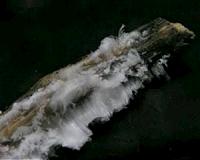
This is a time-lapse of hair ice growth taken at the Gletschergarten in Luzern, Switzerland. Image courtesy Erich Albisser/Gletschergarten Luzern (http://www.gletschergarten.ch/).

You may have never seen or heard of it, but hair ice - a type of ice that has the shape of fine, silky hairs and resembles white candy floss - is remarkable. It grows on the rotten branches of certain trees when the weather conditions are just right, usually during humid winter nights when the air temperature drops slightly below 0C.

Now, a team of scientists in Germany and Switzerland have identified the missing ingredient that gives hair ice its peculiar shape: the fungus Exidiopsis effusa. The research is published (22 July) in Biogeosciences, an open access journal of the European Geosciences Union (EGU).

"When we saw hair ice for the first time on a forest walk, we were surprised by its beauty," says Christian Matzler from the Institute of Applied Physics at the University of Bern in Switzerland. "Sparked by curiosity, we started investigating this phenomenon, at first using simple tests, such as letting hair ice melt in our hands until it melted completely."

Then Matzler, a physicist, joined forces with a chemist (Diana Hofmann) and a biologist (Gisela Preub) in Germany. Inspired by earlier work, and by photographs of hair ice sent in from various countries, the team performed a set of experiments to figure out just what conditions are needed to grow this type of ice and what its properties are. In the process, they confirmed a 100-year-old theory for the origin of hair ice.

Alfred Wegener, of tectonic-plate fame, was the first to study hair ice. In 1918, he noticed a whitish cobwebby coating on the surface of hair-ice-bearing wood, which his assistant identified as fungus mycelium - the mass of thin threads from where mushrooms grow. He suggested there was a relation between the ice and the fungus in the wood.

Some 90 years later, Gerhart Wagner, a retired Swiss professor who has been researching hair ice for decades, found evidence of this relation: treating the wood with fungicide or dunking it in hot water suppressed the growth of hair ice. But the fungus species and the mechanism that drives the growth of hair ice was yet to be identified.

That was the aim of the researchers who have now published their work in Biogeosciences. Preub studied samples of hair-ice-bearing wood collected in the winters of 2012, 2013 and 2014 in forests near Brachbach in western Germany. She analysed the wood samples using microscopic techniques and identified eleven different species of fungi. "One of them, Exidiopsis effusa, colonised all of our hair-ice-producing wood, and in more than half of the samples, it was the only species present," she says.

Matzler, on the other hand, performed experiments designed to better understand the physics of hair ice on samples he collected in a forest at Moosseedorf, Switzerland. He found, confirming guesses by other researchers, that the driving mechanism responsible for producing ice filaments at the wood surface is ice segregation. Liquid water near the branch surface freezes in contact with the cold air, creating an ice front and 'sandwiching' a thin water film between this ice and the wood pores.

Suction resulting from repelling intermolecular forces acting at this 'wood-water-ice sandwich' then gets the water inside the wood pores to move towards the ice front, where it freezes and adds to the existing ice. "Since the freezing front is situated at the mouth of the wood rays, the shape of the growing ice is determined by the wood rays at their mouth," says Matzler.

"The same amount of ice is produced on wood with or without fungal activity, but without this activity the ice forms a crust-like structure. The action of the fungus is to enable the ice to form thin hairs - with a diameter of about 0.01 mm - and to keep this shape over many hours at temperatures close to 0C. Our hypothesis includes that the hairs are stabilised by a recrystallisation inhibitor that is provided by the fungus."

Hofmann then studied the hair ice itself. Her chemical analyses of the melted ice showed the water to contain fragments of the complex organic compounds lignin and tannin. Since these are metabolic products of the fungal activity, this finding further confirms the biological influence on hair ice. "These components may be the ones preventing the formation of large ice crystals at the wood surface," says Hofmann.

The researchers say a reason why it took almost 100 years to confirm Wegener's hypothesis is that hair ice is a somewhat rare and fleeting phenomenon, spotted mainly in broadleaf forests at latitudes between 45 and 55 N. "Hair ice grows mostly during the night and melts again when the sun rises. It's invisible in the snow and inconspicuous in hoarfrost," says Preub.

Keep an eye out next time you go for an early morning walk in the woods. If you can find hair ice, you are in for a treat.


Thanks for being here;
We need your help. The Space Media Network continues to grow but revenues have never been harder to maintain.

With the rise of Ad Blockers, and Facebook - our traditional revenue sources via quality network advertising continues to decline. And unlike so many other news sites, we don't have a paywall - with those annoying usernames and passwords.

Our news coverage takes time and effort to publish 365 days a year.

If you find our news sites informative and useful then please consider becoming a regular supporter or for now make a one off contribution.
SpaceMediaNetwork Contributor
$5 Billed Once


credit card or paypal
SpaceMediaNetwork Monthly Supporter
$5 Billed Monthly


paypal only


.


Related Links
European Geosciences Union
Water News - Science, Technology and Politics


Comment on this article via your Facebook, Yahoo, AOL, Hotmail login.

Share this article via these popular social media networks
del.icio.usdel.icio.us DiggDigg RedditReddit GoogleGoogle


Memory Foam Mattress Review
Newsletters :: SpaceDaily :: SpaceWar :: TerraDaily :: Energy Daily
XML Feeds :: Space News :: Earth News :: War News :: Solar Energy News


WATER WORLD
Predicting the shape of river deltas
Boston MA (SPX) Jul 24, 2015
The Mississippi River delta is a rich ecosystem of barrier islands, estuaries, and wetlands that's home to a diverse mix of wildlife - as well as more than 2 million people. Over the past few decades, the shape of the delta has changed significantly, as ocean waves have carved away at the coastline, submerging and shrinking habitats. To keep flooding at bay, engineers have erected dams and ... read more


WATER WORLD
US Awards Contract to Develop Missile Defense Command System

US Authorizes 'Forward-Based' Missile Defense System for Allies

USAF Early Warning Satellites Get No-Cost Update from Lockheed Martin

Boecore to support Army missile defense

WATER WORLD
More Hydra-70 rockets on way for U.S. military, allies

Iran says UN resolution not linked to ballistic missiles

Israel jails Palestinian engineer over Hamas rocket design

Successful flight tests for Lockheed Martin missile

WATER WORLD
Gun-firing 'drone' built by US teen under investigation

Official recognition for 80-hour UAV flight

NASA assists in pharmaceutical drone delivery

Pakistan says it has shot down an Indian spy drone

WATER WORLD
Harris replacing satellite communications terminals

Lockheed Martin set to advance RF sensors development

Navy engineer invents new data transmission system

Fourth MUOS arrives in Florida for August launch

WATER WORLD
Cost of USAF decoy systems reduced

New tank ammunition enters production for U.S. Army

Canada orders trucks from Mack Defense

Lockheed Martin orders weapons stabilization system

WATER WORLD
India clears $4.74 billion defence purchase

US military to consider transgender troops

State Dept. gives nod to possible border security system sale to Egypt

Russia wants Iran arms embargo 'lifted as soon as possible'

WATER WORLD
US-Cuba relations: A half-century of twists and turns

Philippines cheers growing outcry over South China Sea

US-led drills in Ukraine may threaten peace process: Moscow

Beijing chides US over South China Sea flight

WATER WORLD
On the way to breaking the terahertz barrier for graphene nanoelectronics

Plantations of nanorods on carpets of graphene capture the Sun's energy

Nanoscale light-emitting device has big profile

Nanowires highly 'anelastic'


The content herein, unless otherwise known to be public domain, are Copyright 1995-2014 - Space Media Network. All websites are published in Australia and are solely subject to Australian law and governed by Fair Use principals for news reporting and research purposes. AFP, UPI and IANS news wire stories are copyright Agence France-Presse, United Press International and Indo-Asia News Service. ESA news reports are copyright European Space Agency. All NASA sourced material is public domain. Additional copyrights may apply in whole or part to other bona fide parties. Advertising does not imply endorsement, agreement or approval of any opinions, statements or information provided by Space Media Network on any Web page published or hosted by Space Media Network. Privacy Statement All images and articles appearing on Space Media Network have been edited or digitally altered in some way. Any requests to remove copyright material will be acted upon in a timely and appropriate manner. Any attempt to extort money from Space Media Network will be ignored and reported to Australian Law Enforcement Agencies as a potential case of financial fraud involving the use of a telephonic carriage device or postal service.