Combining diamond anvils and powerful lasers, laboratory researchers have developed a technique that should be able to squeeze materials to pressures 100 to 1,000 times greater than possible today, reproducing conditions expected in the cores of supergiant planets. Until now, these pressures have only been available experimentally next to underground nuclear explosions.
"This lets us explore a new regime of chemistry and reproduce the conditions of more extreme planets," said Raymond Jeanloz, a professor of astronomy and of earth and planetary science at the University of California, Berkeley.
Jeanloz and colleagues at Lawrence Livermore National Laboratory (LLNL), New Mexico State University and France's Atomic Energy Commission report their development in this week's online edition of the Proceedings of the National Academy of Sciences.
To date, Jeanloz and his colleagues have achieved pressures near 10 million atmospheres using the 30 kilojoule ultraviolet Omega laser at the University of Rochester's Laboratory for Laser Energetics in New York. They hope eventually to use the 2 megajoule laser of LLNL's National Ignition Facility to achieve more than a billion atmospheres of pressure.
Jeanloz was instrumental in the development 25 years ago of diamond anvil cells, which squeeze liquids and solids to pressures of 4 to 5 million atmospheres, slightly higher than the pressure at the center of the Earth. With diamond anvils, the temperature as well as pressure can be varied, and experimenters can study the compressed samples for long periods.
Laser-induced shock waves can produce tens of millions of atmospheres, but only for a split-second and at very high temperatures. This technique also requires lasers the size of a building.
"By combining the two, we can get to higher pressures and much higher densities than either of the methods alone," Jeanloz said. "High density is really important, because we are trying to understand what happens as you bring atoms really close together, and compare our observations to quantum mechanical calculations."
The combined methods also allow experimenters to tune the temperature over a wide range independent of density, something almost impossible to do with laser-induced shock waves alone. Though this is possible in diamond anvil cells, studying a tiny hot sample is challenging, according to Jeanloz.
With the development of techniques to reach high pressures, scientists are discovering an entirely new realm of chemistry, Jeanloz said.
"When we squeeze materials to a million atmospheres pressure, the chemistry is changed dramatically," he said. "Materials go from being transparent insulators to becoming metallic or even superconducting. The periodic table is completely changed at high pressures.
"There is reason to expect that when we go from the million atmosphere range to the billion atmosphere range, again there will be huge changes in chemical bonding and material properties."
Some of the most dramatic discoveries have involved the composition of material inside Earth. Diamond anvil experiments have shown that the most dominant mineral in Earth's mantle is perovskite, a combination of magnesium, silicon and oxygen formed only at extremely high-pressures, above 100,000 atmospheres. Jeanloz has shown through similar experiments that Earth's rocky mantle dissolves into the liquid metal core where they meet at the core-mantle boundary, about 1,800 miles under our feet.
An interest in even higher pressures comes as astronomers have discovered more than 200 planets outside our solar system, most of them giant planets and supergiant planets tens or hundreds of times bigger than Jupiter.
"The center of Jupiter is at about 70 million atmospheres," which until now has been inaccessible, Jeanloz said. "We want to be able to understand the hundreds of planets that have now been found that are massive enough that their central pressures are many hundreds of millions of atmospheres, and maybe a billion atmospheres."
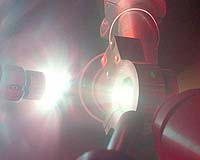
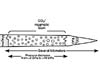
In a diamond anvil, a tiny sample - either liquid or solid - is compressed between the tips of two diamonds. In the combined technique, several powerful laser beams zap one of the diamonds, vaporizing it and sending a shock wave through the sample that compresses it even more. The shock wave compresses the sample for 1 to 2 nanoseconds, enough time to study the properties of the sample, which can range from hydrogen and helium, the stuff of stars and giant planets, to elements that comprise Earth.