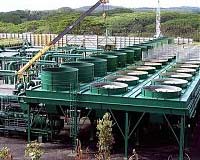
Power generating equipment at the Puna Geothermal Venture plant.
Power generating equipment at the Puna Geothermal Venture plant. |
At Puna Geothermal, state-of-the-art technology taps the vast underground cauldron of Kilauea's volcanic heat -- converting steam to electricity that's marketed through Hawaii Electric Light Company. Kilauea Volcano, whose magma extends from the surface to more than 36 miles into the earth, is one of, if not the most, active volcanoes on the world (USGS).
While Puna Geothermal accounts for 31 percent of the renewable energy resources for the entire state, its use is limited by geography to Hawaii Island.
Hawaii has some applications of solar and wind generation but geothermal is the state's most reliable alternative energy source.
"When the wind doesn't blow and the sun doesn't shine, the volcano continues to produce a steady flow of power. It also could be used to stimulate light industries such as seed germination or hydrogen fuel technology," says PGV Plant Manager Mike Kaleikini.
And, there's room to grow-Puna Geothermal's underground resource holds about 200 megawatts of renewable geothermal energy.
Ormat Technologies, Inc., a company with considerable international depth in geothermal knowledge and production, acquired Puna Geothermal Venture in 2004, and since then the plant has undergone substantial upgrades.
The 30-megawatt facility uses air-cooled condensers and noise reduction enclosures. It's a low-profile plant, 24 feet high, and has zero emissions. One hundred percent of its geothermal fluid and gas is reinjected into the deep earth.
Geothermal potential enormous
Hawaii is one of the most advanced states in its potential for harnessing the earth's natural heat to generate electricity.
A recent year-long Massachusetts Institute of Technology (MIT)-based study concluded that geothermal energy had the potential to become a major energy source for the United States. The U.S. is already the largest producer of geothermal energy. California, Nevada, Utah and Hawaii were cited as top-producing states.
The January 2007 MIT report found that geothermal accounts for about as much as wind and solar combined, and it's a steadier source. Its attributes include accessibility, a small ecological footprint and low emissions. The study concluded that expanding this increasingly low-cost resource for short- and long-term energy solutions is a sound option that helps diversify the U.S.'s energy portfolio with a clean, stable and renewable resource.
More than 90 percent of Hawaii's energy is powered by imported fossil fuels and the state's electric costs are among the highest in the nation. Hawaii lags behind the rest of the United States in fossil fuel reduction, so the state government is seeking other uses for geothermal power and heat that can benefit agriculture and reduce Hawaii's dependence on energy imports.
Puna Geothermal is working on a project with Department of Energy funding an experimental hydrogen program at the Natural Energy Laboratory of Hawaii.
Community
 A Step Nearer To Understanding Superconductivity
 Paris, France (SPX) Jun 11, 2007
| The content herein, unless otherwise known to be public domain, are Copyright 1995-2006 - SpaceDaily.AFP and UPI Wire Stories are copyright Agence France-Presse and United Press International. ESA PortalReports are copyright European Space Agency. All NASA sourced material is public domain. Additionalcopyrights may apply in whole or part to other bona fide parties. Advertising does not imply endorsement,agreement or approval of any opinions, statements or information provided by SpaceDaily on any Web page published or hosted by SpaceDaily. Privacy Statement |