
. Military Space News .


.
INTERN DAILY
Heart-powered pacemaker could one day eliminate battery-replacement surgery
by Staff Writers
Ann Arbor, MI (SPX) Mar 09, 2012

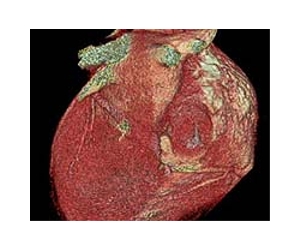
File image.

A new power scheme for cardiac pacemakers turns to an unlikely source: vibrations from heartbeats themselves. Engineering researchers at the University of Michigan designed a device that harvests energy from the reverberation of heartbeats through the chest and converts it to electricity to run a pacemaker or an implanted defibrillator.

These mini-medical machines send electrical signals to the heart to keep it beating in a healthy rhythm. By taking the place of the batteries that power them today, the new energy harvester could save patients from repeated surgeries. That's the only way today to replace the batteries, which last five to 10 years.

"The idea is to use ambient vibrations that are typically wasted and convert them to electrical energy," said Amin Karami, a research fellow in the U-M Department of Aerospace Engineering. "If you put your hand on top of your heart, you can feel these vibrations all over your torso."

The researchers haven't built a prototype yet, but they've made detailed blueprints and run simulations demonstrating that the concept would work. Here's how: A hundredth-of-an-inch thin slice of a special "piezoelectric" ceramic material would essentially catch heartbeat vibrations and briefly expand in response. Piezoelectric materials' claim to fame is that they can convert mechanical stress (which causes them to expand) into an electric voltage.

Karami and his colleague Daniel Inman, chair of Aerospace Engineering at U-M, have precisely engineered the ceramic layer to a shape that can harvest vibrations across a broad range of frequencies. They also incorporated magnets, whose additional force field can drastically boost the electric signal that results from the vibrations.

The new device could generate 10 microwatts of power, which is about eight times the amount a pacemaker needs to operate, Karami said. It always generates more energy than the pacemaker requires, and it performs at heart rates from 7 to 700 beats per minute. That's well below and above the normal range.

Karami and Inman originally designed the harvester for light unmanned airplanes, where it could generate power from wing vibrations.

A paper on the research, titled "Powering pacemakers from heartbeat vibrations using linear and nonlinear energy harvesters," is published in the current print edition of Applied Physics Letters.

Related Links
University of Michigan
Hospital and Medical News at InternDaily.com


.
.
Get Our Free Newsletters Via Email
...
Buy Advertising Editorial Enquiries


.

. Comment on this article via your Facebook, Yahoo, AOL, Hotmail login.

Share this article via these popular social media networks
del.icio.usdel.icio.us DiggDigg RedditReddit GoogleGoogle


INTERN DAILY
Doctor looks to China for spinal injury 'cure'
Hong Kong (AFP) March 7, 2012
One of the world's leading researchers into spinal cord injuries says China could hold the key to a cure that he has been searching for since he met late actor Christopher Reeve in the 1990s. US-based Doctor Wise Young first used the word "cure" in relation to his work after a conversation with Reeve, the "Superman" hero who became quadriplegic in an equestrian accident in 1995. Reeve co ... read more


INTERN DAILY
Raytheon Awarded Contract for Patriot Engineering Services

Lockheed Martin Completes Delivery of All Components of First THAAD Battery to US Army

Opposition deputies protest against NATO radar system

Israel to test Arrow-3 anti-missile system

INTERN DAILY
Raytheon Awarded US Army Contract to Counter Rockets

Pakistan test fires short-range ballistic missile

Raytheon Completes First Test of JSOW-ER Warhead

US Army Fires Raytheon Griffin Missile During Forward Operating Base Protection Test

INTERN DAILY
FAA Starts UAS Test Site Selection Process

Taiwan drone missing

CU Team's Efficient Unmanned Aircraft Jetting Toward Commercialization

Drone makers cashing in as war tactics evolve

INTERN DAILY
Boeing and Artel to Provide Commercial Satellite Services to US Government

Raytheon And DARPA to Help Friendly Forces Communicate While Conducting Electronic Warfare

Lockheed Martin Team Completes On-Orbit Testing Of First AEHF Satellite

Raytheon's US Air Force Satellite Terminal Achieves Two Critical Milestones

INTERN DAILY
Boeing Delivers First P-8A Poseidon Production Aircraft to US Navy

IWI Introduces the World's Only 7.62mm Caliber LMG with Semi-Automatic Mode

Soldiers recover bodies from Congo blast site

Raytheon Demonstrates Enhanced Capabilities for TOW

INTERN DAILY
India moves on howitzer purchase

Indian ban hits Israel's defense industry

Gulf states bale out U.S. arms industry

Fifth Generation Fighters Crucial to Air Superiority

INTERN DAILY
Top Chinese leader speaks to media on political drama

Clinton urges China to prove intentions

China tells US committed to 'peaceful development'

China urges US to respect its interests in Asia

INTERN DAILY
Drexel Advances Understanding of Energy Storage Mechanisms in Nature Materials

Solved: The Mystery of the Nanoscale Crop Circles

New measuring techniques can improve efficiency, safety of nanoparticles

Nanofiber Breakthrough Holds Promise for Medicine and Microprocessors


Memory Foam Mattress Review

Newsletters :: SpaceDaily Express :: SpaceWar Express :: TerraDaily Express :: Energy Daily
XML Feeds :: Space News :: Earth News :: War News :: Solar Energy News

.

The content herein, unless otherwise known to be public domain, are Copyright 1995-2012 - Space Media Network. AFP, UPI and IANS news wire stories are copyright Agence France-Presse, United Press International and Indo-Asia News Service. ESA Portal Reports are copyright European Space Agency. All NASA sourced material is public domain. Additional copyrights may apply in whole or part to other bona fide parties. Advertising does not imply endorsement,agreement or approval of any opinions, statements or information provided by Space Media Network on any Web page published or hosted by Space Media Network. Privacy Statement