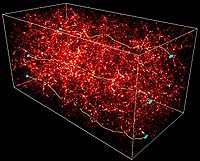
The idea of dark matter was born at Caltech in 1933.
The idea of dark matter was born at Caltech in 1933. |
We have since learned that everything we see is awash in another kind of matter, a "dark" matter, made of particles yet to be discovered. Dark matter is all around us, but we cannot see it. Some estimate that a billion dark matter particles whiz through your body every second, but you cannot feel them.
We now believe that the universe contains five times more dark matter than ordinary matter. While we all may be made of star stuff, we find that the universe is mostly made of something very different.
Why do we believe that dark matter exists? How can we study something that we cannot see or even feel? And how can we unravel the universe's greatest mystery - what is this dark matter?
The idea of dark matter was born at Caltech in 1933. (Just three years later, JPL would be born there as the "rocket boys" began their first launch experiments.) In observations of a nearby cluster of galaxies named the Coma cluster, Fritz Zwicky calculated that the collective mass of the galaxies was not nearly enough to hold them together in their orbits.
He postulated that some other form of matter was present but undetected to account for this "missing mass." Later, in the 1970's and '80's, Vera Rubin similarly found that the arms of spiral galaxies should fly off their cores as they are orbiting much too quickly.
Today dark matter is a widely accepted theory, which explains many of our observations. My colleagues and I at JPL are among those working to reveal and map out dark matter structures. Dark matter is invisible. But astronomers can "see" it in a way and you can too, if you know what to look for! For instance, if you have a wineglass on a table and you look through the glass, the images behind it are distorted.
So too when we look through a dense clump of dark matter, we see distorted and even multiple images of galaxies more distant.
Matter bends space according to Einstein's Theory of General Relativity, and light follows these bends to produce the distorted images. By studying these "lensed" images, we can reconstruct the shape of the lens, or in our case, the amount and distribution of dark matter in our gravitational lens.
Our observations of dark matter in outer space force particle physicists to revise their theories to explain what we see.
Hopefully through their efforts, physicists will soon produce dark matter in the lab, catch and identify a small fraction of that which passes through us, and ultimately explain the relationship between dark matter and "star stuff."
Share This Article With Planet Earth
 del.icio.us del.icio.us |
 Digg Digg |
 Reddit Reddit |
 YahooMyWeb YahooMyWeb |
 Google Google |
 Facebook Facebook |
 Astronomers From Princeton And Japan Unite To Explore The Universe, Near And Far
 Princeton NJ (SPX) Jan 19, 2009
| The content herein, unless otherwise known to be public domain, are Copyright 1995-2007 - SpaceDaily.AFP and UPI Wire Stories are copyright Agence France-Presse and United Press International. ESA Portal Reports are copyright European Space Agency. All NASA sourced material is public domain. Additional copyrights may apply in whole or part to other bona fide parties. Advertising does not imply endorsement,agreement or approval of any opinions, statements or information provided by SpaceDaily on any Web page published or hosted by SpaceDaily. Privacy Statement |