
. Military Space News .
Hubble Captures Stars Going Out In Style

-
by Donna Weaver And Ray Villard
Washington DC (SPX) Sep 13, 2007
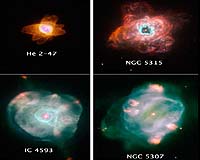
The colorful, intricate shapes in these NASA Hubble Space Telescope images reveal how the glowing gas ejected by dying Sun-like stars evolves dramatically over time. These gaseous clouds, called planetary nebulae, are created when stars in the last stages of life cast off their outer layers of material into space. Ultraviolet light from the remnant star makes the material glow. Planetary nebulae last for only 10,000 years, a fleeting episode in the 10-billion-year lifespan of Sun-like stars.

The name planetary nebula has nothing to do with planets. They got their name because their round shapes resembled planets when seen through the small telescopes of the eighteenth century.

The Hubble images show the evolution of planetary nebulae, revealing how they expand in size and change temperature over time. A young planetary nebula, such as He 2-47, at top, left, for example, is small and is dominated by relatively cool, glowing nitrogen gas. In the Hubble images, the red, green, and blue colors represent light emitted by nitrogen, hydrogen, and oxygen, respectively.

Over thousands of years, the clouds of gas expand away and the nebulae become larger. Energetic ultraviolet light from the star penetrates more deeply into the gas, causing the hydrogen and oxygen to glow more prominently, as seen near the center of NGC 5315. In the older nebulae, such as IC 4593, at bottom, left, and NGC 5307, at bottom, right, hydrogen and oxygen appear more extended in these areas, and red knots of nitrogen are still visible.

These four nebulae all lie in our Milky Way Galaxy. Their distances from Earth are all roughly the same, about 7,000 light-years. The snapshots were taken with Hubble's Wide Field Planetary Camera 2 in February 2007. Like snowflakes, planetary nebulae show a wide variety of shapes, indicative of the complex processes that occur at the end of stellar life.

He 2-47, at top, left, is dubbed the "starfish" because of its shape. The six lobes of gas and dust, which resemble the legs of a starfish, suggest that He 2-47 puffed off material at least three times in three different directions. Each time, the star fired off a narrow pair of opposite jets of gas. He 2-47 is in the southern constellation Carina.

NGC 5315, the chaotic-looking nebula at top, right, reveals an x-shaped structure. This shape suggests that the star ejected material in two different outbursts in two distinct directions. Each outburst unleashed a pair of diametrically opposed outflows. NGC 5315 lies in the southern constellation Circinus. IC 4593, at bottom, left, is in the northern constellation Hercules.

NGC 5307, at bottom, right, displays a spiral pattern, which may have been caused by the dying star wobbling as it expelled jets of gas in different directions. NGC 5307 resides in the southern constellation Centaurus.

Community
Email This Article
Comment On This Article

Related Links
Hubble
Stellar Chemistry, The Universe And All Within It


Memory Foam Mattress Review
Newsletters :: SpaceDaily :: SpaceWar :: TerraDaily :: Energy Daily
XML Feeds :: Space News :: Earth News :: War News :: Solar Energy News


Hubble And Spitzer Space Telescopes Find Lego-Block Galaxies In Early Universe
Pasadena CA (SPX) Sep 07, 2007
NASA's Hubble and Spitzer Space Telescopes have joined forces to discover nine of the smallest, faintest, most compact galaxies ever observed in the distant universe. Blazing with the brilliance of millions of stars, each of the newly discovered galaxies is a hundred to a thousand times smaller than our Milky Way Galaxy. "These are among the lowest mass galaxies ever directly observed in the early universe" says Nor Pirzkal of the Space Telescope Science Institute in Baltimore, Md.


  • Outside View: Life after START
  • Analysis: Strategic strike capability
  • Putin sends legislation on key arms control treaty to parliament
  • Russia draws 'red line' on Kosovo, US missile defence

  • Israel believes N. Korea selling nuke material to Syria: report
  • Iran warns against 'political interference' in UN inspections
  • Iran 'doesn't need nuclear weapons': president
  • Analysis: Iran moves to ditch U.S. dollar

  • Russia to deploy Iskander missiles in three years: official
  • B-52 carried nuclear armed cruise missiles by mistake: US
  • Bulava Missile Not Ready For Mass Production
  • US to look into North Korea's missile threat

  • Outside View: Upgrading Gabala
  • Lockheed Martin Achieves Key Integration Milestone On First-Of-Its-Kind Missile Warning Satellite
  • Putin 'optimistic' accord possible with US on missile defence
  • Putin, Bush fail to break missile defence tension

  • NCAR Teams With United Airlines To Pinpoint Turbulence In Clouds: Research Can Help Reduce Delays, Injuries, Costs
  • KC-30 Tanker's General Electric Power Plant Completes One Million Takeoff And Landing Cycles
  • Skyray 48 Takes Flight
  • Asia's largest airshow to ride on China's wings

  • QinetiQ's Zephyr UAV Exceeds Official World Record For Longest Duration Unmanned Flight
  • Thompson Files: Air Force drones are best
  • New LITENING Targeting System Demonstrated During USJFC's Bold Quest Exercise
  • Airmen Work To Keep Aircraft Cool

  • Interview: Governor of Kirkuk province
  • Bush to announce plans for Iraq troop levels
  • US to build military base on Iraq-Iran border
  • Proposed troop cuts would end US surge in Iraq by mid-2008

  • Corect Guidance Module Successfully Tested
  • Raytheon Delivers Active Denial System 2 To USAF
  • Russian army touts new bomb on television
  • Louisiana Tech Researchers Investigate Tracking And Sensors To Assist USAF

  • The content herein, unless otherwise known to be public domain, are Copyright 1995-2006 - SpaceDaily.AFP and UPI Wire Stories are copyright Agence France-Presse and United Press International. ESA PortalReports are copyright European Space Agency. All NASA sourced material is public domain. Additionalcopyrights may apply in whole or part to other bona fide parties. Advertising does not imply endorsement,agreement or approval of any opinions, statements or information provided by SpaceDaily on any Web page published or hosted by SpaceDaily. Privacy Statement