
The polarization of gamma-ray photons encodes information about the environment in which they were produced, and as such is an important element in the theoretical understanding of the physics of gamma-ray sources.
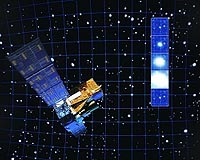
In an article to appear in the Astrophysical Journal Letters, Diego Gotz and colleagues from CEA/SAp Saclay, APC and IAP Paris report the detection of modulated polarization from the strongest Gamma-Ray Burst (GRB) detected by INTEGRAL to date.
This is another important piece of evidence contributed by INTEGRAL to the understanding of the mechanisms at work in GRBs.
GRBs are sudden, short (from ms to several hundred seconds), non repeating spurts of high-energy (from a few ten to several hundred keV) photons. Their existence has been known since the late 1960's, but it was only with the launch of Compton Gamma Ray Observatory (1991) that a systematic study of GRBs began.
Although INTEGRAL has not been optimized for the detection of GRBs, many GRBs have gone off serendipitously inside the field of view of its instruments.
When this happens, INTEGRAL's high sensitivity and unprecedented spatial resolution at these energies make the data it collects very valuable: the closer the GRB is to the centre of the field of view, the richer the temporal and spectral information INTEGRAL can reveal.
On 19 December 2004, a GRB was detected very close (~3deg) to the centre of the field of view of the IBIS instrument, well within the region of its maximum sensitivity. Although IBIS is an imaging instrument, the two detectors, PICsIT (composed of scintillator material) and ISGRI (made of semiconductor crystals), can also be used as a Compton polarimeter if the brightness of the source being observed is high enough.
GRB041219A, as the event was named, turns out to be the brightest GRB detected by INTEGRAL to date. Because of this the authors have been able to perform a time-resolved analysis of the polarization of the signal.
This is an important feature of this analysis, because on most occasions the fluxes are not strong enough and the signal must be integrated over the entire duration of the GRB, and if the polarization of the signal changes with time, the modulation of the signal is smeared out, and eventually it falls below the threshold of detectability.
By slicing the data in 10s segments Gotz and colleagues were able to show that over a period of a couple of minutes the polarization of the signal went from 20% to 90%. Additionally, they were able to determine that the phase of the polarization changed with time.
This makes it plausible to assume that other GRBs will also be polarized, but that this signature is lost because the signal is too weak to be analyzed as a function of time.
A number of theoretical models exist to explain the emission from GRBs. Most of them ascribe the gamma rays to the synchrotron emission of relativistic electrons under various environments.
The observation of polarization, and its variability, put strong constraints on the theoretical models because an environment must be envisioned where the large amount of energy available is transferred to the electrons in an efficient and orderly fashion, able to preserve in the polarization signature the structure of the underlying magnetic field.
Although the INTEGRAL result is statistically strong, it is still not strong enough to clearly rule out particular classes of models.
Gotz and colleagues argue however that the evidence they present does favour models where the synchrotron emission originates from a relativistic outflow with a magnetic field that is coherent over the visible emission region.
The detection of a modulated polarized signal from a GRB underlines once more the significant contribution INTEGRAL is making to the phenomenological characterization and the theoretical understanding of the sources of gamma rays in the Universe.
Another step in the understanding of the inner engine of gamma-ray bursts has been taken: the quest for a complete understanding continues.
Share This Article With Planet Earth
