
The origin of the microscopic meteorites that make up cosmic dust has been revealed for the first time in new research. The research, published in the journal Geology, shows that some of the cosmic dust falling to Earth comes from an ancient asteroid belt between Jupiter and Mars.
This research improves our knowledge of the solar system, and could provide a new and inexpensive method for understanding space.
Cosmic dust particles, originally from asteroids and comets, are minute pieces of pulverised rock. They measure up to a tenth of a millimetre in size and shroud the solar system in a thin cloud.
Studying them is important because their mineral content records the conditions under which asteroids and comets were formed over four and a half billion years ago and provides an insight into the earliest history of our solar system.
The study's author, Dr Mathew Genge, from Imperial College London's Department of Earth Science and Engineering, has trekked across the globe collecting cosmic dust. He says:
"There are hundreds of billions of extraterrestrial dust particles falling though our skies. This abundant resource is important since these tiny pieces of rock allow us to study distant objects in our solar system without the multi-billion dollar price tag of expensive missions."
The origin of the cosmic dust that lands on Earth has always been unclear. Scientists previously thought that analysing the chemical and mineral content of individual dust particles was the key to tracing their origin. But this study suggests that a comparison of multiple particles gives better results.
To pinpoint the cosmic dust's origin, Dr Genge analysed more than 600 particles, painstakingly cataloguing their chemical and mineral content and reassembling them like a complex jigsaw. Dr Genge comments:
"I've been studying these particles for quite a while and had all the pieces of the puzzle, but had been trying to figure out the particles one by one. It was only when I took a step back and looked at the minerals and properties of hundreds of particles that it was obvious where they came from. It was like turning over the envelope and finding the return address on the back."
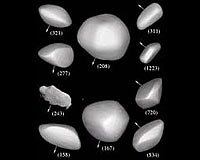
Dr Genge found that the cosmic dust comes from a family of ancient space rocks called Koronis asteroids, which includes 243 Ida, widely photographed by the NASA Galileo probe. The rocks are located in an asteroid belt between Mars and Jupiter and were formed around two billion years ago when a much larger asteroid broke into pieces.
Further analysis shows that the dust originates from a smaller grouping of 20 space rocks within the Koronis family called Karin asteroids. It comes from an ancient chondrite rock, common in Karin asteroids, which was formed in space at the birth of the solar system.
Chondrite meteorites often fall to Earth and Dr Genge was able to match the mineralogy and chemistry of the dust particles with chondrite meteorite samples previously collected. He backed up the cosmic dust's origin with infrared astronomical satellite data which showed Karin asteroids grinding and smashing against one another to create cosmic dust.
Dr Genge says his research holds exciting possibilities for a deeper understanding of our early solar system. He concedes that analysing space dust will never entirely replace space missions, but adds that we may not have to visit so many different places. He concludes:
"This research is the first time we have successfully demonstrated a way to locate the home of these important little particles. The answer to so many important questions, such as why we are here and are we alone in the universe, may well lie inside a cosmic dust particle. Since they are everywhere, even inside our homes, we don't necessarily have to blast off the Earth to find those answers. Perhaps they are already next to you, right here and right now."
