
. Military Space News .
Into The Chrysalis

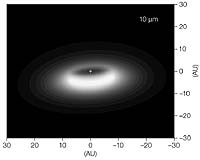
Astronomers have used ESO's Very Large Telescope Interferometer and its razor sharp eyes to discover a reservoir of dust trapped into a disc that surrounds an elderly star. Here, model images of the disc of dust around the aged star, V390 Velorum, as inferred from observations taken with ESO's powerful interferometric instruments, Astronomical Multi-BEam combineR (AMBER) and MID-infrared Interferometric instrument (MIDI), at the Very Large Telescope Interferometer, are shown at two different wavelengths (2 microns, left panel; 10 microns, right panel). The observations reveal a disc with a much puffed-up inner rim, extending from 9 Astronomical Units to several hundreds of AU. The giant star, whose position is indicated by the cross in the images, is 5000 times as bright as our Sun and is located 2,600 light-years away from Earth. The brightest region is the inner wall on the far side.
by Staff Writers
Paris, France (ESA) Oct 02, 2007
A team of European astronomers has used ESO's Very Large Telescope Interferometer and its razor-sharp eyes to discover a reservoir of dust trapped in a disc that surrounds an elderly star. The discovery provides additional clues about the shaping of planetary nebulae. In the last phases of their life, stars such as our Sun evolve from a red giant which would engulf the orbit of Mars to a white dwarf, an object that is barely larger than the Earth.

The transition is accomplished by the shedding of a huge envelope of gas and dust that sparkles in many colours, producing a most spectacular object: a planetary nebula. The celestial chrysalis becomes a cosmic butterfly.

This metamorphosis, rapid in terms of the star's lifetime, is rather complex and poorly understood. In particular, astronomers want to understand how a spherical star can produce a great variety of planetary nebulae, some with very asymmetrical shapes.

A team of scientists therefore embarked upon the study of a star which is presently on its way to becoming a cosmic butterfly. The star, V390 Velorum, is 5000 times as bright as our Sun and is located 2,600 light-years away. It is also known to have a companion that accomplishes its ballet in 500 days.

Astronomers postulate that elderly stars with companions possess a reservoir of dust that is thought to play a lead role in the final chapters of their lives. The shape and structure of these reservoirs remain, however, largely unknown.

To scrutinise the object with great precision, the astronomers linked observations taken with ESO's powerful interferometric instruments, AMBER and MIDI, at the Very Large Telescope Interferometer. In particular, they combined, using AMBER, the near-infrared light of three of VLT's 8.2-m Unit Telescopes. "Only this triple combination of powerful telescopes allows us to pinpoint the position and the shape of the dusty reservoir on a milli-arcsecond scale," explains Pieter Deroo, lead-author of the paper that presents these results in the research journal Astronomy and Astrophysics.

These observations clearly demonstrate that the dust present around the star cannot be distributed in a spherical shell. "This shows that whatever mechanism is shaping asymmetric planetary nebulae is already present prior to the metamorphosis taking place," says Hans Van Winckel, member of the team.

The astronomers found indeed evidence for a disc extending from 9 Astronomical Units to several hundreds of AU. "This disc is found around a star that is in a very brief phase of its life - just a blink of an eye over the star's lifespan of billions of years - but this phase is very important," says Deroo. "It is in this period that a huge morphological change occurs, leading to the creation of a planetary nebula," he adds.

The very high spatial resolution measurements allowed the astronomers to decouple the unresolved contribution of the central star from the resolved disc emission. Even the very inner structure of the disc as well as its orientation and inclination could be determined. The observations probe the physical nature of the disc and reveal that the dust in the inner rim is extremely hot and puffed up. The disc is circumbinary as it surrounds both stars.

Dust processing (coagulation, crystallisation) is found to be very efficient in this circumbinary disc, despite the rather short evolutionary timescales involved. The disc around this evolved object is very similar to those around young stellar objects, in which planets are formed.

"The combination of MIDI and AMBER on ESO's VLTI is an extremely powerful and perhaps unique tool to study the geometry of the material around stars," concludes Van Winckel.

Community
Email This Article
Comment On This Article

Related Links
ESO
Stellar Chemistry, The Universe And All Within It


Memory Foam Mattress Review
Newsletters :: SpaceDaily :: SpaceWar :: TerraDaily :: Energy Daily
XML Feeds :: Space News :: Earth News :: War News :: Solar Energy News


A New Reduction Of The Hipparcos Catalogues
Paris, France (ESA) Oct 02, 2007
ESA's Hipparcos mission provided astrometric data on thousands of stars. Thanks to advances in computational processing power it has been possible to revisit the original data and improve the accuracy of the derived catalogue. The accuracy of a data set, such as the Hipparcos astrometric data, is generally determined by two contributions: intrinsic, random, noise and modelling noise. The latter represents contributions from inaccuracies in the models used to calibrate and reduce the data.


  • Climate poker: Who's bidding what
  • Analysis: Berlin and Paris move apart
  • Military links between Australia, Japan, US worry Russia: official
  • Outside View: Life after START

  • Outside View: Iran nuke questions
  • Bush wants diplomatic end to 'Iran problem'
  • US Weighs Strikes Against Iran As Iraq Fears New Conflict
  • Nuclear envoys reach 'comprehensive' NKorea deal: US

  • China Wants To Target US Aircraft Carriers With Ballastic Missiles
  • Iran shows off new missile, taunts Israel
  • Russia to deploy Iskander missiles in three years: official
  • B-52 carried nuclear armed cruise missiles by mistake: US

  • Bringing Optimistic Realism To Missile Defense Part Two
  • Boeing-led Missile Defense Team Tout Successful Missile Defense Intercept Test
  • US interceptors in Europe fast enough to hit Russian ICBMs: researcher
  • US missile defense system scores intercept in test

  • New Delft Material Concept For Aircraft Wings Could Save Billions
  • Aircraft And Automobiles Thrive In Hurricane-Force Winds At Lockheed Martin
  • Cathay Pacific chief hits out at anti-aviation critics
  • Boeing Projects 340 Billion Dollar Market For New Airplanes In China

  • Boeing Completes Eight-Hour Flight of A160T Hummingbird
  • Boeing-Insitu ScanEagle UAV Logs 5,000 Flight Hours In Support Of Australian Army Operations
  • Lockheed Martin Awarded B-1B Sniper Pod Contract
  • Northrop Grumman Completes Demonstrations Of Broad Area Maritime Surveillance Program System Level Performance

  • Military Matters: The 'seam' in Anbar
  • A pragamatic admiral takes the helm as the US military's top officer
  • Iraqi civilian deaths part of war on terror: US military
  • Pentagon Wants Another 190 Billion For Wars In Iraq And Afghanistan

  • Raytheon Milestone Keeps Dual Band Radar On Track
  • Lockheed Martin Completes Proof Testing Of RATTLRS Vehicle
  • Israel Air Force to Be Equipped With Elbit Systems Lizard Laser-Guided Bombs
  • Analysis: A NICE foray into anti-terror

  • The content herein, unless otherwise known to be public domain, are Copyright 1995-2006 - SpaceDaily.AFP and UPI Wire Stories are copyright Agence France-Presse and United Press International. ESA PortalReports are copyright European Space Agency. All NASA sourced material is public domain. Additionalcopyrights may apply in whole or part to other bona fide parties. Advertising does not imply endorsement,agreement or approval of any opinions, statements or information provided by SpaceDaily on any Web page published or hosted by SpaceDaily. Privacy Statement