
Subscribe free to our newsletters via your
. Military Space News .


INTERN DAILY
Intracellular microlasers could label a trillion individual cells
by Staff Writers
Boston MA (SPX) Jul 30, 2015


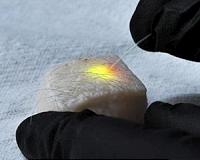
Massachusetts General Hospital investigators have induced subcutaneous fat cells in a piece of skin from a pig to emit laser light in response to energy delivered through an optical fiber. Image courtesy Matja Humar, Ph.D., and Seok Hyun Yun, Ph.D., Wellman Center for Photomedicine, Massachusetts General Hospital. For a larger version of this image please go here.

Massachusetts General Hospital (MGH) investigators have induced structures incorporated within individual cells to produce laser light. The wavelengths of light emitted by these intracellular microlasers differ based on factors such as the size, shape and composition of each microlaser, allowing precise labeling of individual cells. The researchers' report has received Advance Online Publication in Nature Photonics.

"The fluorescent dyes currently used for research and for medical diagnosis are limited because they emit a very broad spectrum of light," explains Seok Hyun Yun, PhD, of the Wellman Center for Photomedicine at MGH, corresponding author of the report. "As a result, only a handful of dyes can be used at a time, since their spectral signatures would overlap."

Lead author Matja Humar, PhD, also of the Wellman Center, adds, "The narrow-band spectrum of light emitted by these intracellular lasers would allow us to label thousands - in principal up to a trillion - of cells individually, and the very specific wavelengths emitted by these microlasers also would allow us to measure small changes happening within a cell with much greater sensitivity than is possible with broadband fluorescence."

Previous studies by Yun's lab demonstrated the first laser based on a living cell, which used fluorescent proteins as the gain medium to amplify the light signal. But this first-generation cellular laser required a laser cavity consisting of a pair of mirrors placed outside the cell to generate laser light.

For the current study, Yun and Humar used tiny spherical objects capable of confining light by reflection from their inner surfaces as microcavities for the amplification of laser light within the cavity.

The first versions used droplets of oil - either injected into individual cells or naturally occurring within the fat cells called adipocytes - and showed that either could be induced to emit specific wavelengths of laser light by pumping energy from an external laser into fluorescent dyes diffused into the droplet, a process that produced minimal heating of the cells.

Changes in the shape of the droplet induced by miniscule pressure alterations within the cell altered the spectra of light emitted, and those alterations could be readily measured. Along with showing lasing with a variety of cells - such as cancer cells, fibroblasts, macrophages and adipocytes extracted from the skin of pigs - the researchers also induced adipocytes residing within a piece of porcine skin to emit clearly visible laser light.

Production of laser light within solid plastic fluorescent microbeads, which are readily taken up into cells, resulted in unique signature spectra based on the size and number of beads within a cell and the fluorescent dye used. The investigators calculated that it would be possible to tag individual cells with more than a trillion different laser signatures, a number that matches the estimated number of cells in the human body.

"One immediate application of these intracellular lasers could be basic studies, such as understanding how cells move and respond to external forces," says Yun, an associate professor of Dermatology at Harvard Medical School.

"Another challenging step will be figuring out how to use biologically generated energy from mechanical movement or a biochemical reaction to pump a cellular laser in a living body. Cells are smart machines, and we are interested in exploiting their amazing capabilities by developing smart-cell lasers that might be able to find diseases and fire light at them on their own. We can envision lasers completely made out of materials that are safe for use within the human body, which could enable remote sensing within the body or be used in laser-light therapies."


Thanks for being here;
We need your help. The Space Media Network continues to grow but revenues have never been harder to maintain.

With the rise of Ad Blockers, and Facebook - our traditional revenue sources via quality network advertising continues to decline. And unlike so many other news sites, we don't have a paywall - with those annoying usernames and passwords.

Our news coverage takes time and effort to publish 365 days a year.

If you find our news sites informative and useful then please consider becoming a regular supporter or for now make a one off contribution.
SpaceMediaNetwork Contributor
$5 Billed Once


credit card or paypal
SpaceMediaNetwork Monthly Supporter
$5 Billed Monthly


paypal only


.


Related Links
Massachusetts General Hospital
Hospital and Medical News at InternDaily.com


Comment on this article via your Facebook, Yahoo, AOL, Hotmail login.

Share this article via these popular social media networks
del.icio.usdel.icio.us DiggDigg RedditReddit GoogleGoogle


INTERN DAILY
Researchers design first artificial ribosome
Chicago IL (SPX) Jul 30, 2015
Researchers at the University of Illinois at Chicago and Northwestern University have engineered a tethered ribosome that works nearly as well as the authentic cellular component, or organelle, that produces all the proteins and enzymes within the cell. The engineered ribosome may enable the production of new drugs and next-generation biomaterials and lead to a better understanding of how riboso ... read more


INTERN DAILY
$1.5B contract goes to Lockheed Martin for Patriot interceptors

Russia Will Knock Out US Missile Shield Installations If Attacked

US Awards Contract to Develop Missile Defense Command System

US Authorizes 'Forward-Based' Missile Defense System for Allies

INTERN DAILY
State Dept. OKs TOW missile sale to Lebanon

More Hydra-70 rockets on way for U.S. military, allies

Iran says UN resolution not linked to ballistic missiles

Israel jails Palestinian engineer over Hamas rocket design

INTERN DAILY
Amazon wants air space for delivery drones

Drones may soon carry blood samples to the lab

Patrick Stewart endorses Snotbot whale research drone

The Friendly Unmanned Skies

INTERN DAILY
Harris replacing satellite communications terminals

Lockheed Martin set to advance RF sensors development

Navy engineer invents new data transmission system

Fourth MUOS arrives in Florida for August launch

INTERN DAILY
Navy researches use of transparent material as armor

Shoot-from-the-hip, around corner sighting capability unveiled

Cost of USAF decoy systems reduced

Women push for equality in Latin America military ranks

INTERN DAILY
French defence minister visits Cairo after warplane deal

Britain extends Lockheed Martin military inventory contract

India clears $4.74 billion defence purchase

US military to consider transgender troops

INTERN DAILY
Olympics: China sees justice in 'historic' Olympics award

NATO eastward expansion would be 'catastrophic': Russian official

Trump the Donald and other musings

Russia revises navy doctrine over NATO's 'inadmissible' expansion

INTERN DAILY
Breakthrough in knowledge of how nanoparticles grow

On the way to breaking the terahertz barrier for graphene nanoelectronics

A most singular nano-imaging technique

Plantations of nanorods on carpets of graphene capture the Sun's energy


The content herein, unless otherwise known to be public domain, are Copyright 1995-2014 - Space Media Network. All websites are published in Australia and are solely subject to Australian law and governed by Fair Use principals for news reporting and research purposes. AFP, UPI and IANS news wire stories are copyright Agence France-Presse, United Press International and Indo-Asia News Service. ESA news reports are copyright European Space Agency. All NASA sourced material is public domain. Additional copyrights may apply in whole or part to other bona fide parties. Advertising does not imply endorsement, agreement or approval of any opinions, statements or information provided by Space Media Network on any Web page published or hosted by Space Media Network. Privacy Statement All images and articles appearing on Space Media Network have been edited or digitally altered in some way. Any requests to remove copyright material will be acted upon in a timely and appropriate manner. Any attempt to extort money from Space Media Network will be ignored and reported to Australian Law Enforcement Agencies as a potential case of financial fraud involving the use of a telephonic carriage device or postal service.