
. Military Space News .
SPACE MEDICINE
Investigation on Space Station to test minimizing pressure of space travel
by Mike Giannone for GRC News
Cleveland OH (SPX) Apr 20, 2017


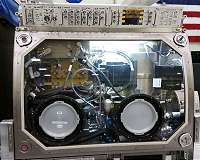
ZBOT in the Microgravity Science Glovebox Engineering Unit Work Volume at NASA's Marshall Space Flight Center in Huntsville, Alabama. Image courtesy NASA. For a larger version of this image please go here.

Spacecraft rely on liquids for everything from fuel to life support systems for astronauts. Storing these liquids at the correct temperature and pressure is essential to prevent loss of fluids or failure of a storage tank. Human life in space is a balancing act of reliable systems and meticulous planning.

Rocket fuel and other liquids used in space are stored at cryogenic temperatures of -423 to -243 degrees F. As these liquid cryogens are warmed by the environment, they evaporate, which increases pressures inside storage tanks.

NASA Glenn Research Center's Zero Boil-Off Tank (ZBOT) experiment on the International Space Station will study ways to relieve that pressure without the loss of fluid. ZBOT launched aboard Orbital ATK's Cygnus spacecraft on its seventh contracted resupply mission for NASA from Cape Canaveral Air Force Station in Florida Tuesday, April 18. Operation of the experiment could occur as early as this summer.

In the presence of gravity, like on Earth, liquid moves heat around by a process known as natural convection. However, the lack of gravity makes the problem more complex.

"In microgravity there is almost no natural convection," said ZBOT project manager William Sheredy. "Warm liquid doesn't distribute its heat as well. As a result, cryogenic tanks experience building pressure, a situation we have to manage."

ZBOT's small-scale, microgravity tests on the space station will use a volatile fluid that boils at 86 degrees F, to simulate a cryogen, and study ways to mitigate pressure in storage tanks. Results from the investigation will help improve tank design for long-term cryogenic liquid storage and pressure control.

According to Sheredy, there are different ways to cool cryogenic tanks and relieve pressure in space. You could actively cool the fluids by running them through a cooling system, like a car's cooling system with its hoses, pumps, fans and radiator. However, the hardware is heavy to launch.

Another way to relieve pressure and cool the tanks is to vent the vapor by opening a valve, like carefully turning the cap on a car's radiator to release the steam. However, venting like this means losing some of the fluid. On space missions, cryogenic fluids are critical and not easily replaced.

ZBOT will explore techniques where there is no boil-off. In doing so, data gathered from the experiment will verify and validate models for fluid tank pressurization. These models can be used to design future, larger storage tanks of cryogenic fluids. This research ultimately reduces the risk and costs of future space expeditions.

On-orbit, the space station crew will install ZBOT hardware and set up the tests. After that, the experimental runs are remotely controlled from Earth by NASA Glenn's ISS Payload Operations Center in Cleveland. Test results are downlinked for analysis and planning of future tests.

SPACE MEDICINE
Life on Earth is used to gravity - so what happens to our cells and tissues in space?
Los Angeles CA (SPX) Apr 18, 2017
There's one force whose effects are so deeply entrenched in our everyday lives that we probably don't think much about it at all: gravity. Gravity is the force that causes attraction between masses. It's why when you drop a pen, it falls to the ground. But because gravitational force is proportional to the mass of the object, only large objects like planets create tangible attractions. Thi ... read more

Related Links
ISS Payload Operations Center i
Space Medicine Technology and Systems


Thanks for being here;
We need your help. The Space Media Network continues to grow but revenues have never been harder to maintain.

With the rise of Ad Blockers, and Facebook - our traditional revenue sources via quality network advertising continues to decline. And unlike so many other news sites, we don't have a paywall - with those annoying usernames and passwords.

Our news coverage takes time and effort to publish 365 days a year.

If you find our news sites informative and useful then please consider becoming a regular supporter or for now make a one off contribution.
SpaceMediaNetwork Contributor
$5 Billed Once


credit card or paypal
SpaceMediaNetwork Monthly Supporter
$5 Billed Monthly


paypal only


Comment using your Disqus, Facebook, Google or Twitter login.

Share this article via these popular social media networks
del.icio.usdel.icio.us DiggDigg RedditReddit GoogleGoogle

SPACE MEDICINE
US, South Korea agree early deployment of THAAD: PM Hwang

South Korean missile interceptor in final development

BAE Systems to develop U.S. space, missile defense tech

Raytheon to upgrade U.S. ballistic missile defense radars

SPACE MEDICINE
Lockheed Martin gets $100M JASSM production order

Saab gets RBS15 MK3 maintenance order from Polish navy

MBDA Systems gets $689M in U.K. missile contracts

U.S. Navy taps Raytheon for Standard Missile engineering

SPACE MEDICINE
MQ-8C Fire Scout takes first flight from littoral combat ship

MS-177 sensor completes test on Global Hawk

Swiss prisons getting drone-detection capability

Radar warning receiver flies for first time in Predator drone

SPACE MEDICINE
Thales supplying Denmark with communications system

US Strategic Command, Norway sign agreement to share space services, data

Pentagon urges Russia not to hang up military hotline

AF announces major changes to space enterprise

SPACE MEDICINE
Field trials underway for Russia's next-generation battle tank

Australia receives new Hercules armored recovery vehicles

Leidos to provide TUAS support for U.S. Army

Canadian army to modernize training simulation system

SPACE MEDICINE
Dutch court jails Charles Taylor arms-supplier for 19 years

Canada moves to join treaty curbing foreign arms sales

India inks weapons deal worth nearly $2 bn with Israel

U.S. lawmakers push for Pentagon reforms

SPACE MEDICINE
EU hopeful UK vote will smooth Brexit path

Swedish government increases defense spending

Pentagon chief pledges support for Egypt's Sisi

Philippine defence chief visits disputed Spratly island

SPACE MEDICINE
Nanoparticles remain unpredictable

Better living through pressure: Functional nanomaterials made easy

Nanotubes that build themselves

Self-assembling polymers provide thin nanowire template


The content herein, unless otherwise known to be public domain, are Copyright 1995-2024 - Space Media Network. All websites are published in Australia and are solely subject to Australian law and governed by Fair Use principals for news reporting and research purposes. AFP, UPI and IANS news wire stories are copyright Agence France-Presse, United Press International and Indo-Asia News Service. ESA news reports are copyright European Space Agency. All NASA sourced material is public domain. Additional copyrights may apply in whole or part to other bona fide parties. All articles labeled "by Staff Writers" include reports supplied to Space Media Network by industry news wires, PR agencies, corporate press officers and the like. Such articles are individually curated and edited by Space Media Network staff on the basis of the report's information value to our industry and professional readership. Advertising does not imply endorsement, agreement or approval of any opinions, statements or information provided by Space Media Network on any Web page published or hosted by Space Media Network. General Data Protection Regulation (GDPR) Statement Our advertisers use various cookies and the like to deliver the best ad banner available at one time. All network advertising suppliers have GDPR policies (Legitimate Interest) that conform with EU regulations for data collection. By using our websites you consent to cookie based advertising. If you do not agree with this then you must stop using the websites from May 25, 2018. Privacy Statement. Additional information can be found here at About Us.