
Subscribe free to our newsletters via your
. Military Space News .


NUKEWARS
Iran nuclear deal vindicates Rouhani's diplomatic push
by Staff Writers
Tehran (AFP) Nov 25, 2013


Israel PM sends security advisor to US for Iran talks
Jerusalem (AFP) Nov 25, 2013 - Israeli Prime Minister Benjamin Netanyahu said Monday he will send his national security advisor to Washington for talks on a pending agreement with Iran on its nuclear programme.

"I spoke yesterday with President (Barack) Obama and we agreed that in the coming days an Israeli team led by National Security Advisor Yossi Cohen would leave for talks with the United States on the final deal with Iran," Netanyahu said in an address to the Israeli parliament.

"That agreement must have a sole result: the dismantling of Iran's military nuclear capability," his office quoted him as telling the Knesset.

"I remind you that only last week, during the (Geneva) talks, the leaders of Iran repeated their commitment to destroy the state of Israel, and I reiterate here today my commitment, as prime minister of Israel, to prevent them from achieving the ability to do so."

Iran's supreme leader, Ayatollah Ali Khamenei, told militia commanders in Tehran last Wednesday that Israel was "doomed to collapse", calling it "the rabid dog" of the Middle East.

The Islamic republic agreed to curb its nuclear programme for the next six months in exchange for limited sanctions relief following marathon talks with the five permanent members of the UN Security Council plus Germany in Geneva that ended Sunday.

But Israel, Iran's arch-foe, slammed the deal as an "historic mistake," having urged for months that sanctions pressure be maintained.

"I would have been happy to join the voices around the world praising the Geneva agreement," said Netanyahu.

"It is true that the international pressure we applied has born partial fruit and has brought better results than were originally planned, but it's still a bad agreement," he said.

"It reduces the pressure on Iran without receiving anything tangible in return and the Iranians, who laughed all the way to the bank, are themselves saying that this deal has saved them."

Netanyahu has said that in order to get sanctions relief Iran would have to halt uranium enrichment, dismantle centrifuges, have enriched uranium material sent abroad and stop work on its Arak heavy water reactor.

Israel and the West suspect the nuclear programme is aimed at developing a weapons capability but Tehran insists is entirely peaceful.

Israel, the Middle East's sole if undeclared nuclear-armed state, has refused to rule out military action to halt Iran's nuclear drive.

Washington has also insisted it will strike if necessary to prevent Tehran from developing a nuclear weapon.

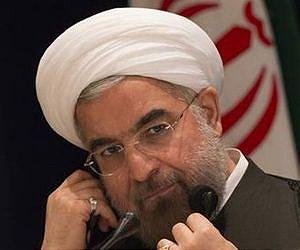
Iranian President Hassan Rouhani's cabinet marked its 100th day Monday, riding the success of a landmark nuclear deal that has for now vindicated his push to engage with the West.

Backed by supreme leader Ayatollah Ali Khamenei, Rouhani embraced the agreement as a victory that has forced the world to recognise Iran's nuclear "rights" and chipped away at international sanctions.

"The sanctions regime will begin to shatter with the (implementation) of this agreement," Rouhani said of the six-month deal that aims to buy time for clinching a comprehensive accord.

Under the deal, Iran agreed to limit uranium enrichment and curb expansion of its nuclear drive in exchange for relief from punitive sanctions and the release of some of its frozen assets.

The deal marks a major, early achievement for Rouhani, who won a first-round electoral victory over a pool of conservatives this year by vowing a more diplomatic approach to the West after eight years of stalled talks and escalating sanctions under his hardline predecessor, Mahmoud Ahmadinejad.

Afshon Ostovar, an analyst at the US-based CNA research centre, attributes Rouhani's success to the realistic expectations of his negotiators and the support of Khamenei.

Rouhani and Foreign Minister Mohammad Javad Zarif, who took part in the Geneva talks, "knew what could be achieved in negotiations with the West and what could not," he said.

Breaking taboos, mending ties

The nuclear deal came against the backdrop of a sharp turn by Rouhani away from the hostility that has often marked Iran's relations with the West since the 1979 Islamic revolution.

In New York for the UN General Assembly in September, Rouhani condemned the Holocaust as "reprehensible" after Ahmadinejad had long dismissed it as a "myth".

He also broke a taboo by holding a direct telephone conversation with US President Barack Obama -- the first time leaders of the two countries had spoken since 1979.

The face-to-face meeting between Zarif and US Secretary of State John Kerry in New York was also remarkable, and yet in the two months since then the diplomats have spent hours together.

On Sunday, a US official said envoys had held "some limited bilateral discussions" since September in addition to the nuclear talks with the P5+1, which also includes Britain, China, France and Russia plus Germany.

The increased contacts have raised the possibility of a wider rapprochement between Washington and Tehran, fuelling concerns among Iran's hardliners and in Israel and Saudi Arabia, US allies who still view Iran as a regional menace.

Israel and Western nations have long accused Iran of seeking a nuclear weapons capability, charges denied by Tehran, which insists its uranium enrichment programme is for purely peaceful purposes.

Analyst Mustafa Alani, of the Geneva-based Gulf Research Center, said Arab monarchies were aware of back-channel negotiations between Washington and Tehran and "were not content".

Khamenei, while backing Rouhani's nuclear negotiators, has raised concerns about the wider diplomatic push, saying at the time that "some of what happened in the New York trip was not appropriate," without elaborating.

The supreme leader has also continued to wage a war of words with Israel, declaring last week the Jewish state was "doomed to collapse".

And it remains to be seen whether Iran's charm offensive will work closer to home.

"Rouhani will probably want to improve relations with Saudi Arabia and other Arab states. Although this is unlikely to happen so long as Tehran and Riyadh continue to be engaged in a proxy war against each other in Syria," Ostovar said.

Iran is a key ally of Syrian President Bashar al-Assad's regime, while Saudi Arabia, most Arab states and the West support the Sunni-led rebels struggling to topple him.

"Syria will be a secondary issue, but it is unlikely that much traction will occur on that front so long as all sides in the conflict remain unwilling (to reach a) serious compromise," said Ostovar, adding the nuclear issue would "remain central until it is solved".

Amnesty International said that with the nuclear deal agreed, Rouhani should now fullfil campaign promises to improve human rights neglected in his first 100 days in office.

"For years, Iran's human rights situation has been overshadowed, both internationally and at home, by discussions about the country's nuclear programme. Now that an agreement has been reached, there must not be any more delays in addressing Iran's dire human rights situation," it said.

.


Related Links
Learn about nuclear weapons doctrine and defense at SpaceWar.com
Learn about missile defense at SpaceWar.com
All about missiles at SpaceWar.com
Learn about the Superpowers of the 21st Century at SpaceWar.com


Comment on this article via your Facebook, Yahoo, AOL, Hotmail login.

Share this article via these popular social media networks
del.icio.usdel.icio.us DiggDigg RedditReddit GoogleGoogle


NUKEWARS
Iran judge condemns American to death for spying
Tehran (AFP) Jan 9, 2012
An Iranian judge sentenced a US-Iranian man to death for spying for the CIA, media reported Monday, exacerbating high tensions in the face of Western sanctions on the Islamic republic's nuclear programme. Amir Mirzai Hekmati, a 28-year-old former Marine born in the United States to an Iranian family, was "sentenced to death for cooperating with a hostile nation, membership of the CIA and try ... read more


NUKEWARS
US has time to boost bid for Turkey missile system: FM

US to keep Patriot missiles in Turkey for another year

Unprecedented Dual Intercept Success for MEADS at White Sands Missile Range

Patriot delivers another flawless performance in Japan test firings

NUKEWARS
Javelin Joint Venture awarded contract for Javelin Weapon System

Russia and Egypt on verge of missile deal: Moscow

Lockheed Martin Conducts Second Successful LRASM Flight Test

Turkey hopes to finalise China missile purchase in six months

NUKEWARS
A new, flying jellyfish-like machine

Thousands rally against US drone strikes in Pakistan

US drone strike kills senior Haqqani leader in Pakistan

Protest against US drone strikes in Pakistan postponed

NUKEWARS
Intelsat General To Provide Satellite Services To US Marines

Manpack Radios in Arctic Connect with MUOS Satellites Orbiting Equator

Self-correcting crystal may unleash the next generation of advanced communications

Northrop Grumman Receives Contract to Sustain Joint STARS Fleet

NUKEWARS
Airbus and Cassidian play key role in Perseus maritime surveillance program

US firm claims first 3D-printed metal gun

Chemical arms treaty meets love-gone-wrong in US high court

Northrop Grumman Demonstrates Micro-Gyro Prototype for DARPA Program

NUKEWARS
EADS chief warns jobs cuts coming in defence unit

India's defense minister wants DRDO investigated

AgustaWestland fights to keep graft-hit Indian chopper deal

Russia 'offers Egypt MiG-29s in $2B arms deal'

NUKEWARS
US backs Japan as China tensions soar on air zone

Turkey mending ties with Shiite powers as regional clout wanes

China creates air defence zone over Japan-controlled islands

US criticizes new China zone, vows to defend Japan

NUKEWARS
Graphene nanoribbons for 'reading' DNA

New hologram technology created with tiny nanoantennas

Nano magnets arise at 2-D boundaries

Structure of bacterial nanowire protein hints at secrets of conduction


The content herein, unless otherwise known to be public domain, are Copyright 1995-2014 - Space Media Network. AFP, UPI and IANS news wire stories are copyright Agence France-Presse, United Press International and Indo-Asia News Service. ESA Portal Reports are copyright European Space Agency. All NASA sourced material is public domain. Additional copyrights may apply in whole or part to other bona fide parties. Advertising does not imply endorsement,agreement or approval of any opinions, statements or information provided by Space Media Network on any Web page published or hosted by Space Media Network. Privacy Statement