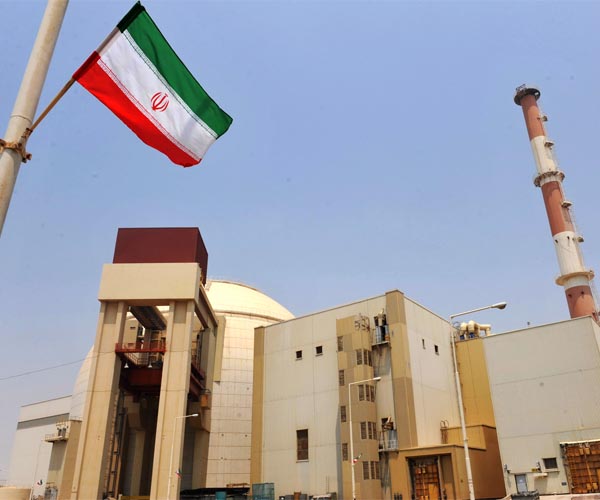
Tehran's nuclear programme is back under the spotlight as international talks between Iran and world powers to revive the 2015 nuclear deal restart on Monday in Vienna.
Tehran insists that its programme is exclusively peaceful but its recent ramping up of its nuclear activities has alarmed experts.
– Which limits has Tehran breached? –
Under the 2015 deal with Britain, France, Germany, China, Russia and the United States, Iran agreed not to enrich uranium above 3.67 percent, well below the 90-percent threshold needed for use in a nuclear weapon.
In addition, it was only allowed to have a stockpile of 202.8 kilogrammes in total — equivalent to 300 kilogrammes in a particular compound form.
But since May 2019, Iran has announced successive breaches of the deal in reaction to then US president Donald Trump's withdrawal from the agreement in 2018 and the reimposition of harsh sanctions.
According to the latest report from the UN's watchdog IAEA, Iran has now amassed a stockpile of 2,489.7 kilogrammes.
The total amount now includes 113.8 kilogrammes enriched to 20 percent, as well as 17.7 kilogrammes enriched up to 60 percent.
In addition, it has started producing uranium metal, "a key material used to make nuclear weapon cores, under a civil use pretext", according to Andrea Stricker, co-author of a recent analysis from the Washington-based Institute for Science and International Security.
Under the 2015 deal, Iran promised not to produce the metal.
It has also made more progress operating advanced centrifuges — machines used for uranium enrichment — than it had prior to the 2015 deal.
"Iran has made irreversible progress on advanced centrifuges and on enrichment including practising multi-step enrichment to shorten the process of moving to weapons-grade," Stricker told AFP.
– How close is it to a nuclear bomb? –
Iran denies wanting nuclear weapons, saying its activities are purely for peaceful purposes such as generating electricity and treating cancer patients.
Under the 2015 deal, "breakout time" — the time needed to acquire the fissile material necessary to manufacture a bomb — was about a year.
But with the recent developments, it is "much less", according to one diplomat.
"Enrichment to 60 percent could be around 99 percent of the effort to reach weapons-grade, which underscores the gravity of the situation," Stricker told AFP, citing a colleague's research, though she adds "there is no reason for hysteria".
According to Stricker, "Iran now possesses enough enriched uranium for four nuclear weapons, after further enrichment to weapons-grade".
– What safeguards are in place? –
Experts note Iran would also need to take other steps, besides enriching uranium, to have a bomb.
"Even if Iran produced enough fissile material for a nuclear weapon, it would need to convert that material into the nuclear core, and package that with explosives and other components to make a nuclear device," said Eric Brewer of the Washington-based Center for Strategic and International Studies (CSIS).
"Additional steps would be required to fit that device on top of a missile and have it work correctly," he told AFP.
IAEA inspectors also regularly visit Iran. Their access has been reduced since earlier this year, but their monitoring activities would still "help it detect a dash to a nuclear weapon fairly quickly", according to Brewer.
"The real challenge right now is that Iran's expanded nuclear activities, in particular its use of advanced centrifuges, are creating knowledge that is hard to erase with a simple return to the nuclear deal," he said.