
 Propeller of Polar 5, the scientific aircraft of Alfred Wegener Institute, on its flight across Svalbard. Photo: Ralf Rochert, Alfred Wegener Institute. |
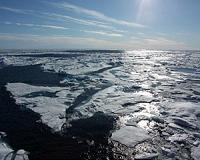
They have indications that the mass of sea ice is dwindling because its thickness is declining. To substantiate this, they are currently measuring the ice thickness north and east of Greenland using the research aircraft Polar 5. The objective of the roughly one-week campaign is to determine the export of sea ice from the Arctic.
Around a third to half of the freshwater export from the Arctic Ocean takes place in this way - a major drive factor in the global ocean current system.
The question of when the Arctic will be ice-free in the summer has been preoccupying the sea ice researchers headed by Prof. Dr. Rudiger Gerdes from the Alfred Wegener Institute for Polar and Marine Research in the Helmholtz Association for a long time now. Satellites have been recording the extent of the Arctic ice for more than 30 years.
In addition to the area covered, the thickness of the ice is a decisive factor in assessing how much sea ice there is. However, the thickness can only be determined locally, for example by means of the so-called EM-Bird, an electromagnetic measuring device which helicopters or planes tow over the ice.
For Gerdes this is a very special job because he usually models his forecasts on his home computer. The campaign with the research aircraft Polar 5 of the Alfred Wegener Institute now takes him on an expedition in the Arctic for the first time. "I'm very keen on seeing the results of the sea ice thickness measurements," says Gerdes.
"Only when we know the distribution of ice of varying thickness, can we calculate how much freshwater is carried out of the Arctic Ocean via ice."
About 3000 cubic kilometres of ice drift out of the Arctic Ocean every year, corresponding to around 2700 billion tons. The ice exports freshwater that reaches the Arctic Ocean via rivers and precipitation. This maintains its salt concentration, which has been constant over the long term. The temperature rise observed worldwide is especially pronounced in the Arctic latitudes.
Researchers have been observing that the ice is getting thinner and thinner for several years now. As a result, it stores and exports less freshwater and the salt concentration (also referred to as salinity) of the Arctic Ocean declines. On the one hand, this influences all living things that have adapted to the local conditions.
On the other hand, changes in salinity also have an impact on current patterns of global ocean circulation and thus on meridional heat transport. In the TIFAX (Thick Ice Feeding Arctic Export) measurement campaign the researchers are primarily interested in ice that is several years old, several metres thick and occurs predominantly on the northern coast of Greenland.
"Taking off on the measurement flights from Station Nord here is a special adventure," reports Gerdes from one of the northernmost measuring stations in the world. "Flying through virtually unsettled regions of the Arctic in the high-tech research aircraft is a stark contrast to my modelling work on the computer."
 del.icio.us del.icio.us |
 Digg Digg |
 Reddit Reddit |
 YahooMyWeb YahooMyWeb |
 Google Google |
 Facebook Facebook |

 Ice-Free Arctic Ocean May Not Be Of Much Use In Soaking Up Carbon Dioxide
| The content herein, unless otherwise known to be public domain, are Copyright 1995-2010 - SpaceDaily. AFP and UPI Wire Stories are copyright Agence France-Presse and United Press International. ESA Portal Reports are copyright European Space Agency. All NASA sourced material is public domain. Additional copyrights may apply in whole or part to other bona fide parties. Advertising does not imply endorsement,agreement or approval of any opinions, statements or information provided by SpaceDaily on any Web page published or hosted by SpaceDaily. Privacy Statement |


