
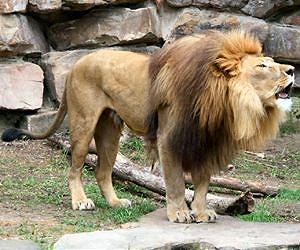
When Danish author Karen Blixen penned her autobiography "Out of Africa", she wrote of the fierce leopards and lions that prowled the coffee estate she farmed at the foot of Kenya's Ngong hills.
Today, that farm is a leafy upmarket suburb of the rapidly growing capital Nairobi, swallowed up by breakneck urbanisation that has turned a century-old colonial railway yard into a traffic-clogged major city.
But the sharp toothed big cats have remained, finding themselves under growing pressure as one of Africa's fastest growing cities creeps onto ancient migration routes and hunting grounds.
"There have been no attacks on humans — only dogs — but as the encroachment increases the probability of attacks grows," said Francis Gakuya, chief vet for Kenya Wildlife Service (KWS), as captured lion cubs growled in the background.
Pacing in a cage at the KWS headquarters in Nairobi, four orphaned cubs hiss and snarl at vets taking care of them — then give a surprisingly powerful roar for a two-month-old baby already the size of a small dog.
Wildlife rangers were forced to shoot dead the cubs' mother after it was spotted in Nairobi's Karen suburb and it charged before it could be darted. The cubs are now being looked after.
But it is not the only recent case. Conservationists warn of the growing likelihood of closer interaction between wildlife and humans if development is not managed in a sustainable manner.
Another lioness captured last month later escaped back into the park, a 117 square kilometre (45 square mile) wilderness where buffalo and rhino roam just seven kilometres (four miles) from the bustling high-rise city centre.
Wildlife officials have issued warnings to residents near the park to call them "should they see another lion in their area as it is possible more than one lion had strayed from the park."
Traps are set out when a big cat is reported but the wily lions have so far avoided the baited cages – sparking concern in residents, fearful at night when guard dogs howl that a lion could be hunting in the back yard.
"Lions can hide invisible in the long grass so it's frightening they could be around waiting to pounce," said Mary Okello, who lives close to where recent lions were caught.
Visit the park and one is rewarded by the bizarre sight of long-necked giraffes running through wide plains of yellow grass with the gleaming skyscrapers of Nairobi's business district rising in the distance.
— 'The lion loses out' —
Although fenced in on the city side — some bars even have terraces where one can view animals over a cold drink — the park is open-sided elsewhere else to allow the annual wildlife migration in search of grazing.
Zebra and wildebeest in the park migrate from the protected Nairobi national park through informal wildlife corridors, areas where pastoralist herders graze their cattle. But Kenya's population is quickly growing.
The land is under threat from increasing urbanisation and more intensive agriculture, and the routes used by migrating herds in search of fresh grass — and the carnivores that follow for fresh meat — are growing narrower.
"Some can't find their way through, and they get stranded," said Nicholas Oguge, President of the Ecological Society for Eastern Africa.
"There is an urgent need for an effective land policy…without establishing formal wildlife corridors, Nairobi National Park will become like an island, a large contained zoo," added Oguge, a professor at the University of Nairobi.
The situation has changed dramatically in recent decades. In the 1970s residents used to report roaming herds of wildebeest several hundred thousand strong. Today, in comparison, there are just a relative handful of wildebeest left.
Conservationists say wildlife protection is a low priority for city officials struggling with multiple challenges in a grossly unequal capital of some 3.5 million people with overstretched basic services and infrastructure.
In Nairobi, lavish villas rub shoulders with squalid slums and cramped high rise apartments.
"Nairobi National Park is a microcosm of what is happening elsewhere," said Luke Hunter, president of the wild cat conservation group Panthera, noting that lions have lost over 80 percent of their historic lands across Africa.
"In protected areas lions do well… but outside they are getting hammered."
Kenyan wildlife officials and other conservation groups are working to support the establishment of a wildlife corridor, including mapping the key routes, but it is no easy matter, said Paul Mbugua, KWS assistant director.
"It would be good to have corridors in place, but we have a challenge as all the land to the south of Nairobi is owned by somebody," Mbugua said.
Land in Kenya is both increasingly expensive and a highly political issue.
Kenya plunged into violence after disputed 2007 elections, with land grievances a key contributing factor to the explosion of brutal killings, and demarcating protected corridors is harder than simply drawing lines on a map.
Lion attacks on livestock are reported, but there have been no recent attacks on humans in Nairobi, experts say, but contact will grow as the city expands.
"Lions respect and fear people and try to get out of the way," added Hunter.
"But with development in areas important to lions, people and lions will mix more and more… and an individual lion can be incredibly dangerous. In that mix, inevitably it is the lion that loses out."
