
Subscribe free to our newsletters via your
. Military Space News .


FARM NEWS
Madagascar unleashes poisoned rain to break locust plague
by Staff Writers
Amparihibe, Madagascar (AFP) May 19, 2014


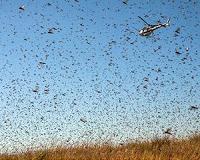
A helicopter of the Food and Agriculture Organization of the United Nations (FAO) flies through millions of Locusts as spreads pesticide to fight against a swarm of locusts threatening to reach Amparihibe village on May 7, 2014 in Tsiroanomandidy , Madagascar. FAO mission is to fight the locust's swarm with an insecticide. Photo courtesy AFP.

The choppers swoop in, dumping insecticide over a plague-stricken village in Madagascar's stunning central highlands.

"The goal is to break the invasion," explains Tsitohaina Andriamaroahina, head of a UN mission to end a locust plague threatening the crops of 13 million farmers on this island nation.

In their countless billions the insatiable hordes cloud the skies as they spread across two thirds of Madagascar, affecting an area roughly the size of Germany or Japan.

Columns of thick black smoke rise from the rolling grasslands surrounding the village of Amparihibe, 200 kilometres (125 miles) west of the capital Antananarivo, as desperate farmers set fires to disperse the crop-eating swarms.

The airborne locust bombers use the tell-tale smoke signals to help them target the insects on daily patrols using three helicopters and an airplane operating from mobile air bases.

"When we fly on a scouting mission, we look at several things: the wind direction, smoke, the position of the sun. All of that shows us where the swarms are," explained Hasibelo Rakotovao, one of the team members.

The 90 people in the joint operation between the UN's Food and Agriculture Organisation and Madagascar's anti-locust agency have already sprayed 500,000 litres (132,000 gallons) of pesticide over one million hectares of land.

Once the insects have been spotted, a technical team arrives before sunrise in a truck carrying pesticide containers which will be attached to the helicopter.

The team moves quickly -- they can only spray at dawn, when the locusts are immobile on the ground, their wings weighed down by the morning dew.

The pesticide only affects insects, according to the mission, neutralising their nervous system.

Villagers then collect the grasshoppers and feed them to their pigs.

"We help one another among neighbours but we aren't enough. We are up to our knees in locusts and can't cope anymore," said Marie Louise Rasoamampionona, a 50-year-old small-scale farmer.

"We have to start bushfires because there's no other way to chase away the locusts."

- 'New invasions loom' -

The swarms have multiplied uncontrollably in recent years because of government inaction during politically turbulent times which saw foreign aid to the country suspended.

The airborne operation under way now is seen as the only solution to the plague, but it is far from over and the FAO still needs $14 million to see the project through over the next two years.

Despite the efforts from the air which have annihilated hundreds of swarms in the past few weeks, local people say they have already been hard hit by rice shortages.

"The locusts cause farmers a lot of suffering, because rice is our livelihood," said Ranaivo, a peasant farmer from Amparihibe.

"If it is destroyed, we are lost, what will we eat? If we only eat cassava, it doesn't give us enough energy to work. Rice is essential."

Even if the current plague is brought under control, environmental degradation points to more problems in the future.

Increased deforestation heightens the risk of swarms, meaning that new locust invasions loom on the horizon.

Around 200,000 hectares of forest is chopped out every year, and 90 percent of Madagascar's rainforest has been lost already.

"Deforestation has very heavy consequences," explained mission head Andriamaroahina.

"When people cut down the forests, it creates more grasslands, which attract locusts."

.


Related Links
Farming Today - Suppliers and Technology


Comment on this article via your Facebook, Yahoo, AOL, Hotmail login.

Share this article via these popular social media networks
del.icio.usdel.icio.us DiggDigg RedditReddit GoogleGoogle


FARM NEWS
Corn dwarfed by temperature dip suitable for growing in caves, mines
West Lafayette IN (SPX) May 16, 2014
Lowering temperatures for two hours each day reduces the height of corn without affecting its seed yield, a Purdue study shows, a technique that could be used to grow crops in controlled-environment facilities in caves and former mines. Raising the crops in isolated and enclosed environments would help prevent genetically modified pollen and seed from escaping into the ecosystem and crossing wit ... read more


FARM NEWS
Canadian missile defense radar to be operated, maintained by Raytheon

Propulsion Module For SBIRS GEO-4 Satellite Completed

Canada revisiting ballistic missile defense: official

South Korea orders missile defense systems from ATK

FARM NEWS
Lockheed Martin weapons turret demonstrated with missile system

Advanced Precision Kill Weapon System rockets for Jordan

Raytheon's JSOW scores direct hits in back-to-back flight tests

Britain eyes adaption of naval air defense missile for army

FARM NEWS
ScanEagle drone capabilities demonstrated in Australia

US flying drones over Nigeria in search for girls

Fire Scout Gets Electromagnetic Interference Tests Ahead Of Ship-based Ops

Fury UAS ground control station features latest technology

FARM NEWS
Harris providing tactical communications to country in central Asia

Production Ramps Up on next Advanced EHF Birds

A Multi-Billion Dollar Military Satellite Market

Sagetech to Study Micro-Mode 5 Transponder for US Navy

FARM NEWS
US senators denounce delays for veterans at clinics

Saudi company to sell Xenonics' night-vision equipment

Oshkosh showcasing unmanned ground vehicle technology

Stryker hulls being improved to withstand mines, IEDs

FARM NEWS
US plans nearly $1 billion arms deal with Iraq

Foreign Military Sales deal in works for Sidewinder missiles

Pentagon chief to head to Saudi, Israel next week

India's Modi pledges defence procurement overhaul

FARM NEWS
Putin heads to China as Ukraine sinks ties with West

China defiant as US warns over sea row with Vietnam

Modi eyes 'India's century' after landslide victory

One month on, Ukraine military fails to rout rebels

FARM NEWS
Nanoscale heat flow predictions

Harnessing Magnetic Vortices for Making Nanoscale Antennas

New method for measuring the temperature of nanoscale objects discovered

Nanomaterial Outsmarts Ions


The content herein, unless otherwise known to be public domain, are Copyright 1995-2014 - Space Media Network. All websites are published in Australia and are solely subject to Australian law and governed by Fair Use principals for news reporting and research purposes. AFP, UPI and IANS news wire stories are copyright Agence France-Presse, United Press International and Indo-Asia News Service. ESA news reports are copyright European Space Agency. All NASA sourced material is public domain. Additional copyrights may apply in whole or part to other bona fide parties. Advertising does not imply endorsement, agreement or approval of any opinions, statements or information provided by Space Media Network on any Web page published or hosted by Space Media Network. Privacy Statement All images and articles appearing on Space Media Network have been edited or digitally altered in some way. Any requests to remove copyright material will be acted upon in a timely and appropriate manner. Any attempt to extort money from Space Media Network will be ignored and reported to Australian Law Enforcement Agencies as a potential case of financial fraud involving the use of a telephonic carriage device or postal service.