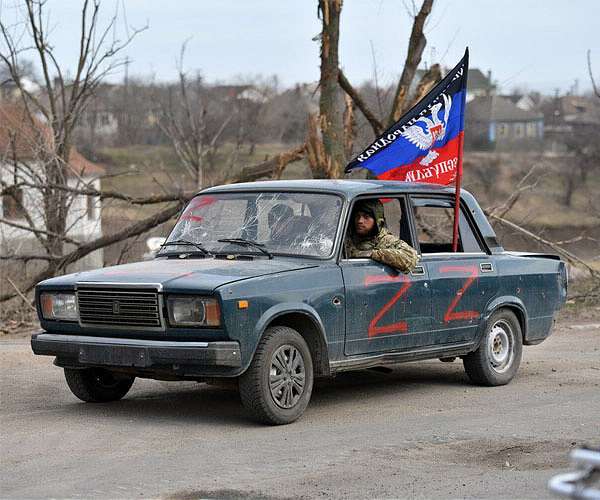
Shortly after footage emerged of the carnage Russian troops left behind in the town of Bucha, Ukraine, an article was published April 4, 2022, in one of the largest Russian state-run media companies.
The article called for even more bloodshed in Ukraine.
Written by journalist and Kremlin-aligned political operative Timofey Sergeytsev and published in RIA-Novosti, the article answers the question posed by its Manifesto published in Russian media reflects Putin regime's ruthless plans in Ukraine: "What should Russia do with Ukraine?"
The answer, Sergeytsev writes, is total annihilation. He writes that "all who have associated themselves with Nazism should be liquidated and banned."
Sergeytsev urges Russian soldiers to be merciless and force Ukraine to its knees and calls for more of the same inhumane tactics that took place in Bucha and the towns of Mariupul and Berdyansk.
As an academic focusing on Russian government, politics and society, I believe the article demonstrates what is foremost on the mind of President Vladimir Putin's regime.
The silencing of independent Russian media
Sergeytsev's piece merits close attention because RIA-Novosti is one of the three largest news agencies in Russia and has a mass circulation. It functions as a loyal mouthpiece of the Russian government and has an inordinate impact on what Russians see and hear about the war in Ukraine.
This is the result of the Russian government's ever tightening control over independent media since 2000, when Putin became president. In his first year in power, Putin shut down companies of media businessman Vladimir Gusinsky.
Since then, Putin has used what is known as the Roskomnadzor, the Federal Service for Supervision of Communications, Information technology and Mass Media, a federal agency that monitors and censors Russian mass media and decides which need to be shut down.
In 2022 alone, Putin closed the last remaining independent sources of information in Russia: liberal radio station Ekho Moskvy, online television channel TV Rain, bilingual news site Meduza and Novaya Gazeta, whose editor, Dmitry Muratov, was awarded the Nobel Peace Prize in 2021.
The Russian government not only has total control over all media, but it dictates what can be seen and heard. The war in Ukraine, for instance, can only be referred to as "a special military operation." Anyone who calls it a "war" is subject to a prison term of 15 years.
Given where it appeared, Sergeytsev's article must have been published with the knowledge and approval of the Russian government.
Who is Sergeytsev?
Sergeytsev is an experienced Russian political operative who worked on behalf of the Russian government to prop up pro-Russian Ukrainian president Leonid Kuchma in 1991. He also supported Ukrainian President Viktor Yanukovych, whose questionable election victory, promoted by Putin, resulted in Ukraine's Orange Revolution of 2004.
Sergeytsev is also a member of the Russian far right Zinoviev Club, named after Alexander Zinoviev. Zinoviev was a champion of Josef Stalin as a model leader, the murderous dictator who ruled the Soviet Union from 1928 to 1953.
Given this pedigree, it's not surprising that it was Sergeytsev who wrote the answer to the question about what Russia should do about Ukraine.
A fight against Nazis?
In the invented world he describes in his article, Sergeytsev accuses both Ukraine's former President Petro Poroshenko and current President, Volodymyr Zelensky, of using "total terror" against the Russian "anti-fascists in Odesa, Kharkov, Dnepropetrovsk, Mariupol and other Russia cities."
As for the Donbass regions of Donetsk and Lukhansk in Ukraine's east, where pro-Russian separatists have fought Ukraine over the past eight years, Sergeytsev says they have been bravely rebelling "against Ukrainian Nazism."
Sergeytsev calls for the destruction of all "Nazis that have taken up arms" and that they "should be destroyed to the maximum on the battlefield."
He includes the Ukrainian armed forces, the national battalions, the territorial defense forces and "a significant part of the masses, which are passive Nazis" and "are also guilty."
All "are equally involved in extreme cruelty against the civilian population, equally guilty of the genocide of the Russian people, and do not comply with laws and customs of war," Sergeytsev writes.
In this piece of bald disinformation, Sergeytsev further writes that the majority of Ukrainians have been drawn to the Nazi politics of their government and "this fact is the basis of the policy of denazification."
The idea of Zelensky, the only Jewish president outside of Israel, subscribing to Nazi ideology along with his government has nothing to do with reality.
Russian propaganda
Sergeytsev's choice of words, such as "de-Ukrainization" and "denazification," are terms calling for the destruction of Ukraine. In his April 4 article of 1,700 words, Sergeytsev uses the word Nazi 69 times.
In order to achieve the ultimate goal of "de-Ukrainization," Sergeytsev calls for a rejection of Ukrainian ethnicity and the peoples' right to self-determination.
Echoing Putin, Sergeytsev writes that Ukraine has never been a nation state, adding that its attempts at becoming independent have led to "Nazism."
Sergeytsev calls on all of Ukraine's elite to be "liquidated" and "the social swamp which actively and passively supports it should undergo the hardship of war and digest the experience as a historical lesson and atonement."
The constant use of the word "Nazi" triggers a visceral reaction among the Russian population. During World War II, the Soviet Union suffered horrible atrocities at the hands of the Nazis. In one example, the Nazi blockade of Leningrad lasted from September 1941 until January 1944, a total of 900 days. An estimated over 1 million people died from systematic starvation.
Using the word "Nazi" is bearing fruit for the Kremlin.
The independent polling center Levada showed in late March polls, one month into the invasion, that 83% of Russians approved of Putin.
But despite Russian media efforts to falsely portray Ukrainians as Nazis, there have been reports of Russian soldiers captured by Ukrainian military confused by the purpose of the war, saying they couldn't find any Nazis or fascists.
Old and new boundaries
In addition to calling for the need for "de-Ukrainization," Sergeytsev writes that Ukraine "must be returned to its natural boundaries."
These boundaries were the ones formed between 1765 and 1783 after Russia's Empress Catherine the Great defeated the Turks, annexed Crimea and incorporated the entire southern part of today's Ukraine known as Novorossiya into the Russian empire.
Sergeytsev says that the five regions in western Ukraine, which he refers to as the "residual Ukraine in a neutral state," are not likely to become part of the pro-Russian territories and will remain hostile to Russia. "The haters of Russia will go there," he writes.
For Sergeytsev, compromising with the United States, NATO and other Western nations is not an option.
The reason, Sergeytsev concludes, is because the "collective West itself is the designer, source and sponsor of Ukrainian Nazism."