look ma, no hands
look ma, no hands |
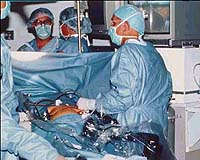
The surgeon's finger motions, conveyed through sophisticated joy sticks, direct the minute maneuvers carried out by two robotic hands holding surgical instruments.
The surgeon views the surgery on a computer screen, which shows an enlarged and three-dimensional view of the surgical area. The images are transmitted by a tiny camera with multiple lenses, which is attached to a third robotic hand.
"This technology enhances a surgeon's skills, making it easier to do more complex surgeries laparoscopically -- that is with incisions as small as one centimeter," says Michael Blute, M.D., a urologist at Mayo Clinic.
"Patients who have laparoscopic surgery, rather than open surgery, often recover more quickly and return to their normal activities sooner," says Dr. Blute.
Surgery for prostate removal Mayo Clinic surgeons expect to use this new technology, called the da Vinci system, to remove prostate glands, a common treatment for prostate cancer, and for other urologic surgeries.
Prostate cancer is the second-leading cause of cancer deaths in American men. Surgery to remove the prostate gland, called radical prostatectomy, is one of the most effective ways to treat prostate cancer. Typically, radical prostatectomies are open surgeries, with larger incisions.
The da Vinci system was approved by the U.S. Food and Drug Administration in 2001 for prostate surgery. Last year, a handful of U.S. medical centers in the United States began using da Vinci for other types of general laparoscopic surgery and for some chest surgeries.
Laparoscopic surgery is not new, but a limited number of procedures can be done with this technique, and it requires years of surgical training.
"With the da Vinci, surgeons skilled in open surgery can use their expertise, and the help of robotic hands, to do more types of surgery laparoscopically," says Dr. Blute. "That has the potential to improve care for many of our patients."
Related Links
 Los Alamos Researchers Recommend AIDS Vaccine Strategies
 Los Alamos - Jul 11, 2002
| The content herein, unless otherwise known to be public domain, are Copyright 1995-2006 - SpaceDaily.AFP and UPI Wire Stories are copyright Agence France-Presse and United Press International. ESA PortalReports are copyright European Space Agency. All NASA sourced material is public domain. Additionalcopyrights may apply in whole or part to other bona fide parties. Advertising does not imply endorsement,agreement or approval of any opinions, statements or information provided by SpaceDaily on any Web page published or hosted by SpaceDaily. Privacy Statement |