
. Military Space News .
BIO FUEL
Microbial fuel cell converts methane to electricity
by Staff Writers
University Park PA (SPX) May 19, 2017


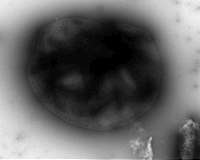
Transmission electron microscopy image from Thomas Wood's laboratory of their engineered M. acetivorans strain capturing methane. Credit Thomas Wood, Penn State

Transporting methane from gas wellheads to market provides multiple opportunities for this greenhouse gas to leak into the atmosphere. Now, an international team of researchers has taken the first step in converting methane directly to electricity using bacteria, in a way that could be done near the drilling sites.

"Currently, we have to ship methane via pipelines," said Thomas K. Wood, holder of the biotechnology endowed chair and professor of chemical engineering, Penn State. "When you ship methane, you release a greenhouse gas. We can't eliminate all the leakage, but we could cut it in half if we didn't ship it via pipe long distances."

The researchers' goal is to use microbial fuel cells to convert methane into electricity near the wellheads, eliminating long-distance transport. That goal is still far in the future, but they now have created a bacteria-powered fuel cell that can convert the methane into small amounts of electricity.

"People have tried for decades to directly convert methane," said Wood. "But they haven't been able to do it with microbial fuel cells. We've engineered a strain of bacteria that can."

Microbial fuel cells convert chemical energy to electrical energy using microorganisms. They can run on most organic material, including wastewater, acetate and brewing waste. Methane, however, causes some problems for microbial fuel cells because, while there are bacteria that consume methane, they live in the depths of the ocean and are not currently culturable in the laboratory.

"We know of a bacterium that can produce an energy enzyme that grabs methane," said Wood. "We can't grow them in captivity, but we looked at the DNA and found something from the bottom of the Black Sea and synthesized it."

The researchers actually created a consortium of bacteria that produces electricity because each bacterium does its portion of the job. Using synthetic biological approaches, including DNA cloning, the researchers created a bacterium like those in the depths of the Black Sea, but one they can grow in the laboratory. This bacterium uses methane and produces acetate, electrons and the energy enzyme that grabs electrons.

The researchers also added a mixture of bacteria found in sludge from an anaerobic digester - the last step in waste treatment. This sludge contains bacteria that produce compounds that can transport electrons to an electrode, but these bacteria needed to be acclimated to methane to survive in the fuel cell. They report the results of their work today (May 17) in Nature Communications.

"We need electron shuttles in this process," said Wood. "Bacteria in sludge act as those shuttles."

Once electrons reach an electrode, the flow of electrons produces electricity. To increase the amount of electricity produced, the researchers used a naturally occurring bacterial genus - Geobacter, which consumes the acetate created by the synthetic bacteria that captures methane to produce electrons.

To show that an electron shuttle was necessary, the researchers ran the fuel cell with only the synthetic bacteria and Geobacter. The fuel cell produced no electricity. They added humic acids - a non-living electron shuttle - and the fuel cells worked. Bacteria from the sludge are better shuttles than humic acids because they are self-sustaining. The researchers have filed provisional patents on this process.

"This process makes a lot of electricity for a microbial fuel cell," said Wood. "However, at this point that amount is 1,000 times less than the electricity produced by a methanol fuel cell."

BIO FUEL
Genome sequence of fuel-producing alga announced
College Station TX (SPX) May 15, 2017
The genome of the fuel-producing green microalga Botryococcus braunii has been sequenced by a team of researchers led by a group at Texas A and M AgriLife Research. The report, in Genome Announcements, comes after almost seven years of research, according to Dr. Tim Devarenne, AgriLife Research biochemist and principal investigator in College Station. In addition to sequencing the genome, ... read more

Related Links
Penn State
Bio Fuel Technology and Application News


Thanks for being here;
We need your help. The Space Media Network continues to grow but revenues have never been harder to maintain.

With the rise of Ad Blockers, and Facebook - our traditional revenue sources via quality network advertising continues to decline. And unlike so many other news sites, we don't have a paywall - with those annoying usernames and passwords.

Our news coverage takes time and effort to publish 365 days a year.

If you find our news sites informative and useful then please consider becoming a regular supporter or for now make a one off contribution.
SpaceMediaNetwork Contributor
$5 Billed Once


credit card or paypal
SpaceMediaNetwork Monthly Supporter
$5 Billed Monthly


paypal only


Comment using your Disqus, Facebook, Google or Twitter login.

Share this article via these popular social media networks
del.icio.usdel.icio.us DiggDigg RedditReddit GoogleGoogle

BIO FUEL
Lockheed Martin contract for AEGIS system development

Lockheed Martin receives Patriot missile contract for Qatar

State Dept. approves UAE for possible PAC-3 missile buy

US approves sale of $2 billion in missiles to UAE: Pentagon

BIO FUEL
Israeli missile ship receives new radar

Raytheon contracted for support of the MK-31 Rolling Airframe Missile

China says it tested new missile in northeastern sea

Purchase of S-400 From Russia 'Might Signal Turkey's Estrangement From NATO'

BIO FUEL
Drone to replace Israeli manned maritime patrol aircraft

General Atomics receives MQ-9 contract

UK prison moves to stop drone deliveries of contraband

Latvian daredevil in 'drone-diving' world first

BIO FUEL
Radio communications have surprising influence on Earth's near-space environment

Navy receiving data terminal sets from Leonardo DRS

European country orders Harris tactical radios

Israel orders satellite-on-the-go for military vehicles

BIO FUEL
Development of Textron's Fury glide munition completed

Orbital ATK producing 120mm training rounds for Army

U.S. Army testing Saab camouflage

Elbit introduces upgraded vehicle mortar system

BIO FUEL
US admiral gets 18 months in 'Fat Leonard' case

Northrop Grumman Australia invests in new facility; Final Nulka decoy delivered

Dutch court jails Charles Taylor arms-supplier for 19 years

Canada moves to join treaty curbing foreign arms sales

BIO FUEL
China backs security services after spy deaths report

China sidesteps Duterte claim of war threat over sea row

Six more Japanese detained in China

Russia to lift some Turkey sanctions, tomato ban stays

BIO FUEL
Stanford scientists use nanotechnology to boost the performance of key industrial catalyst

Molecular Lego for nanoelectronics

Nanophysics: Saving energy with a spot of silver

Scientists print nanoscale imaging probe onto tip of optical fiber


The content herein, unless otherwise known to be public domain, are Copyright 1995-2024 - Space Media Network. All websites are published in Australia and are solely subject to Australian law and governed by Fair Use principals for news reporting and research purposes. AFP, UPI and IANS news wire stories are copyright Agence France-Presse, United Press International and Indo-Asia News Service. ESA news reports are copyright European Space Agency. All NASA sourced material is public domain. Additional copyrights may apply in whole or part to other bona fide parties. All articles labeled "by Staff Writers" include reports supplied to Space Media Network by industry news wires, PR agencies, corporate press officers and the like. Such articles are individually curated and edited by Space Media Network staff on the basis of the report's information value to our industry and professional readership. Advertising does not imply endorsement, agreement or approval of any opinions, statements or information provided by Space Media Network on any Web page published or hosted by Space Media Network. General Data Protection Regulation (GDPR) Statement Our advertisers use various cookies and the like to deliver the best ad banner available at one time. All network advertising suppliers have GDPR policies (Legitimate Interest) that conform with EU regulations for data collection. By using our websites you consent to cookie based advertising. If you do not agree with this then you must stop using the websites from May 25, 2018. Privacy Statement. Additional information can be found here at About Us.