
. Military Space News .


.
INTERN DAILY
Morning UV exposure may be less damaging to the skin
by Staff Writers
Chapel Hill NC (SPX) Oct 27, 2011

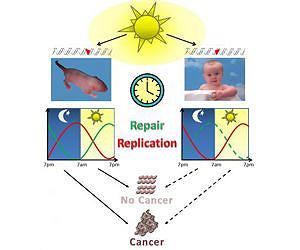
This diagram shows the relationship between DNA repair rates, time of day and skin cancer risk. Credit: Laura A. Lindsey-Boltz, Ph.D., Sancar lab.

Research from the University of North Carolina at Chapel Hill suggests that the timing of exposure to UV rays - early in the morning or later in the afternoon - can influence the onset of skin cancer.

The study, performed in mice, found that exposure to UV radiation in the morning increased the risk of skin cancer by 500 percent over identical doses in the afternoon.

Although mice and humans both reside on a 24-hour day, the "circadian" clocks of these nocturnal and diurnal creatures run counter each other.

This key difference in biology means that humans are most protected from the sun's harmful rays when mice are most susceptible, and vice versa.

"Therefore, our research would suggest that restricting sunbathing or visits to the tanning booth to morning hours would reduce the risk of skin cancer in humans," said senior study author Aziz Sancar, M.D., PhD, a member of the UNC Lineberger Comprehensive Cancer Center and Sarah Graham Kenan professor of biochemistry and biophysics in the UNC School of Medicine. Sancar is also a member of the National Academy of Sciences and the Turkish Academy of Sciences "However, further studies in humans are needed before we can make any definitive recommendations."

Sancar has previously shown that a protein called XPA, responsible for repairing the DNA damage wrought by UV radiation, waxes and wanes throughout the day.

In a study published online the week of October 24-30 in the Proceedings of the National Academy of Sciences, he and his colleagues looked to see if the cyclical nature of this DNA repair molecule had an influence on the onset of skin cancer.

They exposed two groups of mice to UV radiation - either at 4 a.m. or at 4 p.m. - and waited for cancer to develop.

Mice irradiated when the repair activity was at its minimum developed tumors much faster and at five-fold higher frequency compared with mice exposed to UV when the protein's repair function was at its maximum.

The researchers predict that humans will have a higher rate of DNA repair in the morning and would be less prone to the carcinogenic effect of UV radiation in the morning hours.

They plan to measure actual DNA repair rates in the skin of human volunteers to confirm that morning sun is safest for humans.

The research was funded by the National Institute of General Medical Sciences and the National Institute of Environmental Health Sciences. UNC co-authors with Sancar were Shobhan Gaddameedhi (study 1st author), Christopher P. Selby, William K. Kaufmann, and Robert C. Smart of North Carolina State University, Raleigh, NC.

Related Links
University of North Carolina School of Medicine
Hospital and Medical News at InternDaily.com


.
.
Get Our Free Newsletters Via Email
...
Buy Advertising Editorial Enquiries


.

. Comment on this article via your Facebook, Yahoo, AOL, Hotmail login.

Share this article via these popular social media networks
del.icio.usdel.icio.us DiggDigg RedditReddit GoogleGoogle


INTERN DAILY
Manufacturing goes viral
Washington DC (SPX) Oct 24, 2011
Using a simple, single-step process, engineers and scientists at the University of California at Berkeley have developed a technique to direct benign, filamentous viruses called M13 phages to serve as structural building blocks for materials with a wide range of properties. By controlling the physical environment alone, the researchers caused the viruses to self-assemble into hierarchicall ... read more


INTERN DAILY
Aerostat system detects cruise missiles and supports engagement

Raytheon Successfully Test Fires First New-Build Patriot Missile

NATO missile shield 'not targeted at anyone': Spain

THAAD Weapon System Achieves Intercept of Two Targets at Pacific Missile Range Facility

INTERN DAILY
Lightweight MEADS Launcher Arrives At White Sands for Initial Flight Test

Launchers carry AMRAAM, Sparrow, Sidewinder missiles

U.S. aid to help find Libyan missiles

Philippines unfazed by Taiwan Spratlys missile plan

INTERN DAILY
Computer virus did not target US drone fleet: general

US Army to fly 'kamikaze' drones

Raytheon Aims to Integrate STM on Light-Attack Aircraft

Miscommunication caused US drone deaths: report

INTERN DAILY
First MEADS Battle Manager Begins Integration Testing in the United States

Elbit Establishes Israeli MOD Comms Equipment Supply Upgrade and Maintenance Project

Boeing FAB-T Demonstrates High-Data-Rate Communications with AEHF Satellite Test Terminal

NRL TacSat-4 Launches to Augment Communications Needs

INTERN DAILY
F-22 fighters back in the air: US Air Force

US Air Force grounds F-22 fighters -- again: officers

Boeing Completes Delivery of RAAF Super Hornets Ahead of Schedule

US Army and LockMart Demonstrate Multi-Sensor Situational Awareness Technology

INTERN DAILY
Viktor Bout lawyer assails undercover witness

Arms sales to Mideast under the gun

Eurocopter aims for S. Korean contracts

Thales to upgrade Australia's Steyr rifles

INTERN DAILY
German FM: Turkey deserves fairness

US urges deeper China engagement to avoid 'miscalculation'

Panetta backs developing military ties with Indonesia

Panetta says US committed to being Pacific power

INTERN DAILY
LockMart Directed Energy Leader Receives Purdue's Outstanding Aerospace Engineer Award


.

The content herein, unless otherwise known to be public domain, are Copyright 1995-2011 - Space Media Network. AFP and UPI Wire Stories are copyright Agence France-Presse and United Press International. ESA Portal Reports are copyright European Space Agency. All NASA sourced material is public domain. Additional copyrights may apply in whole or part to other bona fide parties. Advertising does not imply endorsement,agreement or approval of any opinions, statements or information provided by Space Media Network on any Web page published or hosted by Space Media Network. Privacy Statement