
. Military Space News .
IRON AND ICE
NASA mission to search for rare asteroids
by Staff Writers
Greenbelt MD (SPX) Dec 13, 2016


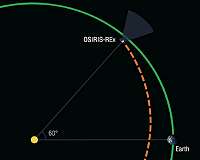
In February 2017, the OSIRIS-REx spacecraft will undertake a search for Earth-Trojan asteroids while on its outbound journey to the asteroid Bennu. Earth Trojans are asteroids that share an orbit with Earth while remaining near a stable point 60 degrees in front of or behind the planet. Image courtesy University of Arizona/Heather Roper. For a larger version of this image please go here.

NASA's first mission to return a sample of an asteroid to Earth will be multitasking during its two-year outbound cruise to the asteroid Bennu. On Feb. 9-20, the OSIRIS-REx (Origins, Spectral Interpretation, Resource Identification, and Security- Regolith Explorer) spacecraft will activate its onboard camera suite and commence a search for elusive "Trojan" asteroids.

Trojans are asteroids that are constant companions to planets in our solar system as they orbit the sun, remaining near a stable point 60 degrees in front of or behind the planet. Because they constantly lead or follow in the same orbit, they will never collide with their companion planet.

There are six planets in our solar system with known Trojan asteroids-Jupiter, Neptune, Mars, Venus, Uranus and, yes, even Earth. The Earth Trojan is elusive; to date, scientists have only discovered one Earth trojan asteroid - 2010 TK7 - found by NASA's NEOWISE project in 2010. Yet there are more than 6,000 known Trojans that are co-orbiting the sun with the gas giant Jupiter.

Scientists predict that there should be more Trojans sharing Earth's orbit, but these asteroids are difficult to detect from Earth because they appear close to the sun from Earth's point of view. In mid-February 2017, however, the OSIRIS-REx spacecraft will be positioned in an ideal spot to undertake a survey.

Over 12 days, the OSIRIS-REx Earth-Trojan asteroid search will employ the spacecraft's MapCam imager to methodically scan the space where Earth Trojans are expected to exist.

Many of these observations will closely resemble MapCam's planned activities during its upcoming search for satellites of asteroid Bennu, so the Trojan asteroid search serves as an early rehearsal for the mission's primary science operations.

"The Earth-Trojan asteroid search provides a substantial advantage to the OSIRIS-REx mission," said OSIRIS-REx Principal Investigator Dante Lauretta of the University of Arizona, Tucson.

"Not only do we have the opportunity to discover new members of an asteroid class, but more importantly, we are practicing critical mission operations in advance of our arrival at Bennu, which ultimately reduces mission risk."

The OSIRIS-REx spacecraft is currently on a seven-year journey to rendezvous with, study, and bring a sample of Bennu to Earth. This sample of a primitive asteroid will help scientists understand the formation of our solar system more than 4.5 billion years ago.


Comment on this article using your Disqus, Facebook, Google or Twitter login.


Thanks for being here;
We need your help. The Space Media Network continues to grow but revenues have never been harder to maintain.

With the rise of Ad Blockers, and Facebook - our traditional revenue sources via quality network advertising continues to decline. And unlike so many other news sites, we don't have a paywall - with those annoying usernames and passwords.

Our news coverage takes time and effort to publish 365 days a year.

If you find our news sites informative and useful then please consider becoming a regular supporter or for now make a one off contribution.
SpaceMediaNetwork Contributor
$5 Billed Once


credit card or paypal
SpaceMediaNetwork Monthly Supporter
$5 Billed Monthly


paypal only


.


Related Links
OSIRIS-REx
Asteroid and Comet Mission News, Science and Technology


Share this article via these popular social media networks
del.icio.usdel.icio.us DiggDigg RedditReddit GoogleGoogle

Previous Report
IRON AND ICE
NASA Scientists see Asteroid through the Eyes of a Robot
Greenbelt MD (SPX) Dec 13, 2016
Retrieving an asteroid sample is no easy task. Doing the job blindfolded is even more challenging. That's why scientists equipped the OSIRIS-REx spacecraft with a set of eyes to watch it all unfold. NASA's Origins, Spectral Interpretation, Resource Identification, Security-Regolith Explorer (OSIRIS-REx) launched Sept. 8, 2016, and is travelling to a near-Earth asteroid known as Bennu, to h ... read more


IRON AND ICE
U.S. Air Force approves Lockheed Martin's SBIRS ground system

Raytheon to provide Patriot missile capability for undisclosed country

Saudis intercept missile fired from Yemen

US general says missile system in S. Korea in 8-10 months

IRON AND ICE
South Korea receives 60 KEPD 350K missiles for deployment

Raytheon gets $60 million contract modification for RAM missiles

U.S. Army contracts BAE Systems for rocket propellant grains

2 million Israelis exposed to rocket fire, says report

IRON AND ICE
MBDA's Brimstone missile planned for Britain's Protector drone

Britain signs off on General Atomics' Protector program

NTU and Stratasys 3iD print operational ULTEM drone with embedded electronics

'Dronejacking' may be the next big cyber threat

IRON AND ICE
Japan to Launch First Military Communications Satellite on January 24

Intelsat General to provide satellite services to RiteNet for US Army network

NSA gives Type1 certification to Harris radio

Upgraded telecommunications network for Marines

IRON AND ICE
U.S. Army to begin Armored Multi-Purpose Vehicle testing

Veyance contracted for Abrams tank tracking

U.S. State Dept. approves sale of Stryker vehicles to Peru

Saab receives Carl-Gustaf M4 weapon system contract

IRON AND ICE
US cancels weapons transfers to Saudi over Yemen campaign

Saudi arms industry may take years, chief says

Europe, Russia arms groups gain market share in 2015: study

China complains to Singapore over armoured vehicles

IRON AND ICE
Satellite images appear to show Vietnam dredging on disputed reefl

Putin calls for peace treaty with Japan ahead of visit

Beijing warns Trump over One China policy

Rex Tillerson, oilman with Putin ties, to lead State Dept

IRON AND ICE
New aspect of atom mimicry for nanotechnology applications

ANU demonstrates 'ghost imaging' with atoms

Supersonic spray yields new nanomaterial for bendable, wearable electronics

Researchers use acoustic waves to move fluids at the nanoscale


The content herein, unless otherwise known to be public domain, are Copyright 1995-2024 - Space Media Network. All websites are published in Australia and are solely subject to Australian law and governed by Fair Use principals for news reporting and research purposes. AFP, UPI and IANS news wire stories are copyright Agence France-Presse, United Press International and Indo-Asia News Service. ESA news reports are copyright European Space Agency. All NASA sourced material is public domain. Additional copyrights may apply in whole or part to other bona fide parties. All articles labeled "by Staff Writers" include reports supplied to Space Media Network by industry news wires, PR agencies, corporate press officers and the like. Such articles are individually curated and edited by Space Media Network staff on the basis of the report's information value to our industry and professional readership. Advertising does not imply endorsement, agreement or approval of any opinions, statements or information provided by Space Media Network on any Web page published or hosted by Space Media Network. General Data Protection Regulation (GDPR) Statement Our advertisers use various cookies and the like to deliver the best ad banner available at one time. All network advertising suppliers have GDPR policies (Legitimate Interest) that conform with EU regulations for data collection. By using our websites you consent to cookie based advertising. If you do not agree with this then you must stop using the websites from May 25, 2018. Privacy Statement. Additional information can be found here at About Us.