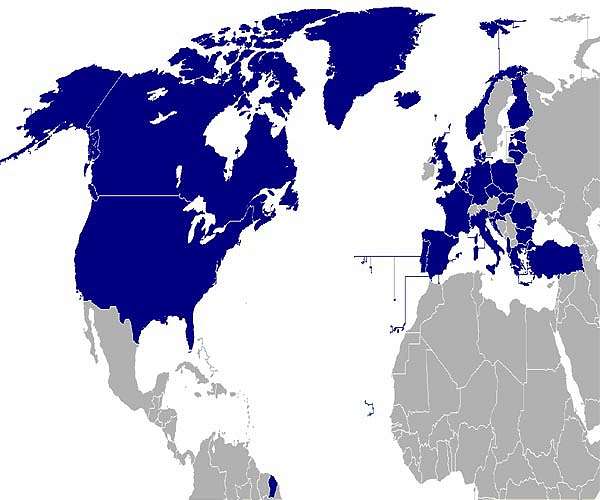
NATO is activating its "defence plans" for allied countries as Russia attacks non-NATO member Ukraine, alliance chief Jens Stoltenberg told a media conference on Thursday.
Stoltenberg also confirmed that NATO will hold a video summit on Friday to discuss the Russian invasion of its pro-Western neighbour.
And he reiterated that NATO had no "plans" to send alliance troops to Ukraine.
It is the first time the alliance has publicly said it is activating its defence plans, which were drawn up after Russia's 2014 invasion and annexation of Ukraine's Crimea peninsula.
Stoltenberg did not give details of them beyond saying they are "defensive plans" allowing deployments that "cover the whole east of our alliance" and which "give our military commanders some more authority within politically defined guidelines".
He said it would include elements of NATO's rapid reaction force of 40,000 soldiers, including a highly prepared unit of 7,000 personnel, most of them French, and an air wing under French command.
Stoltenberg said Friday's summit would also include non-NATO members Sweden and Finland, and EU chiefs Ursula von der Leyen and Charles Michel.
The NATO chief said the invasion would have "long-term effects" on the Western alliance's relationship with Russia and NATO's security posture.
"We don't have all the answers today. But it will be a new reality. It will be a new Europe after the invasion we saw today," he said.
Russia, he said, had not taken "seriously" efforts to find a political solution to the tensions that preceded its military attack on Ukraine.
"So Russia has shut the door to a political solution. We regret that. But that's, sadly, the reality, which has severe and very serious consequences for the people of Ukraine, but also actually impacts the security for all of us.
"And that's the reason why we step up our presence in the eastern part of the alliance."
German army 'limited' in Russia response, says commander
Frankfurt (AFP) Feb 24, 2022 –
Germany's army can do little to support the response to the Russian invasion, its chief said said Thursday, as the country's ex-defence minister admitted that Berlin committed a "historical failure" in not bolstering itself militarily.
Annegret Kramp-Karrenbauer, who was defence minister in Angela Merkel's cabinet said Germany had forgotten lessons from the past that "negotiation always comes first, but we have to be militarily strong enough to make non-negotiation not an option for the other side".
"I'm so angry at ourselves for our historical failure. After Georgia, Crimea, and Donbas, we have not prepared anything that would have really deterred Putin," admitted Kramp-Karrenbauer, referring to incursions carried out by Russia while Merkel was in power.
Her outburst on Twitter came as the chief of the German land army, Alfons Mais, wrote on a post on the social network LinkedIn that "the options we can offer to politicians to support (NATO) are extremely limited."
The Bundeswehr "is more or less bare," he wrote.
Western allies had "seen it coming and were not in the position to come through with our arguments, to draw the lessons from the annexation of Crimea and to implement them," the commander said.
"NATO territory is not directly threatened yet, even if our partners in the east feel the constantly growing pressure," he said.
Mais said it was high time to bolster the army.
"When if not now is the time to … rebuild, otherwise we will not be able to carry out our constitutional mission or our obligations to our allies with any prospect of success," Mais said.
NATO partners will hold a virtual summit Friday to discuss their response.
Around 550 German soldiers are stationed in Lithuania as part of a NATO mission and the government has pledged up to 350 additional troop reinforcements.
Germany was criticised in the build-up to the invasion for refusing to deliver lethal weapons into the crisis zone, sending instead 5,000 helmets to Ukraine.
The weapons export policy is a long-standing principle, which has its roots in the war of aggression led by the Nazis during World War II.
Instead, Germany has provided the Ukraine with upwards of 2 billion euros ($2.2 billion) in financial support over the last eight years.
In January, the head of the German navy, Kay-Achim Schoenbach, stepped down following his remark made at an Indian think-tank that the Russian President Vladimir Putin "is to be respected".
sea/hmn/yad
LINKEDIN CORPORATION