
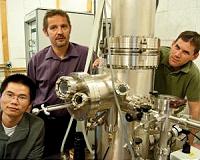
 This is NJIT professor Somenath Mitra working in his lab. Credit: New Jersey Institute of Technology |
"Unfortunately the current membrane distillation method is too expensive for use in countries and municipalities that need potable water," said Mitra. "Generally only industry, where waste heat is freely available, uses this process. However, we're hoping our new work will have far-reaching consequences bringing good, clean water to the people who need it."
The process is outlined in "Water Desalination Using Carbon Nanotube Enhanced Membrane Distillation," by Mitra and his research team in the current issue of the American Chemistry Society's Applied Materials and Interfaces. Doctoral students Ken Gethard and Ornthida Sae-Khow worked on the project. Mitra is chairman of the department of chemistry and environmental science.
Membrane distillation is a water purification process in which heated salt water passes through a tube-like membrane, called a hollow fiber. "Think of your intestines," said Mitra. "It's designed in such a way that nutrition passes through but not the waste." Using a similar structure, membrane distillation allows only water vapor to pass through the walls of the hollow tube, but not the liquid. When the system works, potable water emerges from the net flux of water vapor which moves from the warm to the cool side. At the same time, saline or salt water passes as body waste would through the fiber.
Membrane distillation offers several advantages. It's a clean, non-toxic technology and can be carried out at 60-90�".5C. This temperature is significantly lower than conventional distillation which uses higher temperatures. Reverse osmosis uses relatively high pressure.
Nevertheless, membrane distillation is not trouble free. It is costly and getting the membrane to work properly and efficiently can be difficult. "The biggest challenge," said Mitra, "is finding appropriate membranes that encourage high water vapor flux but prevent salt from passing through."
Mitra's new method creates a better membrane by immobilizing carbon nanotubes in the pores. The novel architecture not only increases vapor permeation but also prevents liquid water from clogging the membrane pores. Test outcomes show dramatic increases in both reductions in salt and water production. "That's a remarkable accomplishment and one we are proud to publish," said Mitra.
Another advantage is that the new process can facilitate membrane distillation at a relatively lower temperature, higher flow rate and higher salt concentration. Compared to a plain membrane, this new distillation process demonstrates the same level of salt reduction at a 20�".5C lower temperature, and at a flow rate six times greater.
"Together these benefits lead to a greener process which could make membrane distillation economically competitive with existing desalination technologies and we hope could provide potable water where it is most needed," said Mitra.
 del.icio.us del.icio.us |
 Digg Digg |
 Reddit Reddit |
 YahooMyWeb YahooMyWeb |
 Google Google |
 Facebook Facebook |

 Probing Atomic Chicken Wire
| The content herein, unless otherwise known to be public domain, are Copyright 1995-2010 - SpaceDaily. AFP and UPI Wire Stories are copyright Agence France-Presse and United Press International. ESA Portal Reports are copyright European Space Agency. All NASA sourced material is public domain. Additional copyrights may apply in whole or part to other bona fide parties. Advertising does not imply endorsement,agreement or approval of any opinions, statements or information provided by SpaceDaily on any Web page published or hosted by SpaceDaily. Privacy Statement |


