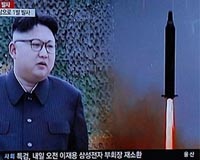
North Korea launched what appeared to be its longest-range ballistic missile yet on Tuesday, with experts suggesting it could reach Alaska, triggering a Twitter outburst from US President Donald Trump who urged China to "end this nonsense once and for all".
If the test — which came as the United States prepared to mark its independence day on the Fourth of July — represents an intercontinental ballistic missile (ICBM) it would force a recalculation of the strategic threat posed by Pyongyang.
The North has long had ambitions to build a rocket capable of delivering an atomic warhead to the continental United States – something that Trump has vowed "won't happen".
It said it would make an "important announcement" later Tuesday, the South's Yonhap news agency reported.
Analysts say the isolated, impoverished country has made great progress in its missile capabilities in the years since the ascension to power of young leader Kim Jong-Un, who has overseen three nuclear tests and multiple rocket launches.
In response to the latest, Trump asked on Twitter: "Does this guy have anything better to do with his life?"
There are still doubts whether the North can miniaturise a nuclear weapon sufficiently to fit it onto a missile nose cone, or has mastered the technology needed for it to survive re-entry into the Earth's atmosphere.
But Tuesday's launch was the latest in a series of provocations that have ratcheted up tensions, and came days after Seoul's new leader Moon Jae-In and Trump focused on risks from Pyongyang in their first summit.
The United Nations has imposed multiple sets of sanctions on Pyongyang over its weapons programmes, which retorts that it needs nuclear arms to defend itself against the threat of invasion.
– 'All of Alaska' –
The "unidentified ballistic missile" was fired from a site in North Phyongan province, the South's Joint Chiefs of Staff said in a statement, and came down in the East Sea, the Korean name for the Sea of Japan.
It flew for "more than 930 kilometres", they added.
US Pacific Command confirmed the test and said it was a land-based, intermediate range missile that flew for 37 minutes, adding the launch did not pose a threat to North America.
It was estimated to have reached an altitude of more than 2,500 kilometres, Japan said.
"That's it. It's an ICBM," responded arms control specialist Jeffrey Lewis on Twitter. "An ICBM that can hit Anchorage not San Francisco, but still."
David Wright, of the Union of Concerned Scientists, wrote on the organisation's allthingsnuclear blog that the available figures implied the missile "could reach a maximum range of roughly 6,700 km on a standard trajectory".
"That range would not be enough to reach the lower 48 states or the large islands of Hawaii, but would allow it to reach all of Alaska."
– Growing threat –
The device came down in the Sea of Japan within the country's exclusive economic zone, the defence ministry said in a statement, waters extending 200 nautical miles from its coast.
Prime Minister Shinzo Abe told reporters: "This launch clearly shows that the threat has grown."
The US, Japan and South Korea will hold a summit on the sidelines of this week's G20 meeting on the issue, he added. "Also I will encourage President Xi Jinping and President Putin to take more constructive measures."
South Korea's President Moon, who backs both engagement with the North to bring it to the negotiating table and sanctions, strongly condemned what he called an "irresponsible provocation".
North Korea's nuclear and missile programmes "threaten the lives of our people and the security of our allies", he told a meeting of the South's National Security Council.
– Independence Day –
Washington, South Korea's security guarantor, has more than 28,000 troops in the country to defend it from its Communist neighbour, and fears of conflict reached a peak earlier this year as the Trump administration suggested military action was an option under consideration.
There has also been anger in the United States after Otto Warmbier, an American student detained in North Korea on a tourist trip around 18 months ago, was returned home in a coma in June, dying days later.
Trump has been pinning his hopes on China — North Korea's main diplomatic ally — to bring pressure to bear on Pyongyang.
Last week he declared that Beijing's efforts had failed, but returned to the idea on Twitter following the launch: "Perhaps China will put a heavy move on North Korea and end this nonsense once and for all!"
But a former foreign policy adviser to Hillary Clinton warned that his comments risked undermining the credibility of both the US deterrent, and its assurances to its allies in Seoul and Tokyo.
She added: "Picking a twitter fight with a nuclear-armed dictator is not wise – this is not reality TV anymore."
Trump and China's Xi struck a friendly tone when they met at the US leader's Florida resort in Florida in April, but he infuriated Beijing last week by approving a $1.3 billion arms sales to self-governing Taiwan.
The US administration also imposed sanctions on a Chinese bank accused of laundering North Korean cash, voiced concern about freedom in semi-autonomous Hong Kong and placed the country on a list of the world's worst human trafficking offenders.
Shea Cotton, a researcher at the James Martin Center for Nonproliferation Studies in the US, suggested the North Korean launch was deliberately timed to coincide with the anniversary of the US declaration of independence.
"It's already 4th of July in North Korea," he said on Twitter. "I somewhat suspect they're shooting off some fireworks today specifically because of that."
North Korea crisis could 'get out of control': China's UN envoy
United Nations, United States (AFP) July 3, 2017 –
China's UN ambassador on Monday warned of "disastrous" consequences if world powers fail to find a way to ease tensions with North Korea which he said could "get out of control".
Ambassador Liu Jieyi made the remarks a day after US President Donald Trump spoke by phone with Chinese leader Xi Jinping on the threat posed by North Korea's missile and nuclear tests.
"Currently tensions are high and we certainly would like to see a de-escalation," Liu told a news conference at UN headquarters as China takes over the Security Council presidency in July.
"If tension only goes up… then sooner or later it will get out of control and the consequences would be disastrous," he said.
China is pushing for talks on dismantling North Korea's nuclear program after its ally carried out two nuclear tests last year and a series of ballistic missile tests.
A proposal from Beijing for a freeze of Pyongyang's military programs in exchange for a suspension of US-South Korea military exercises has however failed to gain traction.
The United States maintains that it will open up talks with North Korea if it first halts its nuclear and missile tests.
Describing the crisis with North Korea as "very, very serious", Liu said "other parties" should be "more forthcoming in accepting and supporting these proposals."
"We cannot afford to wait for too long without dialogue taking place," he added.
The Trump administration has for months urged China to rein in Pyongyang but recently the US president declared that Beijing efforts had failed.
During a phone call on Sunday, Trump "raised the growing threat posed by North Korea's nuclear and ballistic missile programs", the White House said, without providing details.
In a sign of a possible rift with China over North Korea, the US Treasury Department last week slapped sanctions on a China's Bank of Dandong over its dealings with North Korea.
Washington also put two Chinese nationals who established front companies to facilitate transactions with North Korea and one Chinese company, Dalian Global Unity Shipping, which helped smuggle banned luxury goods, on its sanctions blacklist.
Tillerson urges Rouhani to end ballistic missile tests
US Secretary of State Rex Tillerson on Saturday urged Iranian President Hassan Rouhani to dismantle Tehran's "network of terrorism" and end ballistic missile testing, in Washington's first reaction to his re-election.
"What I would hope, is that Rouhani… use that (new) term to begin a process of dismantling Iran's network of terrorism, dismantling its financing of the terrorist network, d … read more