
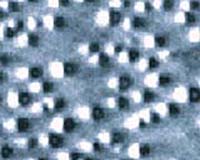
 Simultaneously acquired images and polarizability maps of four different families of molecules, including single-molecule switches (bottom panels), which can be both manipulated and imaged using the scanning tunneling microscope (STM). |
A team of researchers led by Paul Weiss, UCLA's Fred Kavli Chair in NanoSystems Sciences, has developed a tool to study nanoscale interactions. Their device is a dual scanning tunneling and microwave-frequency probe that is capable of measuring the interactions between single molecules and the surfaces to which the molecules are attached.
"Our probe can generate data on the physical, chemical, and electronic interactions between single molecules and substrates, the contacts to which they are attached. Just as in semiconductor devices, contacts are critical here," remarked Weiss, who directs UCLA's California NanoSystems Institute and is also a distinguished professor of chemistry and biochemistry and materials science and engineering.
The team, which also includes theoretical chemist Mark Ratner from Northwestern University and synthetic chemist James Tour from Rice University, published their findings in the peer-reviewed journal ACS Nano.
For the past 50 years, the electronics industry has endeavored to keep up with Moore's Law, the prediction made by Gordon E. Moore in 1965 that the size of transistors in integrated circuits would halve approximately every two years.
The pattern of consistent decrease in the size of electronics is approaching the point where transistors will have to be constructed at the nanoscale to keep pace. However, researchers have encountered obstacles in creating devices at the nanoscale because of the difficulty of observing phenomena at such minute sizes.
The connections between components are a vital element of nanoscale electronics. In the case of molecular devices, polarizability measures the extent to which electrons of the contact interact with those of the single molecule.
Two key aspects of polarizability measurements are the ability to do the measurement on a surface with subnanometer resolution, and the ability to understand and to control molecular switches in both the on and off states.
To measure the polarizability of single molecules the research team developed a probe capable of simultaneous scanning tunneling microscopy (STM) measurements and microwave difference frequency (MDF) measurements. With the MDF capabilities of the probe, the team was able to locate single molecule switches on substrates, even when the switches were in the off state, a key capability lacking in previous techniques.
Once the team located the switches, they could use the STM to change the state to on or off and to measure the interactions in each state between the single molecule switches and the substrate.
The new information provided by the team's probe focuses on what the limits of electronics will be, rather than targeting devices for production. Also, because the probe is capable of a wide variety of measurements - including physical, chemical and electronic - it could enable researchers to identify submolecular structures in complex biomolecules and assemblies.
 del.icio.us del.icio.us |
 Digg Digg |
 Reddit Reddit |
 YahooMyWeb YahooMyWeb |
 Google Google |
 Facebook Facebook |

 Nanoscale Light Sensor Compatible With Etch-A-Sketch Nanoelectronic Platform
| The content herein, unless otherwise known to be public domain, are Copyright 1995-2010 - SpaceDaily. AFP and UPI Wire Stories are copyright Agence France-Presse and United Press International. ESA Portal Reports are copyright European Space Agency. All NASA sourced material is public domain. Additional copyrights may apply in whole or part to other bona fide parties. Advertising does not imply endorsement,agreement or approval of any opinions, statements or information provided by SpaceDaily on any Web page published or hosted by SpaceDaily. Privacy Statement |


