|
 |
 |
 |
 |
 |
 |
 |
 |
 |

| . |  |
. |
Nanotube Sandwiches Could Lead To Better Composite Materials
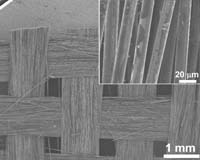
Troy NY (SPX) May 15, 2006 By stacking layers of ceramic cloth with interlocking nanotubes in between, a team of researchers has created new composites with significantly improved properties compared to traditional materials. The "nanotube sandwiches," which are described in the May 7 online edition of the journal Nature Materials, could find use in a wide array of structural applications. "Nanotubes are a very versatile material with absolutely fascinating physical properties, all the way from ballistic conduction to really interesting mechanical behavior," says Pulickel Ajayan, the Henry Burlage Professor of Materials Science and Engineering at Rensselaer and a lead author of the paper, along with colleagues at the University of Hawaii at Manoa. Some fundamental issues, however, have kept researchers from realizing the full potential of nanotubes, particularly when combining them with other materials to make composites. The interface between the materials is not as strong as one might expect, Ajayan notes, because it is difficult to disperse nanotubes and to align them in an orderly way. Ajayan and his colleagues have pioneered a process to help overcome these difficulties, and they are putting it to use in a wide variety of applications. For the current project, the researchers are applying the process to a new area: reinforced composite fabrics made from woven ceramic fibers. These materials have been used for decades in structural applications, but they tend to perform poorly in terms of "through-thickness," or the ability of a material to respond to forces applied perpendicular to the fabric-stacking direction, according to Ajayan. "We have demonstrated that these through-thickness properties can be improved by adding nanotube Velcro-like structures between the layers," says Mehrdad Ghasemi-Nejhad, professor of mechanical engineering at Hawaii and a lead author of the paper. To make the new materials, the researchers deposit a forest of carbon nanotubes across the surface of a cloth woven from fibers of silicon carbide � a ceramic compound made from silicon and carbon. The fabric layers are infiltrated with a high-temperature epoxy matrix, and then several layers of cloth are stacked on top of each other to form a three-dimensional composite "sandwich," with interlocking nanotubes acting to fasten the layers together. "This is a very nice example of how to use nanotubes to solve major existing problems, rather than going all-out to make composites based on nanotubes alone, which has proven to be a very challenging task," Ajayan says. The team has successfully made cloths up to roughly five inches by two inches, and the process is easily scalable to make larger materials, they say. The researchers ran several experiments to test the new material's properties, and they found that the interlocking nanotubes provided remarkable improvements in strength and toughness under various loading conditions. The materials performed extremely well in fracture tests, and they demonstrated a five-fold increase in damping � or the ability to dissipate energy � over the original ceramic composites without nanotubes included. This suggests that the new composites could be used in many applications where mechanical properties are important, from automobile engines to golf club shafts. Tests also showed that both the thermal and electrical conductivity of the new composites were significantly improved, which means that they could potentially be employed as sensors to monitor crack propagation in various structures, the researchers note. The University of Hawaii at Manoa team included Vinod Veedu, a graduate student at the Hawaii Nanotechnology Laboratory; Anyuan Cao, assistant professor of mechanical engineering; and Kougen Ma, associate director of the Intelligent and Composite Materials Laboratory. Several other Rensselaer researchers also participated in the project: Caterina Soldano, a doctoral student in physics, applied physics, and astronomy; Xuesong Li, a doctoral student in materials science and engineering; and Swastik Kar, a postdoctoral researcher in materials science and engineering. Ajayan received funding for the project from the Focus Center-New York, which is part of the Interconnect Focus Center; and Rensselaer's National Science Foundation-funded Nanoscale Science and Engineering Center for the Directed Assembly of Nanostructures. Related Links Rensselaer University of Hawaii  Supercomputing Center Advances Nanotechnology Science
 Troy NY (SPX) May 16, 2006
Rensselaer Polytechnic Institute, in collaboration with IBM and New York state, has announced a $100 million partnership to create the world's most powerful university-based supercomputing center, and a top 10 supercomputing center of any kind in the world. |
|
|

| The content herein, unless otherwise known to be public domain, are Copyright 1995-2006 - SpaceDaily.AFP and UPI Wire Stories are copyright Agence France-Presse and United Press International. ESA PortalReports are copyright European Space Agency. All NASA sourced material is public domain. Additionalcopyrights may apply in whole or part to other bona fide parties. Advertising does not imply endorsement,agreement or approval of any opinions, statements or information provided by SpaceDaily on any Web page published or hosted by SpaceDaily. Privacy Statement |