
. Military Space News .


.
NANO TECH
Nanowrinkles, nanofolds yield strange hidden channels
by Staff Writers
Providence RI (SPX) Nov 24, 2011

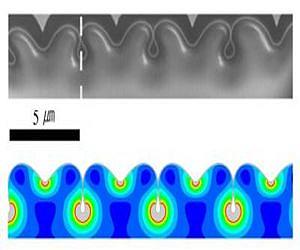
Researchers at Brown University and in Korea used focused ion beams to extract a cross-section of compressed gold nanofilm. When tips of regular, neighboring folds touched, nanopipes were created beneath the surface. Credit: Kyung-Suk Kim lab, Brown University.

Wrinkles and folds are ubiquitous. They occur in furrowed brows, planetary topology, the surface of the human brain, even the bottom of a gecko's foot. In many cases, they are nature's ingenious way of packing more surface area into a limited space. Scientists, mimicking nature, have long sought to manipulate surfaces to create wrinkles and folds to make smaller, more flexible electronic devices, fluid-carrying nanochannels or even printable cell phones and computers.

But to attain those technology-bending feats, scientists must fully understand the profile and performance of wrinkles and folds at the nanoscale, dimensions 1/50,000th the thickness of a human hair.

In a series of observations and experiments, engineers at Brown University and in Korea have discovered unusual properties in wrinkles and folds at the nanoscale.

The researchers report that wrinkles created on super-thin films have hidden long waves that lengthen even when the film is compressed.

The team also discovered that when folds are formed in such films, closed nanochannels appear below the surface, like thousands of super-tiny pipes.

"Wrinkles are everywhere in science," said Kyung-Suk Kim, professor of engineering at Brown and corresponding author of the paper published in the journal Proceedings of the Royal Society A.

"But they hold certain secrets. With this study, we have found mathematically how the wrinkle spacings of a thin sheet are determined on a largely deformed soft substrate and how the wrinkles evolve into regular folds."

Wrinkles are made when a thin stiff sheet is buckled on a soft foundation or in a soft surrounding. They are precursors of regular folds: When the sheet is compressed enough, the wrinkles are so closely spaced that they form folds.

The folds are interesting to manufacturers, because they can fit a large surface area of a sheet in a finite space.

Kim and his team laid gold nanogranular film sheets ranging from 20 to 80 nanometers thick on a rubbery substrate commonly used in the microelectronics industry.

The researchers compressed the film, creating wrinkles and examined their properties. As in previous studies, they saw primary wrinkles with short periodicities, the distance between individual wrinkles' peaks or valleys.

But Kim and his colleagues discovered a second type of wrinkle, with a much longer periodicity than the primary wrinkles - like a hidden long wave. As the researchers compressed the gold nanogranular film, the primary wrinkles' periodicity decreased, as expected. But the periodicity between the hidden long waves, which the group labeled secondary wrinkles, lengthened.

"We thought that was strange," Kim said.

It got even stranger when the group formed folds in the gold nanogranular sheets. On the surface, everything appeared normal. The folds were created as the peaks of neighboring wrinkles got so close that they touched.

But the research team calculated that those folds, if elongated, did not match the length of the film before it had been compressed. A piece of the original film surface was not accounted for, "as if it had been buried," Kim said.

Indeed, it had been, as nano-size closed channels. Previous researchers, using atomic force microscopy that scans the film's surface, had been unable to see the buried channels. Kim's group turned to focused ion beams to extract a cross-section of the film. There, below the surface, were rows of closed channels, about 50 to a few 100 nanometers in diameter.

"They were hidden," Kim said. "We were the first ones to cut (the film) and see that there are channels underneath."

The enclosed nano channels are important because they could be used to funnel liquids, from drugs on patches to treat diseases or infections, to clean water and energy harvesting, like a microscopic hydraulic pump.

Contributing authors include Jeong-Yun Sun and Kyu Hwan Oh from Seoul National University; Myoung-Woon Moon from the Korea Institute of Science and Technology; and Shuman Xia, a researcher at Brown and now at the Georgia Institute of Technology. The National Science Foundation, the Korea Institute of Science and Technology, the Ministry of Knowledge Economy of Korea, and the Ministry of Education, Science, and Technology of Korea supported the research.

Related Links
Brown University
Nano Technology News From SpaceMart.com
Computer Chip Architecture, Technology and Manufacture


.
.
Get Our Free Newsletters Via Email
...
Buy Advertising Editorial Enquiries


.

. Comment on this article via your Facebook, Yahoo, AOL, Hotmail login.

Share this article via these popular social media networks
del.icio.usdel.icio.us DiggDigg RedditReddit GoogleGoogle


NANO TECH
On the Road to Plasmonics With Silver Polyhedral Nanocrystals
Berkeley CA (SPX) Nov 24, 2011
The question of how many polyhedral nanocrystals of silver can be packed into millimeter-sized supercrystals may not be burning on many lips but the answer holds importance for one of today's hottest new high-tech fields - plasmonics! Researchers with the U.S. Department of Energy (DOE)'s Lawrence Berkeley National Laboratory (Berkeley Lab) may have opened the door to a simpler approach for the ... read more


NANO TECH
Northrop Grumman Plays Key Role in Unprecedented Joint Service Air and Missile Defense Demonstration

STSS Demonstration Satellites Participate in THAAD Weapon System Multiple Missile Test

Israel speeds up anti-missile systems

Space Tracking and Surveillance System Demonstration Completes Mission

NANO TECH
MEADS Conducts First Flight Test At White Sands Missile Range

General killed in Iran blast 'was working on missiles'

Arms blast death toll rises to at least 36: Iran media

India: more AWACS and BrahMos missiles

NANO TECH
US drone kills six militants: Pakistani officials

Lockheed Martin Wins Major Contract From US Army To Maintain Aerostat Detection Systems

US shifts drones from Iraq to Turkey: Pentagon

LONGBOW Data Link Controls UAV From Apache Helicopter For First Time

NANO TECH
Lockheed Martin AMF JTRS Team Demonstrates Communications and Tactical Data Sharing At Army Exercise

Boeing Ships WGS-4 to Cape Canaveral for January Launch

Harris to maintain satellite ground system

Raytheon Reaches Fielding Milestone in Airborne Communications System

NANO TECH
North America to Modernize its Military Helicopter Fleet

Raytheon Advances Image Processing for US Army Situational Awareness Technology

Raytheon SDB II Warhead Exceeds Test Requirements

Raytheon Wins Majority Share of US Air Force Paveway Purchase

NANO TECH
Panetta slams US debt committee failure

Emirates put French in spin over jet deal

NATO looks to pool resources amid budget pressures

Activists press closure of US military training school

NANO TECH
Three-way US-China drills possible: Australia

US to cease observing arms treaty with Russia: State Dept

Obama scores diplomatic victory over China

No need to panic over US Asia return: China media

NANO TECH
LockMart Directed Energy Leader Receives Purdue's Outstanding Aerospace Engineer Award


.

The content herein, unless otherwise known to be public domain, are Copyright 1995-2011 - Space Media Network. AFP and UPI Wire Stories are copyright Agence France-Presse and United Press International. ESA Portal Reports are copyright European Space Agency. All NASA sourced material is public domain. Additional copyrights may apply in whole or part to other bona fide parties. Advertising does not imply endorsement,agreement or approval of any opinions, statements or information provided by Space Media Network on any Web page published or hosted by Space Media Network. Privacy Statement