|
 |
 |
 |
 |
 |
 |
 |
 |
 |

| . |  |
. |
Networks Create Instant World Telescope
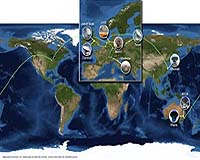
Canberra, Australia (SPX) Sep 10, 2007 For the first time, a CSIRO radio telescope has been linked to others in China and Europe in real-time, demonstrating the power of high-speed global networks and effectively creating a telescope almost as big as the Earth. Last week a CSIRO telescope near Coonabarabran NSW was used simultaneously with one near Shanghai, China, and five in Europe to observe a distant galaxy called 3C273. "This is the first time we've been able to instantaneously connect telescopes half a world apart," Dr Tasso Tzioumis, VLBI operations and development manager at CSIRO's Australia Telescope National Facility said. "It's a fantastic technical achievement, and a tribute to the ability of the network providers to work together." Data from the telescopes was streamed around the world at a rate of 256 Mb per second - about ten times faster than the fastest broadband speeds available to Australian households - to a research centre in Europe, where it was processed with a special-purpose digital processor. The results were then transmitted to Xi'an, China, where they were watched live by experts in advanced networking at the 24th APAN (Asia-Pacific Advanced Network) Meeting. From Australia to Europe, the CSIRO data travelled on a dedicated 1 Gb per second link set up by the Australian, Canadian and Dutch national research and education networks, AARNet, CANARIE and SURFnet respectively. "The diameter of the Earth is 12 750 km and the two most widely separated telescopes in our experiment were 12 304 km apart, in a straight line," Dr Tzioumis said.Within Australia, the experiment used the 1 Gb per second networks that now connect CSIRO's NSW observatories to Sydney and beyond. The links, installed in 2006, were funded by CSIRO and provided by AARNet (the Australian Academic Research Network). The telescope-linking technique, VLBI (very long baseline interferometry) used to take weeks or months. "We used to record data on tapes or disks at each telescope, along with time signals from atomic clocks. The tapes or disks would then be shipped to a central processing facility to be combined," Dr Tzioumis said "The more widely separated the telescopes, the more finely detailed the observations can be. The diameter of the Earth is 12 750 km and the two most widely separated telescopes in our experiment were 12 304 km apart, in a straight line," Dr Tzioumis said. The institutions that took part in the experiment are all collaborators in the EXPReS project (Express Production Real-time e-VLBI Service), which is coordinated by the Joint Institute for VLBI in Europe (JIVE) in The Netherlands. Community Email This Article Comment On This Article Related Links Space Telescope News and Technology at Skynightly.com
 Thermometer Camera Reveals New Frontiers
 Atacama Desert, Chile (SPX) Sep 07, 2007
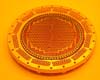
Space is a vast expanse which hides deep within its depths the secrets behind how the first galaxies emerged from the Big Bang. Now thanks to the world's largest bolometer camera constructed and operated by a collaborative European consortium, these secrets will slowly begin revealing themselves to scientists worldwide. |
|
|

| The content herein, unless otherwise known to be public domain, are Copyright 1995-2006 - SpaceDaily.AFP and UPI Wire Stories are copyright Agence France-Presse and United Press International. ESA PortalReports are copyright European Space Agency. All NASA sourced material is public domain. Additionalcopyrights may apply in whole or part to other bona fide parties. Advertising does not imply endorsement,agreement or approval of any opinions, statements or information provided by SpaceDaily on any Web page published or hosted by SpaceDaily. Privacy Statement |