File image.
File image. |
This process plays a key role in numerous astrophysical phenomena: star formation, solar flares and intense aurorae, to name a few. On Earth, magnetic reconnection prevents the efficient production of electricity in controlled fusion reactors, potential sources of electricity for the future.
Schematic of magnetic field lines during reconnection
At the heart of magnetic reconnection is the 'electron diffusion region', where reconnection is thought to be triggered. Here, a kink in newly-reconnected magnetic field lines produces large-scale high-velocity jets of plasma.
"Understanding the structure of the diffusion region and its role in controlling the rate at which magnetic energy is converted into particle energy remains a key scientific challenge," says Dr Michael Shay, University of Delaware, USA.
Until recently, theoretical scientists believed that the electron diffusion region was relatively tiny (width about 2 km, length about 10 km). In the vastness of space, the chance of a spacecraft encountering this region would therefore be exceedingly small.
With increased computational power, simulations showed electron diffusion regions that were a lot more elongated than those seen earlier. It was not possible to judge whether the new finding was real because the length of the region increased with more powerful simulations. Nor it was known whether such a layer would be stable in the real, 3D world.
Comparison between observations and simulation
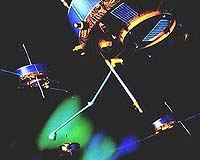
On 14 January 2003, the four Cluster satellites were crossing the magnetosheath, a turbulent plasma region located just outside Earth's magnetosphere, when they encountered an electron diffusion region. The length of the observed region measured 3000 km, 300 times longer than the earlier theoretical expectations and four times longer than seen in recent simulations. Nevertheless, the observations strongly support new simulations.
"These Cluster observations are very significant since they are the first measurements of the length of the electron diffusion region in the space environment. The finding drastically changes the way we understand the physics of reconnection," noted Dr James Drake, University of Maryland, USA.
"This discovery of a large electron diffusion region gives future ESA and NASA missions a much better chance to study it," said Tai Phan at the University of California at Berkeley, USA, lead author of the paper on the findings.
Magnetic reconnection simulation
Cluster was able to detect the region based on its high-resolution magnetic field, electric field and ion measurements. But to understand the fundamental physics of the electron diffusion region responsible for reconnection, higher time resolution measurements are needed to resolve the layer.
The four spacecraft of NASA's Magnetospheric Multi-Scale mission, planned for launch in 2014, are being designed for such measurements. Cross-scale, a mission under study at ESA in collaboration with other space agencies, would use 12 spacecraft to probe the diffusion region, whilst simultaneously measuring the consequences of energy released by reconnection in the surrounding environment.
"With the higher probability of encountering the electron diffusion region, we can be confident that future missions will be able to fully understand magnetic reconnection," said Dr Philippe Escoubet, ESA's Cluster and Double Star Project Scientist and Cross-scale Study Scientist.
Community
 Could The Universe Be Tied Up With Cosmic String
 Brighton, UK (SPX) Jan 22, 2008
| The content herein, unless otherwise known to be public domain, are Copyright 1995-2007 - SpaceDaily.AFP and UPI Wire Stories are copyright Agence France-Presse and United Press International. ESA Portal Reports are copyright European Space Agency. All NASA sourced material is public domain. Additional copyrights may apply in whole or part to other bona fide parties. Advertising does not imply endorsement,agreement or approval of any opinions, statements or information provided by SpaceDaily on any Web page published or hosted by SpaceDaily. Privacy Statement |