
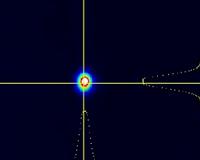
 This is a simulation of classical light propagating in a multimode interference device. The multimode propagation results in equal intensity in each of the four output waveguides. Credit: Alberto Peruzzo |
Quantum computers, holding the great promise of tremendous computational power for particular tasks, have been the goal of worldwide efforts by scientists for several years. Tremendous advances have been made but there is still a long way to go.
Building a quantum computer will require a large number of interconnected components - gates - which work in a similar way to the microprocessors in current personal computers. Currently, most quantum gates are large structures and the bulky nature of these devices prevents scalability to the large and complex circuits required for practical applications.
Recently, the researchers from the University of Bristol's Centre for Quantum Photonics showed, in several important breakthroughs, that quantum information can be manipulated with integrated photonic circuits. Such circuits are compact (enabling scalability) and stable (with low noise) and could lead in the near future to mass production of chips for quantum computers.
Now the team, in collaboration with Dr Terry Rudolph at Imperial College, London, shows a new class of integrated divides that promise further reduction in the number of components that will be used for building future quantum circuits.
These devices, based on optical multimode interference (and therefore often called MMIs) have been widely employed in classical optics as they are compact and very robust to fabrication tolerances. "While building a complex quantum network requires a large number of basic components, MMIs can often enable the implementation with much fewer resources," said Alberto Peruzzo, PhD student working on the experiment.
Until now it was not clear how these devices would work in the quantum regime. Bristol researchers have demonstrated that MMIs can perform quantum interference at the high fidelity required.
Scientists will now be able to implement more compact photonics circuits for quantum computing. MMIs can generate large entangled states, at the heart of the exponential speedup promised by quantum computing.
"Applications will range from new circuits for quantum computation to ultra precise measurement and secure quantum communication," said Professor Jeremy O'Brien, director of the Centre for Quantum Photonics.
The team now plans to build new sophisticated circuits for quantum computation and quantum metrology using MMI devices.
The research will be published online in the next issue of Nature Communications (Tuesday 1 March). The open-access paper can be downloaded here.
 del.icio.us del.icio.us |
 Digg Digg |
 Reddit Reddit |
 YahooMyWeb YahooMyWeb |
 Google Google |
 Facebook Facebook |

 New MIT Developments In Quantum Computing
| The content herein, unless otherwise known to be public domain, are Copyright 1995-2010 - SpaceDaily. AFP and UPI Wire Stories are copyright Agence France-Presse and United Press International. ESA Portal Reports are copyright European Space Agency. All NASA sourced material is public domain. Additional copyrights may apply in whole or part to other bona fide parties. Advertising does not imply endorsement,agreement or approval of any opinions, statements or information provided by SpaceDaily on any Web page published or hosted by SpaceDaily. Privacy Statement |


