
 This is a scanning electron microscope image of polystyrene nanoparticles. These particles are roughly 100 nanometers in diameter, and are readily detected with the analyzer. The uniform size distribution is used to calibrate the instrument. Credit: J.L. Fraikin and A.N. Cleland, UCSB |
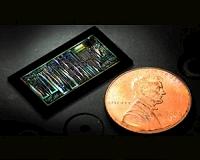
The UCSB research team has developed a new instrument capable of detecting individual nanoparticles with diameters as small as a few tens of nanometers. The study will be published on line this week by Nature Nanotechnology, and appear in the April print issue of the journal.
"This device opens up a wide range of potential applications in nanoparticle analysis," said Jean-Luc Fraikin, the lead author on the study. "Applications in water analysis, pharmaceutical development, and other biomedical areas are likely to be developed using this new technology."
The instrument was developed in the lab of Andrew Cleland, professor of physics at UCSB, in collaboration with the group of Erkki Ruoslahti, Distinguished Professor, Sanford-Burnham Medical Research Institute at UCSB.
Fraikin is presently a postdoctoral associate in the Marth Lab at the Sanford-Burnham Medical Research Institute's Center for Nanomedicine, and in the Soh Lab in the Department of Mechanical Engineering at UC Santa Barbara.
The device detects the tiny particles, suspended in fluid, as they flow one by one through the instrument at rates estimated to be as high as half a million particles per second. Fraikin compares the device to a nanoscale turnstile, which can count - and measure - particles as they pass individually through the electronic "eye" of the instrument.
The instrument measures the volume of each nanoparticle, allowing for very rapid and precise size analysis of complex mixtures. Additionally, the researchers showed that the instrument could detect bacterial virus particles, both in saline solution as well as in mouse blood plasma.
In this study, the researchers further discovered a surprisingly high concentration of nanoparticles present in the native blood plasma. These particles exhibited an intriguing size distribution, with particle concentration increasing as the diameter fell to an order of 30 to 40 nanometers, an as-yet unexplained result.
 del.icio.us del.icio.us |
 Digg Digg |
 Reddit Reddit |
 YahooMyWeb YahooMyWeb |
 Google Google |
 Facebook Facebook |

 Nanofabrication Tools May Make Silicon Optical Chips More Accessible
| The content herein, unless otherwise known to be public domain, are Copyright 1995-2010 - SpaceDaily. AFP and UPI Wire Stories are copyright Agence France-Presse and United Press International. ESA Portal Reports are copyright European Space Agency. All NASA sourced material is public domain. Additional copyrights may apply in whole or part to other bona fide parties. Advertising does not imply endorsement,agreement or approval of any opinions, statements or information provided by SpaceDaily on any Web page published or hosted by SpaceDaily. Privacy Statement |


