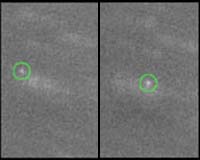
A team of astronomers led by Matthew Holman (Harvard-Smithsonian Center for Astrophysics) and JJ Kavelaars (National Research Council of Canada) has discovered three previously unknown moons of Neptune.
This boosts the number of known satellites of the gas giant to eleven. These moons are the first to be discovered orbiting Neptune since the Voyager II flyby in 1989, and the first discovered from a ground-based telescope since 1949.
It now appears that each giant planet's irregular satellite population is the result of an ancient collision between a former moon and a passing comet or asteroid.
"These collisional encounters result in the ejection of parts of the original parent moon and the production of families of satellites. Those families are exactly what we're finding," said Kavelaars.
The team that discovered these new satellites of Neptune includes Holman and Kavelaars, graduate student Tommy Grav (University of Oslo & Harvard-Smithsonian Center for Astrophysics), and undergraduate students Wesley Fraser and Dan Milisavljevic (McMaster University, Hamilton, Ontario, Canada).
Needle in a Haystack
The new satellites were a challenge to detect because they are only about 30-40 kilometers (18-24 miles) in size. Their small size and distance from the Sun prevent the satellites from shining any brighter than 25th magnitude, about 100 million times fainter than can be seen with the unaided eye.
To locate these new moons, Holman and Kavelaars utilized an innovative technique. Using the 4.0-meter Blanco telescope at the Cerro Tololo Inter-American Observatory, Chile, and the 3.6-meter Canada-France-Hawaii Telescope, Hawaii, they took multiple exposures of the sky surrounding the planet Neptune.
After digitally tracking the motion of the planet as it moved across the sky, they then added many frames together to boost the signal of any faint objects. Since they tracked the planet's motion, stars showed up in the final combined image as streaks of light, while the moons accompanying the planet appeared as points of light.
Prior to this find, two irregular satellites and six regular satellites of Neptune were known. The two irregular satellites were also the largest: Triton, discovered in 1846 by William Lassell, and Nereid, discovered in 1949 by Gerard Kuiper.
Triton is considered irregular because it orbits the planet in a direction opposite to the planet's rotation, indicating that Triton is likely a captured Kuiper Belt Object.
The Kuiper Belt is a disk-shaped collection of icy objects that circle the Sun beyond the orbit of Neptune. Nereid is considered irregular because it has a highly elliptical orbit around Neptune.
In fact, its orbit is the most elliptical of any satellite in the solar system. Many scientists believe that Nereid once was a regular satellite whose orbit was disrupted when Triton was gravitationally captured. The six regular satellites were discovered by the Voyager probe during its encounter with Neptune.
The three new satellites were missed by Voyager II because of their faintness and great distance from Neptune. According to Holman, "The discovery of these moons has opened a window through which we can observe the conditions in the solar system at the time the planets were forming."
Tracking Faint Blips
The researchers are currently conducting follow-up observations to better define the orbits of the newfound moons using orbital predictions supplied by Brian Marsden (Director of the Minor Planet Center in Cambridge, Mass.) and Robert Jacobson (Jet Propulsion Laboratory).
To follow up the initial find, team members Brett Gladman (University of British Columbia, Canada); Jean-Marc Petit, Philippe Rousselot, and Olivier Mousis (Observatoire de Besancon, France); and Philip Nicholson and Valerio Carruba (Cornell University) conducted additional observations using the Hale 5-meter telescope on Mount Palomar and one of the four 8. 2-meter telescopes of the European Southern Observatory's Very Large Telescope at Paranal Observatory, Chile. Grav made additional tracking observations using the 2.6-meter Nordic Optical Telescope on La Palma, Spain.
Holman says, "Tracking these moons is an enormous, international undertaking involving the efforts of many people. Without teamwork, such faint objects could be easily lost."
Based in La Serena, Chile, the Cerro Tololo Inter-American Observatory is part of the National Optical Astronomy Observatory, which is operated by the Association of Universities for Research in Astronomy, Inc., under a cooperative agreement with the National Science Foundation.
The Canada-France-Hawaii Telescope is operated by the CFHT Corporation under a joint agreement between the National Research Council of Canada, the Centre National de la Recherche Scientifique of France, and the University of Hawaii.
The European Southern Observatory is an intergovernmental, European organization for astronomical research. It has ten member countries. ESO operates astronomical observatories in Chile and has its headquarters in Garching, near Munich, Germany.